
We flew, for a three-day visit, to the Gobi Desert. Upon arrival, we drove approximately 1 hour over unpaved and very bumpy roads to reach our Ger (Mongolian name for yurts) camp, Dream Gobi. Our flight was late in the day, so our trek on the bumpy roads was in total darkness…..a bit uncomfortable along with the bumps.

By the time we got there…we were exhausted and weary! This picture of walking to our Ger is blurry, but that is how our bodies felt too!!! But upon opening the door to our Ger, we saw these two beautiful beds! They felt like a cocoon within a cocoon!

Covering much of southern Mongolia, the Gobi Desert is a region of semi-arid terrain dazzling in its variety—from rocky outcrops to barren stretches of seemingly endless, rolling gravel plains. It is the world’s coldest and northernmost desert and an excellent repository of dinosaur remains. Caravan routes have been crossing the Gobi since ancient times. When Marco Polo, seeking the fabled capital of the Kublai Khan, encountered this vast and unforgiving landscape in the 1270s, he proclaimed, “It consists entirely of mountains and sands and valleys. There is nothing at all to eat.”
So it was to our surprise that we actually came upon a spring-fed area where vegetables can be grown in the desert!


Like all Mongolian people, the owners were extremely welcoming as we explored their end-of-the-season crops. This was the only place we saw crops growing (however, we did see some modern-day greenhouses.) When our guide was growing up in a Ger, vegetables were not readily available, and the families survived mainly on meat and dairy (mare and yak milk.). Nomads and animals do survive well in this mysterious, otherworldly region!
We had three 4-wheel drive SUVs (all LEXUS!) and three drivers who carted us around the desert to various points of interest.

EXCEPT…. there are no roads! It was just gravel, sand, and tiny bits of grass. Off-roading was the norm, and we were impressed these drivers could sense where they were going since everything looked pretty much alike and there were NO signs!!

One day we did come across one paved road, and I had to take a picture of it!!

A Family Visit
It was such a joy visiting the home of a nomadic herding family engaged in breeding Bactrian camels. We were amazed at what a comfortable home it was. These homes can be put up/taken down in around an hour! Depending on the movement of the animals they follow, and the climate, they may move 4-5 times a year. Families may have multiple gers, so the cooking and storage areas are separate from the sleeping area. The Gers can also come in various sizes, depending on the family’s needs.


The mother served tea and a biscuit as we asked questions about their way of life. There is no running water (they have to go to the well to get it), but power is supplied by either solar panels or (these days) by cables run from electrical lines. And they even had a television!

This family raised 7 children, all grown now, in this Ger.
This particular family owns 200+ Bactrian camels, and we hopped aboard one of these twin-humped creatures for a ride! We have ridden camels before, but they were dromedary or one-humped camels.

These camels were much more comfortable to ride as it felt like a natural saddle between the humps!

We observed how the nomads get their water not too far from the family ger! Pete is lifting water out of the underground spring. Nomadic families bring containers to carry water back to their gers; water is also put into the trough for the animals. By our standards, being a nomadic Mongolian seems like a tough life!

Controversy in the Gobi…Mining
Mongolia possesses large deposits of coal and fluorite (fluorspar) and copper, gold, silver, and other metallic ores. The industry accounts for 30% of Mongolia’s GDP and 90% of the country’s annual exports. One-fifth of Mongolian land has been earmarked for mining….and the Gobi Desert, in particular, contains vast stores of mineral deposits.
However, the Gobi Desert is also home to nomadic herders who live by crisscrossing their flocks to different pastures from season to season. Now that mining companies have begun excavating land that the herders once relied on, conflicts over territorial rights have arisen, and nomadic lifestyles have been interrupted.

We met a local teacher who is a member of a mining family. She shared how her family was impacted by mining in the Gobi and revealed the changes they have had to make as a result.

It turned out that we met the teacher at her after-school program. Children whose parents can afford it attend the program to learn English. The kids were delightful, polite, and as cute as could be! When I spoke, the young man in the red shirt offered me a part of his candy bar!
More Good Food!!


Moltsog Els
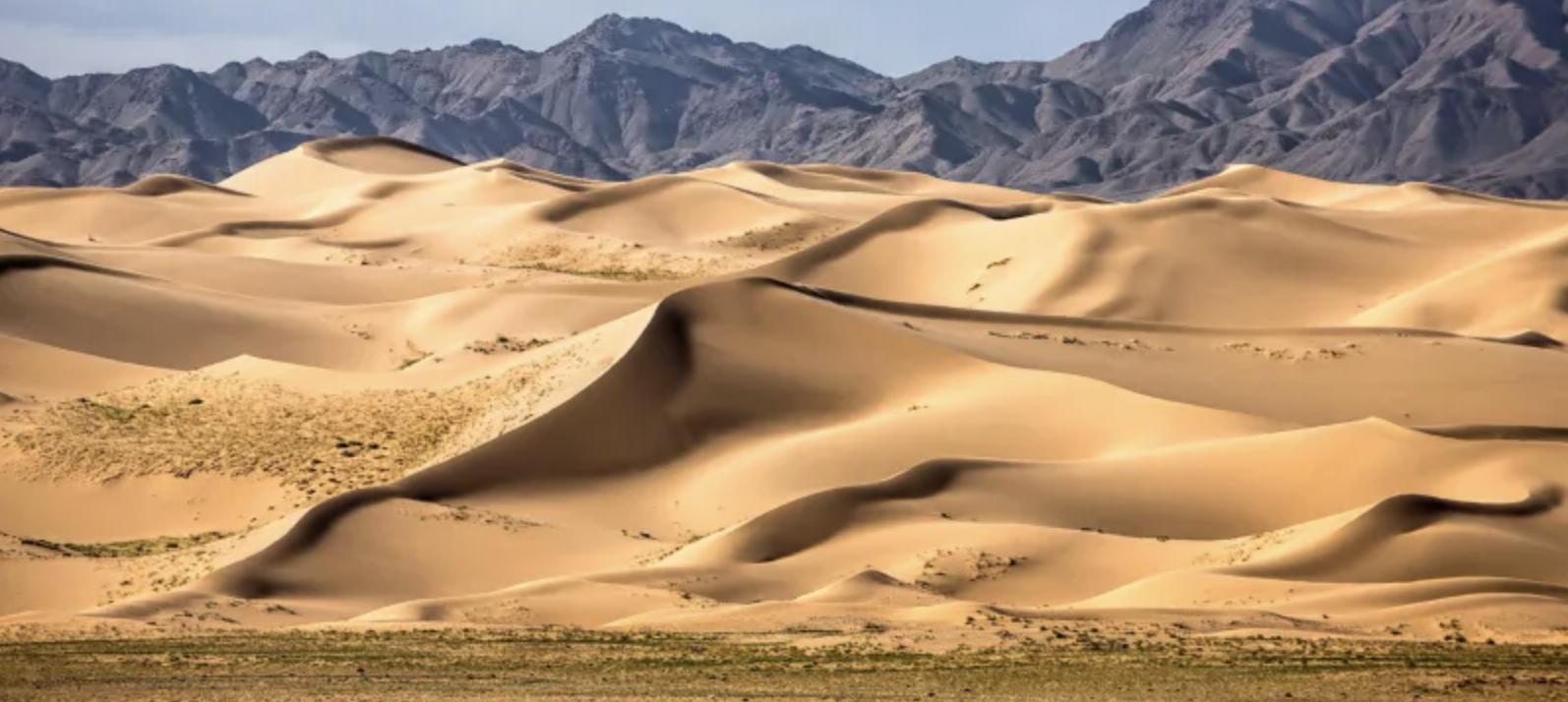
While only about 5% of the Gobi Desert is sand, we explored one of the few regions covered in dunes…Moltsog Els.

This was a spot where one could feel like kids again…climbing dunes of magnificent sand.

Flaming Cliffs
Another area of the Gobi Desert known as Bayanzag is more commonly referred to as the Flaming Cliffs. The region is famous for the location of the first nest of dinosaur eggs and other fossils found by American paleontologist Roy Chapman Andrews in the 1920s.

Andrews nicknamed the site “Flaming Cliffs” for the surrounding rocks and cliffs’ surreal, glowing orange color. We enjoyed a hike around the cliffs on a very windy day.

Animals….Wild and Domesticated
As we continued our drive in the Gobi, we looked for the unique wildlife that roams this marvelous desert, from golden eagles and saker falcons to Argali mountain sheep, goitered gazelle, and various reptiles. It’s also home to the rare snow leopard and desert-dwelling Gobi bear.

Unfortunately, we did not have much wildlife spotting, but plenty of domesticated animals like sheep, horses, cattle, and camels.

Stopping at a small museum helped us picture what we did not see on our own! This is the lammergeier vulture (yol in Mongolian), responsible for the cleanup of deceased animals and humans across the desert floor. Some families still practice “sky burials,” where the dead body is put on a hill or mountain for consumption by the vultures.
Yol Valley in the Mongolian National Park
Another very windy day found us traveling across the Gobi to the Gurvan Saikhan Mountains, entering the deep gorge of Yol Valley in the Mongolian National Park ( aka Yolyn Am, or the Vulture’s Mouth!) The park was initially established to conserve the birdlife in the region. Now it’s more famous for its dramatic and unusual scenery – it is a valley in the middle of the Gobi Desert, with meters-thick ice almost year-round.
Despite the wind, we managed a round-trip 5-mile hike into this gorge, following the stream and enjoying the awe-inspiring mountain scenery. Pete was really helpful in aiding some of the less-capable ladies across streams of water!


Petroglyphs Hike
The geological composition of the Gurvan Saikhan mountain range is sandstone and covered in black, making them easy to draw on…thus, lots of petroglyphs. Those pictured below were believed to be created about 4000-5000 years ago, in the late Bronze Age or Iron Age. The people of this time depicted mostly antelope, ibex, hunters, galloping horses, etc. So many stories to tell….different people from different periods……it provides a glimpse into their lives.


Because of the elevation climb and lots of loose rocks…this climb was not easy! So half of our group did not go! We are glad we did, though….in addition to the petroglyphs, we had a great view of the surrounding valley from the mountaintop.

Sitting on the rock is our new friend Joyce, an amazing almost 84-year-old and a great inspiration for us!!

We stopped to watch the fantastic sunset as we drove back to the Ger Camp! One of the drivers captured our car!!

Ger (yurt) Assembly!
On another very windy afternoon, we helped assemble/disassemble a ger! The gers are portable, circular dwellings constructed with flexible poles, felt, and other protective fabrics. For thousands of years, these traditional abodes have been the primary home style in Mongolia and other parts of central Asia.


Although a portion of Mongolia has modernized and transitioned to Western-style structures, the Gobi Desert population still uses gers, as they are convenient…particularly for nomadic tribes as they move to follow the herds. These dwellings can be erected/taken down within 1-3 hours.
Life at Dream Gobi Lodge

Our group was understandably tired by each day’s end, so having a great place to relax at our lodge was very nice! Although we were the very last guests of the season…they still had plenty of liquid refreshments and sumptuous meals for us.


Then off to bed under the stars and planets!!

The staff at our ger camp was just excellent, and we appreciated everything they did for us. Our drivers were equally capable and very friendly (although our English and their Mongolian did not always translate easily!)

It was a wonderful Gobi experience! We boarded the plane for our return to Ulaanbaatar and the final activities of our Mongolian experience. The plane was filled with miners returning home after 2 weeks of working in the area copper and gold mines.
