
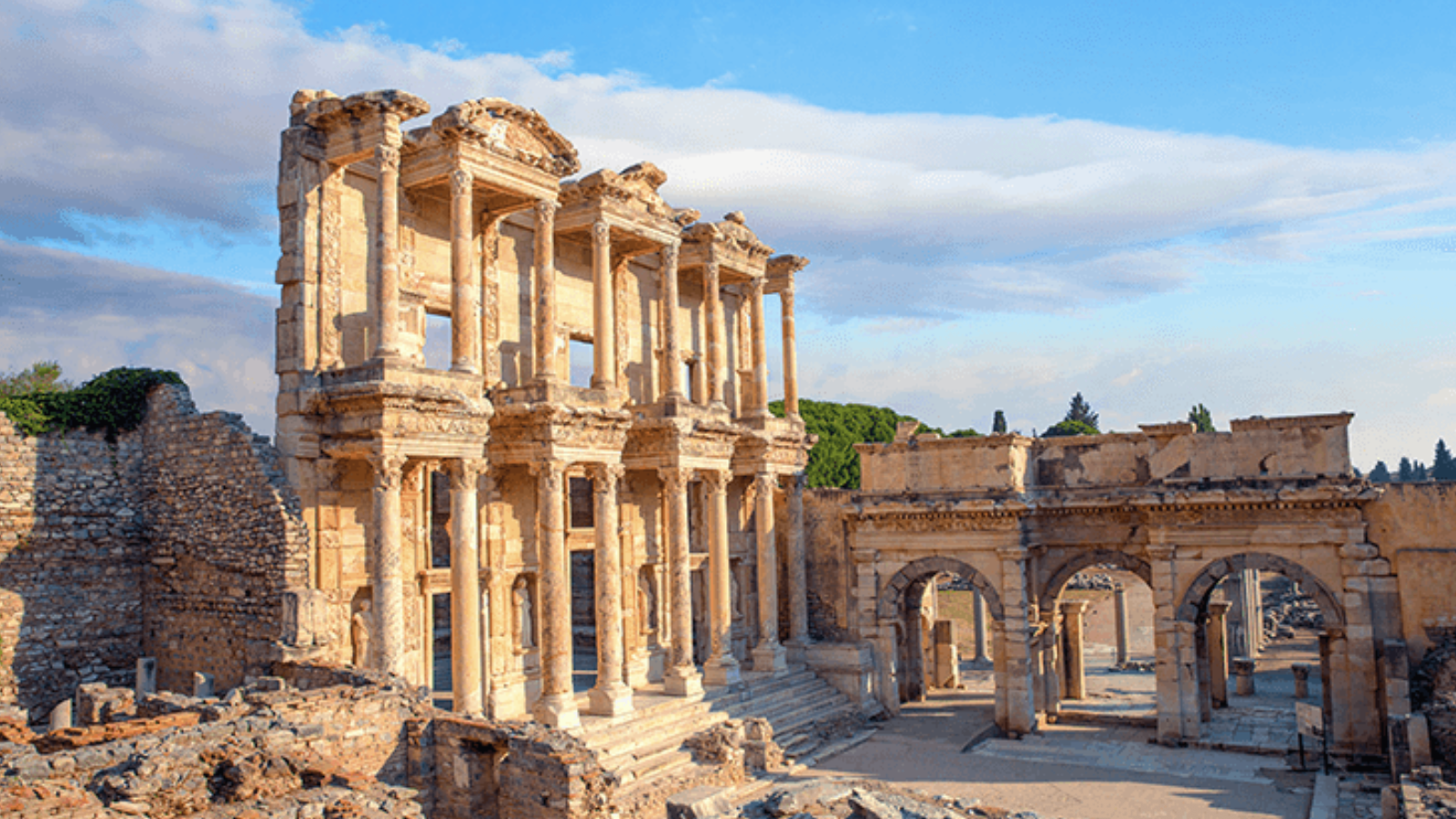
Ephesus is the best-preserved and most extensive classical Greco-Roman city in Asia (2,000 acres.) Established in the 10th century BCE, Ephesus flourished as a prominent city in the ancient world, serving as a major center of trade, culture, and spirituality. It is renowned for its rich history, architectural marvels, and religious significance.

Ephesus was also the largest port on the Aegean Sea two thousand years ago and the primary trade link between the Mediterranean and Asia. It was the Roman capital of Asia Minor, second only to Rome in size and prestige.
Early Christianity and Ephesus
Ephesus was a thriving Roman city during the life of Christ. After His death, the Apostles fanned out to spread his message.

Saint John retreated to Ephesus to write the Gospel of John and four other books in the New Testament while also watching over the Virgin Mary. He was buried here in 98 AD.
Saint Paul lived in the city for more than two years to denounce the worship of the goddess Artemis. His preaching incited a riot near the Great Theatre. He also wrote letters to the Ephesians (the Epistles) until his execution in Rome.

A frequent missionary companion of Paul was Saint Luke the Evangelist. Some speculate his grave is near Magnesian Gate. Lastly, the Virgin Mary resided in Ephesus from the age of 54 to 63.

We probably could not have come to Ephesus on a worse day!! There were four cruise ships in port and I think all of the passengers were right here! Our guides tried hard for early timing through the back entrance gate…..but in no time this is what we encountered!
Despite that…..this was a fascinating walk through a city with splendid temples, a towering library, and one of the most impressive theaters of the ancient world. The city glistens with grand architecture, monuments to emperors and gods, and marble roads. Ephesus epitomized Roman riches and world dominance at the apex of its success.
We could not see it all….but here are a few of the high points:
Great Theater
This theater is dramatic: 475 feet wide and nearly 100 feet tall. The three tiers contain sixty-six rows of seats with a capacity for 24,000 people. The Greeks started construction in the 4th century BC and the Romans expanded the theatre several times from the mid-1st century-2nd century CE. This was the theatre where St. Paul confronted the pagans.


This theatre is once again a venue for concerts…..Madonna, Elton John, Sting, Diana Ross and Joan Baez have performed here. They were setting up for a performance tonight!
Bath Houses
An essential element of Roman culture was the bathhouse…. a center of social life and relaxation. The facilities included exercise rooms, a large open-air pool plus rooms with plunge baths. Slaves regulated temperatures by monitoring hot air and water generated from a furnace and delivered through clay pipes. Private rooms were reserved for messages and physical treatments.

Terrace Houses
We paid an extra entrance fee to visit the Terrace Houses, also known as the “Houses of the Rich.” It provided a fascinating glimpse into the luxurious lifestyle of the ancient elite during the Roman period. These well-preserved residences were built between the 1st century BCE and the 7th century CE.

The Terrace Houses were uncovered in the 1960s, and much of the site is preserved under a large protective structure to prevent further deterioration. This allowed us to walk along elevated walkways and peer down into the homes, gaining a detailed view of the beautifully preserved mosaics, frescoes, and architectural elements.

Six luxurious residential buildings were in use from the 1st to the 7th century CE. The houses were abandoned in the 7th century CE when a series of devastating Arab raids and the silting up of the harbor caused the Ephesians to move. After being abandoned, the homes fell into decay, or were buried under soil from landslides.

The soil preserved the houses well, and their contents have offered archeologists a close look into the lives of the Ephesian upper class in the Roman and Byzantine periods. The excavations of the terrace houses started in 1960 and continue today.

These houses were built according to the Hippodamian grid style plan popular in the city during Roman times. Each one was built with multiple stories and an atrium with an entrance onto the side street. On the ground floor there were living and dining rooms, while upstairs held the bedrooms and guest rooms. They were equipped for running water and supplied with heating through clay pipes like the city’s bath houses.

The homes were adorned with intricate mosaics, vibrant frescoes, and marble paneling, showcasing the wealth and artistic taste of their inhabitants.
The Terrace Houses were also equipped with advanced amenities for their time, such as underfloor heating, running water, and private baths.


Courtyards, atriums, and multiple levels of rooms, were all connected by an elaborate system of staircases and terraces.

This was a unique window into the domestic life of Ephesus’ wealthy citizens! Ongoing archaeological work continues to reveal more about the everyday lives of the Ephesians, and the houses serve as a valuable historical record of Roman domestic architecture and interior decoration.
Curetes Street
Curetes Street (meaning priests) saw religious processions along this route to the Temple of Artemis. The road was started about 2,200 years ago during the Hellenistic period and was enhanced by the Romans. The marble stones concealed an elaborate drainage system.

Vedius (Theater) Gymnasium
A prestigious high school and training center (dedicated to the goddess Artemis) was built in the mid-2nd century. It included an elaborate courtyard, marble columns, mosaics, statues, and a major bath complex.

Gymnasiums were the schools for young people to take art, sports, literature, drama and speech. I find it so amazing that archeologists can figure out this information from piles of rubble!
Marble Street

The 1st century white marble pavement, the city’s most important road, is adorned with columns and sculptures. There are also lots of broken architectural elements in an open field which had been the Agora….the gathering place or marketplace. This was a center for world trade, a major slave market and political offices.
Ancient Brothel Advertisement
These etchings are an ancient advertisement for the world’s oldest profession. Arriving sailors eagerly understood the symbols… if you want love (heart top left) of a woman (lower right), turn left (left foot) at the intersection (cross above foot). It will cost you (purse lower right). This slab helped archeologists uncover the ruins of the nearby brothel.

Library of Celsus
This is ancient Ephesus at the peak of success. Imagine the grandeur of this former Roman city two thousand years ago! Unfortunately, scaffolding for our visit today!


The Library of Celsus was destroyed by fire in the 3rd century CE during a Gothic invasion, and later by earthquakes. Its magnificent façade lay in ruins for centuries before being partially restored in the 1970s. Today, it stands as a testament to the architectural and cultural brilliance of ancient Ephesus and serves as one of the city’s most important archaeological landmarks.
Gate of Mazeus and Mithridates

This gate was built around 4 AD during the reign of Emperor Augustus and served as the grand entrance to the commercial Agora, or marketplace, of Ephesus. This impressive structure is named after two freed slaves, Mazeus and Mithridates, who constructed the gate in honor of Emperor Augustus and his family as a symbol of gratitude for granting them their freedom.
Hadrian’s Gate

In 117 AD, this three-level marble monument was built while Trajan was Roman emperor (98 – 117.) The fluted Corinthian and Ionic columns supporting architrave fragments were uncovered in 1904 and raised in the mid-1980s. You have to imagine the arch!
Hadrian’s Temple
Construction of Hadrian’s Temple was completed in 138, the same year the emperor died at the age of 62. Historians consider him one of the Five Good Emperors (who collectively ruled from 96 through 180 AD.)

Public Toilets

These were public toilets for men; holes cut into three marble benches. Used by the poor who could not afford their own facilities, they did have mosaic floors, running water, a temperature-controlled room as well as cleaning tools consisting of a sponge on a stick. (The wealthy had running water and sewerage at home. Some required their slaves to warm the toilet seats before using them!).
Overlooking the Agora

Marble Everywhere

An impressive aspect of Ephesus is the abundance of marble. It is everywhere … on the streets, statues, columns, stadiums and buildings. This material was typically reserved for the world’s most impressive architecture. The area surrounding Ephesus was rich with marble.
Ephesus is a fascinating window into ancient history. The city glistens with grand architecture, monuments to emperors and gods, and marble roads. Ephesus epitomized Roman riches, success and world dominance…and with the numbers of visitors to this site each year…it is still a major success! Our group certainly enjoyed it!!

2024, with Overseas Adventure Travel