
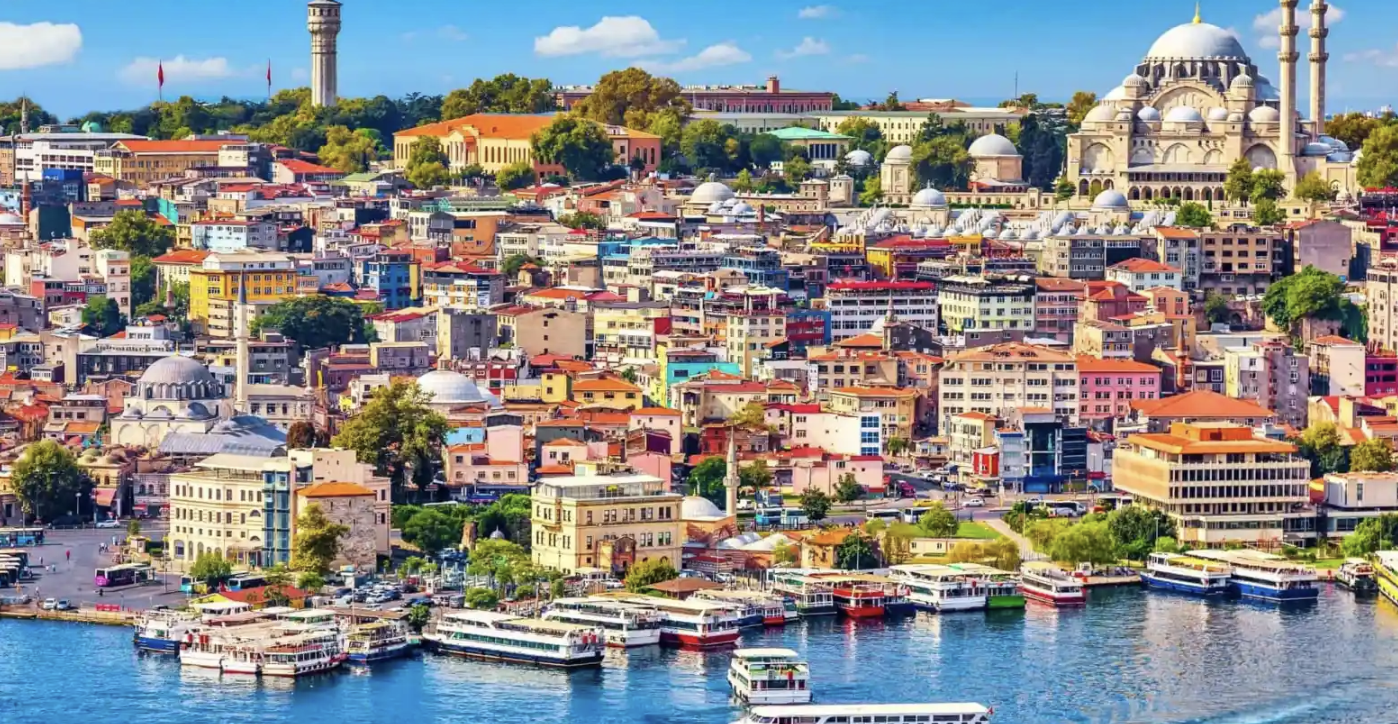
Istanbul, the fifteenth largest city in the world, is filled with rich culture and fascinating history. Its location is unique: it straddles the Bosporus Strait in Europe and Asia.
Although Istanbul isn’t technically the capital of Turkey, it’s still the country’s largest city and acts as Turkey’s economic, political, and historical hub.

Istanbul was discovered as Byzantium in the 7th Century BCE by Greek settlers. It was later made an imperial capital by Constantine, the Roman emperor, and went on to be named Constantinople (after himself!). The city was renowned for its power and influence and soon became an integral part of the Silk Road, leading to Istanbul’s rich cultural diversity.
Over many centuries, the city changed hands and played a key role in several different religions and empires until finally being renamed Istanbul in 1930 after the Turkish War of Independence.
Istanbul was named “the European Center of Culture” in 2018, attracting millions of tourists. In addition to its rich history and heritage, Istanbul offers unique architecture and breathtaking landscapes, bustling streets and intriguing sights, sounds, and smells. This city deserves much more time than we had on this trip….but here are some highlights we were able to see:
Hagia Sophia
From Cathedral to Mosque to Museum to Mosque!
The Hagia Sophia is one of the most iconic and historically significant architectural masterpieces in the world. Originally built as a Christian cathedral in 537 CE under the Byzantine Emperor Justinian I, it was the largest building of its time and a symbol of Byzantine ingenuity.

A bit of an Identity Crisis!!
In 1453, when the Ottoman Empire captured Constantinople, the Hagia Sophia was converted from a cathedral into a mosque, and Islamic elements such as minarets were added. In 1935, under the secular Turkish government, it was transformed into a museum, symbolizing Turkey’s cultural blend of East and West. In 2020, the Hagia Sophia was reconverted back to a mosque!

I thought this mosque would be one of the highlights of our trip, but unfortunately we came away disappointed. It is not the amazing building itself, but the series of circumstances present during our visit. Extensive renovations are going on, there were LONG lines of visitors (three cruise ships were in town!), and we had admission only to the 2nd floor gallery and not the actual mosque. Stantions prevented us from easily looking down into the mosque. Very frustrating!!
Our friends Joe and Ellen had visited here 9 years earlier when it was still a museum and they were able to get a much better perspective of the immense size of the dome. It was the largest dome in the world for centuries. Despite my disappointments, here are a few pics we captured!

Of course, before entering, the ladies had to make sure our heads and knees were covered…it is a sign of modesty and cultural sensitivity. It is also a sign of respect for the holiness of the mosque.


The Identity Crisis continues!
Our guides shared that there continues to be controversy, both nationally and internationally, about the 2020 conversion back to a mosque. Those who disagree see the decision as a growing trend towards Islamic conservatism under President Erdoğan. Supporters see it as a reflection of Turkey’s Islamic identity. Christian leaders voiced dismay, viewing the Hagia Sophia as a symbol of their heritage. UNESCO, which lists the Hagia Sophia as a World Heritage Site, expressed concern over the decision, emphasizing that the change could affect the building’s universal value. WOW…..this is all very complicated!!
Hippodrome of Constantinople
The Hippodrome of Constantinople was an ancient chariot racing and public entertainment venue. It was originally built in the early 3rd century CE, but underwent significant expansions and renovations over the centuries. This picture shows what it would have looked like if it had survived until today. The stadium could house 60,000+ spectators.

It was shaped like a large elongated U-shaped arena, with a central spine (spina) running down its length. The primary event was chariot racing, a popular and prestigious sport in the Roman and Byzantine Empires. The races were fiercely competitive and drew large crowds. Other public events like athletic contests, ceremonies, and political gatherings were also hosted in the hippodrome.
The hippodrome gradually fell into disuse and disrepair after the city’s conquest by the Ottoman Empire in 1453. Many of its original decorations and structures were removed or destroyed over time. Today, the site of the Hippodrome is marked by a few remnants and the Sultanahmet Square (AKA Hippodrome Square), which still retains some of the layout and historical significance of the ancient venue.


Spotted on our way to Lunch!

The Milion Stone was a marker from which all distances across the Roman Empire were measured. Erected by Septimus Severus in the 3rd century AD, it became the zero-mile marker for the empire. On its base were inscribed the distances of all the main cities of the Empire.
And here was lunch! The Turkish food has been FABULOUS…..vibrant flavors, healthful ingredients, beautifully presented.

The Blue Mosque
The Blue Mosque, officially known as the Sultan Ahmed Mosque, is one of Istanbul’s most iconic landmarks, renowned for its stunning architectural beauty and religious significance. Its nickname, the “Blue Mosque,” comes from the thousands of hand-painted blue Iznik tiles that adorn its interior walls, creating a serene and ethereal atmosphere.

Built between 1609 and 1616 during the reign of Sultan Ahmed I, the mosque faces Hagia Sophia in the heart of the historic district. It is considered a masterpiece of Ottoman architecture and features six towering minarets and a grand central dome, surrounded by smaller domes.


This mosque has a very soothing and tranquil beauty. It really helped me overcome the disappointing Hagia Sophia experience…the pictures really do not emote the feeling inside. Every inch seems to be covered with a comforting sense of spirituality. (The lighting fixtures do seem to interfere with the pictures though!!!)


Basilica Cistern
Sounds like a funny place to visit…..a cistern!! The Basilica Cistern is located in the heart of Istanbul and is one of the city’s fascinating and mysterious historical landmarks. Built in 532 AD during the reign of the Byzantine Emperor Justinian I, this underground marvel once served as a massive water reservoir for the Great Palace of Constantinople and other nearby buildings.


Many of the columns were repurposed from earlier Roman structures and give the cistern an almost cathedral-like appearance, hence its name “Basilica”. Among the most famous……. two massive Medusa head carvings used as column bases. One is placed upside down, and the other is positioned sideways. The exact reason for their orientation is unclear, but they are believed to be reused from an earlier Roman structure. The Medusa heads have become one of the most intriguing and iconic elements of the cistern.

The Cistern is dimly lit, with soft lighting casting shadows on the columns and the water, creating an eerie and atmospheric environment. We walked on raised platforms above shallow pools of water where fish swim.

The sound of dripping water and the space’s echoing vastness enhance the sense of mystery! We also enjoyed the artwork spread throughout.


Topkapi Palace
Topkapi Palace served as the primary residence and administrative headquarters of the Ottoman sultans for nearly 400 years. Commissioned by Sultan Mehmed II, it was built in the 15th century, shortly after the Ottoman conquest of Constantinople in 1453.


The palace overlooks the Bosporus Strait.

This is a sprawling complex of pavilions, courtyards, gardens, and administrative buildings…..one of those places you need many visits to absorb. It is renowned for its exquisite Ottoman architecture, characterized by domes, arches, and ornate tile work.

Today’s visit was really a journey through centuries of Ottoman history and culture, offering a glimpse into the opulent lifestyle of the sultans. The palace is organized into several sections, each serving specific functions such as state affairs, private residences, and leisure activities.


Our group had a tour of the harem portion of the palace. It is filled with rich history, intrigue, and a glimpse into the private lives of the Ottoman sultans. The word “Harem” comes from the Arabic word “haram,” meaning “forbidden” or “sacred,” and it refers to the secluded living quarters for the sultan’s family, particularly his wives, concubines, and children.

The Harem was a complex system of living quarters, not just for the sultan’s family but also for the female servants and eunuchs who worked there. It housed as many as 300 women at its peak. It includes over 400 rooms, courtyards, and gardens. The layout was hierarchical, with the sultan’s mother, the Valide Sultan, occupying the most important position in the Harem.
The Harem was guarded by eunuchs, who were enslaved men, usually of African or Balkan origin, who had been castrated. They held a unique position within the Ottoman hierarchy, often wielding considerable influence as intermediaries between the sultan and his household.


Life in the Harem was highly structured and regulated. The Valide Sultan had significant power, often influencing the affairs of the empire and the sultan himself. The women in the Harem were mostly of non-Turkish origin, often brought in through conquest or as gifts. They were educated in palace etiquette, music, arts, and even politics. Some of the women, especially the sultan’s favorites played significant roles in political matters.
The architecture of the Harem is intricate and ornate, reflecting the opulence of the Ottoman Empire. There are beautiful Iznik tiles, stained-glass windows, marble pillars, and detailed frescoes.


Beyond the Harem….
One of the highlights of Topkapi Palace is its extensive collections of artifacts, including manuscripts, ceramics, textiles, jewelry and weaponry.


So…..I was really impressed with the museum…..but some of the things in the museum seemed a bit hard to believe!!


Topkapi Palace not only symbolizes the grandeur and power of the Ottoman Empire but also reflects its cultural and artistic achievements. The palace’s architecture, decoration, and historical significance have made it a UNESCO World Heritage Site, recognized for its outstanding universal value. This was a thoroughly enjoyable visit…like walking through a living museum of Ottoman history.
Cruising the Bosphorus Strait

We took a delightful one-hour cruise along the Bosphorus Strait, which separates Europe from Asia, and the Black Sea from the Sea of Marmara. It was a great way to see picturesque cityscapes, hills dotted with historic buildings, and lush greenery from a very different point of view!

Some sights along the way…..


The Spice Bazaar
The Spice Bazaar is one of the city’s most famous and vibrant markets…..this is a sensory feast of colors, aromas, and sounds. It was built in the 17th century and originally served as a hub for the spice trade, where merchants sold exotic spices brought from the East via Egypt.


Today, the Spice Bazaar offers a wide range of products….. Turkish delights, dried fruits, nuts, teas, herbs, and even souvenirs like jewelry and ceramics. It was hard to get out without buying anything….I did accept this free treat from one young vendor!

The “Iron Church”

We were offered a “surprise “ on our way to the airport as we were leaving Istanbul. It was this “Iron Bulgarian Church”, an Orthodox Christian Church built in the late 19th century. It is notable for its unique construction, made entirely of prefabricated cast iron elements (thus,the name “Iron Church.”)

The church was commissioned by the Bulgarian community in Istanbul during the Ottoman period and is a symbol of Bulgarian independence from the Greek Orthodox Church. It is a blend of Neo-Gothic and Byzantine Revival architecture, and serves as a place of worship and cultural landmark in Istanbul.

This was the first (and only) Christian church we saw in the city among the more than 3000+ mosques! There are about 100 Christian churches of various denominations.
2024, with Overseas Adventure Travel