
The Forest and the Civil War….
This park serves as a living reminder of the region’s history.
When El Salvador’s Civil war started in the 1980’s, families who could no longer work their farms moved to this forest. (This PDF is a ChatGPT summary summarizing the causes, U.S. involvement, and outcomes of the war that killed over 75,000 people.)

Land in the country was concentrated in the hands of very few families; opportunities were scarce, and simply speaking out could put families at risk. Children could no longer attend school, so they were not learning to read or write. It was a very difficult life, but they stuck together to protect the forest and each other.
It was here today that our group was very fortunate to be joined by Raphael, a 63-year-old man who had been one of the leaders of the FMLN during the civil war. The FMLN, or Farabundo Martí National Liberation Front, was a coalition of leftist guerrilla groups that fought against the Salvadoran government during El Salvador’s civil war from 1980 to 1992.


As repression grew and people in his community began to disappear, Raphael joined the FMLN. He was only 16 at the time, but there was little human dignity left in life, and this felt like an act of survival.
Formed in response to decades of inequality, military repression, and human rights abuses, the FMLN drew much of its support from rural communities, labor organizers, and students. This was an example of one of the abuses:
The Killing of Student Protesters
In July 1975, students from the University of El Salvador organized a peaceful march in San Salvador. They were protesting government repression and the military’s occupation of the university, which had long been a center of free thought and dissent. As the march moved through the city, security forces opened fire on the unarmed students.
The exact number of dead was never officially confirmed, but dozens were killed and many more wounded. Bodies were removed quickly, records were suppressed, and families were left without answers—an early example of the disappearances that would become tragically common.
For many Salvadorans, especially young people, this event shattered the belief that protest, dialogue, or education could lead to reform. Universities had been seen as places of ideas and debate; after the massacre, they were also places of fear. The message seemed clear: even peaceful dissent could be met with lethal force.
Former students, organizers, and rural activists later said moments like this pushed them toward armed resistance. If the state responded to nonviolence with bullets, many felt they had no remaining options.
The civil war officially began in 1980, but incidents like the student killings—along with fraudulent elections, death squads, rural massacres, and the assassination of Archbishop Óscar Romero—created the conditions that made war almost inevitable. By the time fighting broke out openly, trust in government institutions had already collapsed.
For people like Raphael, these events weren’t abstract history. They were memories of neighbors who never came home, of silence imposed by fear, and of the moment when a generation realized the cost of speaking out.

Raphael described daily life during the war as a constant state of alert. There were long periods of hiding, limited food, and an ever-present fear of military patrols or sudden attacks. Civilians and fighters coexisted in uncertainty.
He told us that even preparing food in the forest required careful thought. Smoke from a cooking fire could betray an entire group, visible from far away and easily spotted by patrols. To reduce that risk, they learned ways to keep the smoke from rising in a clear column. Fires were kept small and low, and the smoke was guided so it dispersed beneath dense forest cover, thinning out before it could be seen.

The human cost of this war was staggering. Villages were emptied, families torn apart, and many people simply vanished, leaving loved ones without answers. Children lost their childhoods, parents buried sons and daughters, and survivors carried trauma long after the fighting ended. Listening to him, it became clear that the civil war is not just history in El Salvador—it is a memory that still shapes the country today. This is one of those OAT Travel experiences I will never forget. (Of course, I realize I have heard the story only from the guerrilla side.)
Parque Ecológico de Cinquera
Next, we set out for a hike in the community-managed forest reserve, Parque Ecológico de Cinquera, known for both its natural beauty and historical significance. Being with Raphael, this was not an ordinary hike in the woods, but rather a hike through Civil War History.

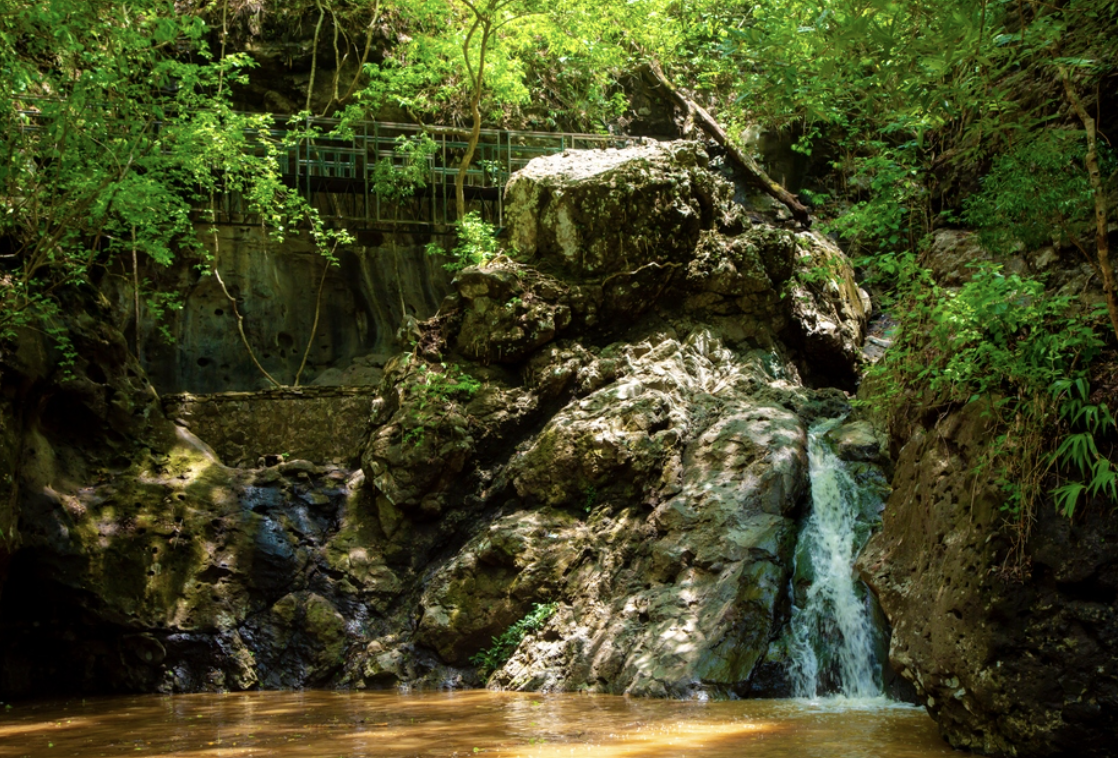
The forest has naturally regenerated and now stands as a powerful symbol of resilience and renewal. We walked shaded trails through dense forest, past clear streams and natural pools, and encountered reminders of the region’s history hidden among the trees.

Raphael showed us where, years after the war had ended, a body was found, complete with a backpack like the one he is holding.

Below is a living example of the model we saw at the Indigo store in Suchitoto…..some of the vats used for fermenting, oxidizing, and settling the indigo dye into a sludge. Along with subsistence farming and foraging, indigo production was one of the survival methods for those living in the forest. The forest provided cover, food, medicinal plants, and safety, allowing entire communities to endure the war years while remaining largely invisible to military forces.

In the trench shown below, Raphael was demonstrating the positions they had to take to be on guard for hour after hour.


In 1991, near the end of El Salvador’s civil war, this area was still an active conflict zone. The region saw continued military operations even as national peace negotiations were underway. Our group learned a lot from this man………and we are grateful.

This hike was so interesting. It’s incredible to hear stories and experiences from the conflict, from the mouth of someone who lived it. It doesn’t matter how many books or articles you read, or how knowledgeable your tour guide is, hearing someones first-hand account of the war gives a perspective like no other.
What a visit to a jungle that, just 30 years ago, was one of the most treacherous places on earth!
This was also a fun “modern-day” discovery in the middle of the forest….a family celebrating a birthday party!! They were making pupusas, soup, and chicken!


The Village of Cinquera
This small mountain town, located among coffee-covered hills and fertile farmland, is a remarkable symbol of resilience. It was a stronghold of guerrilla resistance during El Salvador’s brutal civil war in the 1980’s. The village was nearly wiped out; residents were forced to flee as military and guerrilla forces clashed in the region. We could still see the bomb and bullet damage to several of its buildings, as well as the downed military helicopter on display in the town square.

This was such a horror in a country so small. Today, however, Cinquera has been carefully rebuilt by its returning community, which, through collective efforts, has restored homes, schools, and local infrastructure.

It is easy to sense the town’s history in its quiet streets, memorials, and small museums that honor its struggles. From conflict to recovery…a spirit of survival and hope.
Museum of the Revolution

This Museum of the Revolution commemorates the events, heroes, and victims of the Civil War. Housed in a modest building, the museum doesn’t rely on grand displays or polished technology. Instead, it tells its story through photographs, everyday objects, and simple explanations—items that once belonged to people who lived, hid, and survived here during the Civil War.

Many of the exhibits focus on daily life in the surrounding forest, which served as refuge for guerrillas and civilians alike. There are handmade tools, cooking implements, and personal belongings that speak to ingenuity and endurance rather than ideology.

This landmark 12-year period (1980-1992) was characterized by civilian massacres and a draft that recruited child soldiers, with the final death toll estimated at 75,000, not accounting for the 8,000-plus citizens who vanished without a trace.


A Salvadoran Air Force UH-1H helicopter was shot down (in fact, shot down by Raphael!) near this community, an incident later commemorated locally as a symbol of resistance and survival. For civilians, events like this were part of a daily reality marked by displacement, fear, and life lived largely in hiding.

The museum was small, but its impact was not. It places Cinquera’s past firmly in human terms, emphasizing resilience, and community.
Hen Soup for Lunch!!
It was some of these “free-range hens” that we had for lunch today in a flavorful chicken soup!


Now….back to Suchitoto. Today was a very memorable excursion. It felt like stepping into one of El Salvador’s most evocative corners. …..the intersection of natural beauty and heavy historical memory.
One of our travel companions, Bobbi Bragan, is an excellent photographer and has shared a YOUTUBE of her pics. This excellent video includes both Suchitoto and Cinquera. Our photos could never come close to what Bobbi has produced!!!
https://www.youtube.com/watch?v=4IPALR3syjA
These locations were centers of resistance during the Salvadoran Civil War in the 1980s. Both Suchitoto and Cinquera have colonial architecture and Suchitoto overlooks Lago Suchitlán, a large man-made lake with boats and migratory birds. Thank you Bobbi Bragan!!