
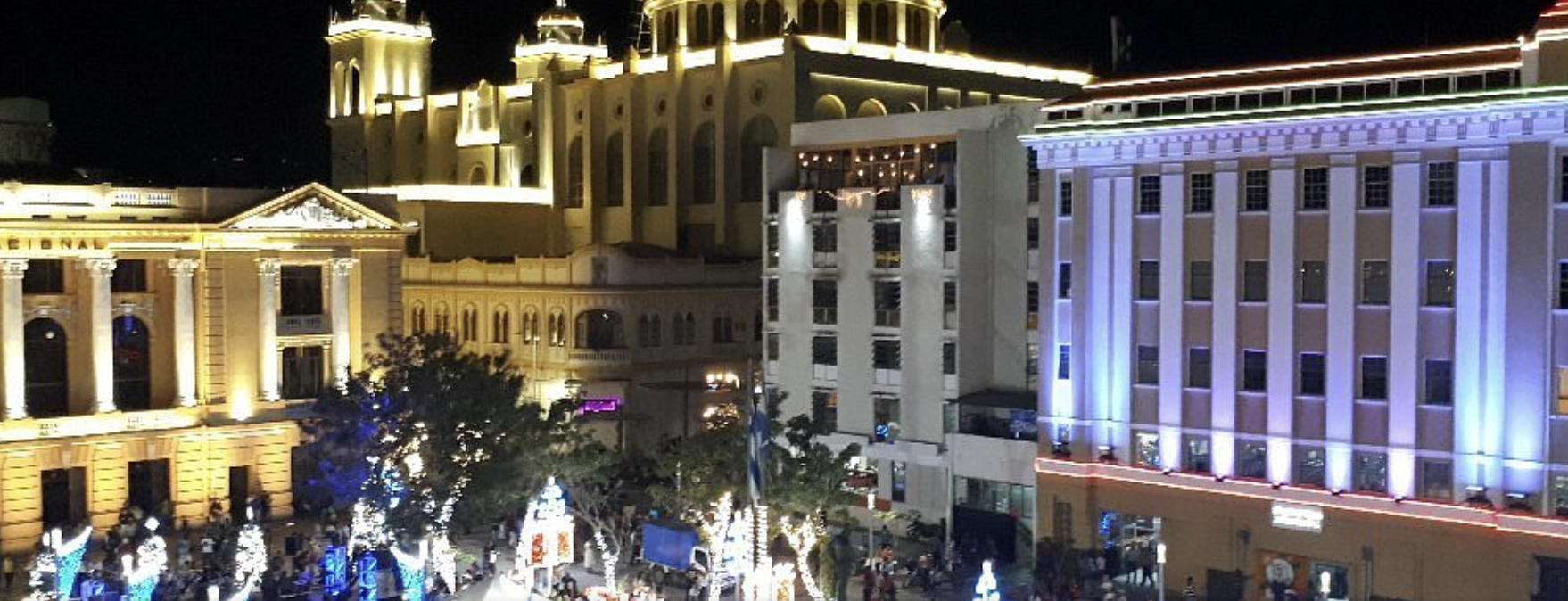
San Salvador is the resilient heart of Central America. For years, the city remained near the top of many “most dangerous cities” lists. But the city is undergoing a dramatic transformation. The downtown area is now bustling with locals and tourists alike, thanks to major government and private investment aimed at restoring its grand architecture and enhancing security.
We followed our day guide, Jeraldo, through the busy downtown area to see some highlights. It was a family day, church day, and shopping day all in one….so lots of people!!
The Central Market
San Salvador’s central market was our first stop. This was truly an assault on the senses!! The noise comes from vendors calling out prices, radios blaring, buses honking nearby, and the constant hum of hundreds of people layered on top of one another…. It was really overwhelming.
The crowds, however, reflect how essential these markets are to daily life—for us, it was a tourist experience, but for the Salvadorans, it was eeking out a living or shopping for the family’s dinner for the week, clothing, or the cheapest household goods. They seem to sell EVERYTHING at this market!

These are the unopened flower buds of loroco … native to Central America — especially El Salvador and Guatemala. They are edible and highly prized in Salvadoran cooking. They tasted slightly tangy and floral, almost like a mild asparagus with a hint of artichoke. They are used here in stuffed tortillas, scrambled eggs, rice, and stews.

The stalls are packed tightly together, often spilling into narrow walkways, with deliveries, shoppers, and pedestrians all sharing the same space.


These dresses are for Quinceañera; the traditional celebration in many Spanish-speaking cultures marking a girl’s 15th birthday and her symbolic transition from childhood to young womanhood. Its roots blend Indigenous coming-of-age rituals in Mesoamerica with Spanish Catholic traditions introduced in the 1500s. Today the celebration often begins with a special Mass of thanksgiving, followed by a formal reception featuring a ball gown, a court of honor, choreographed dances, and symbolic moments such as the changing of flat shoes to high heels or the presentation of a “last doll” to represent leaving childhood behind.

For us, this market was pure chaos, but for locals, it seemed organized—they knew exactly where to go, whom to trust, and how to move through it efficiently.
Exhausting? Absolutely. Memorable? Without question. And a real window into everyday life in San Salvador.
The Library
San Salvador’s standout library is the Biblioteca Nacional de El Salvador, a striking modern building in the historic downtown. It is a bright, welcoming space spread over multiple floors and much more than a place for books…….rather an accessible public space for learning, culture, and civic pride in this downtown that has come back to life.

It opened in 2023, symbolizing the city’s cultural renewal. There are reading rooms, children’s areas, technology and innovation spaces, exhibition halls, and views over the city that are all open 24/7!

As we were leaving, Pete noticed the Chinese Flag in front of the library! We have seen China’s presence in so many countries! In this case, China is apparently signaling friendship and partnership after El Salvador switched diplomatic recognition from Taiwan to China in 2018!


And, of course, more policeman….in this case all female!

Metropolitan Cathedral of San Salvador
The Metropolitan Cathedral of San Salvador is the main Catholic church of El Salvador and one of the city’s most important spiritual and historical landmarks….a symbol of faith, resilience, and national identity. It was consecrated in 1999 after decades of construction that began in 1956 — replacing earlier cathedrals destroyed by earthquake and fire.

The cathedral holds the tomb and crypt of Archbishop Óscar Arnulfo Romero, a beloved figure who stood up for social justice during El Salvador’s civil war and was assassinated in 1980; this makes the site a place of pilgrimage and reflection for many visitors and believers.


This is a painting of the Salvadoran Martyrs who were beatified together on January 22, 2022. These men are central figures in El Salvador’s modern religious and social history, often associated with Saint Óscar Romero. These four were chosen for a joint beatification because they represent the different “faces” of the church’s sacrifice during the Salvadoran Civil War: the clergy (Jesuit and Franciscan), the elderly, and the youth. (Rutilio Grande — Jesuit priest, Cosma Spessotto — Franciscan priest, Manuel Solórzano — layman and Nelson Lemus — layman.)
More than just a beautiful church, the cathedral stands at the center of Salvadoran history, from Romero’s powerful ministry to post-war celebrations and everyday worship.
Yellow-Shirted Prison Labor Crews

In El Salvador in recent years, under President Nayib Bukele, incarcerated individuals are transported in supervised groups to work on: Setting up stages or scaffolding for civic events, cleaning streets and parks, painting buildings, and minor construction or maintenance projects. The administration presents the program as a way for inmates to “repay society” and contribute labor rather than remain idle in prison.
National Museum of Anthropology
In our spare time, we walked to the National Museum of Anthropology, the main archaeology museum in San Salvador, where we learned about El Salvador’s ancient past. The museum was not air-conditioned, so we only stayed about 90 minutes, but it helped to bring together some experiences we had over the last several days: an overview of the country’s pre-Columbian history, focusing on indigenous societies that lived in the region long before Spanish colonization.

Displays centered on how early communities adapted to the volcanic landscape and developed complex social, religious, and economic systems.

There was a full range of archaeological artifacts, including ceramic vessels, stone tools, jade ornaments, figurines, and ceremonial objects, many from Maya-influenced sites and from Pipil cultures.

The exhibits pointed out daily life, agriculture (especially maize cultivation), trade networks, and spiritual beliefs.


Spotted as we were walking from the museum to the hotel! I am figuring this is where the call center is located when I call for Google Help!! (I usually get someone from Central America.)

One travel companions, Bobbi Bragan, is an excellent photographer and has shared a YOUTUBE of her pics.