
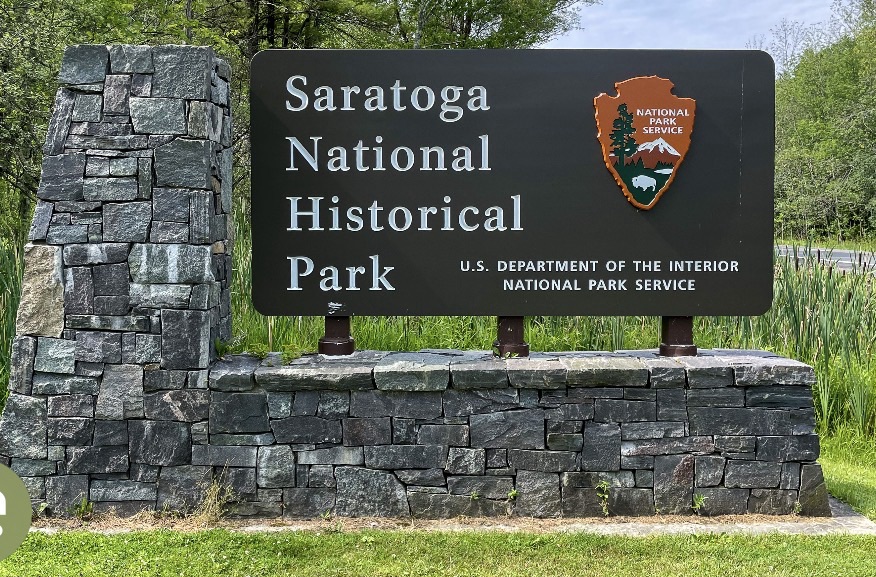
We have visited several Civil War sites during this Amazing 2026 Road Trip… but here we find ourselves going back in time to the Revolutionary War era. Saratoga National Historical Park, located in Schuylerville, NY, is one of the most important Revolutionary War sites in the United States. The battles fought here in September and October 1777 are often called the turning point of the American Revolution.

A sad thought: Little did I know of this site when I lived not too far north of here, in Plattsburgh, New York, in the 1990s! Pete has really taught me to appreciate history!
This park preserves the fields, forests, hills, and river overlooks where the battles unfolded. This is where, in the fall of 1777, the American victory over British General Burgoyne convinced France that the colonies had a real chance to win independence. Many historians call Saratoga the turning point of the Revolutionary War.

What Happened Here?

British General John Burgoyne led an ambitious plan to split New England from the other colonies. He marched south from Canada, expecting support from other British forces that never fully materialized.
American troops under leaders including Horatio Gates and Benedict Arnold fought two major engagements: the Battle of Freeman’s Farm — September 19, 1777, and the Battle of Bemis Heights — October 7, 1777

A Fascinating Character: Benedict Arnold

Before becoming infamous for treason later in the war, Benedict Arnold was considered one of the Revolution’s boldest battlefield commanders. At Saratoga, he fought aggressively and was severely wounded. Many historians believe his actions were crucial to the American victory.
In 1776, the British planned to move south from Canada along the Lake Champlain corridor, which was a natural invasion route into New York and the Hudson Valley. The Americans had almost no navy on the lake, so Arnold supervised the frantic construction of a small, improvised fleet of gunboats and schooners.
Arnold chose to make a stand near Valcour Island, in Lake Champlain, just offshore from my former home in Plattsburgh, NY, and on the lake in front of my son’s home in Vermont!) Militarily, the battle itself was technically a British victory — many American ships were destroyed or captured. But strategically, Arnold accomplished something extremely important: He delayed the British advance for an entire season by forcing them to turn back to Canada for the winter rather than pushing south immediately. That delay helped give the Americans time to prepare defenses the following year. Many historians believe this delay contributed directly to the American success at the Battle of Saratoga, which convinced France to openly support the American cause.
Arnold himself fought fiercely during the battle and personally directed the escape of surviving vessels through the British lines at night — classic Benedict Arnold as one of the U.S.’s most daring commanders.
Bottom Line: Benedict Arnold started out as one of America’s best generals before becoming its most famous traitor!

This is quite an unusual memorial…. It honors Benedict Arnold’s wounded leg without naming him, given his later betrayal of the American revolutionary cause and his defection to the British. We didn’t have time to walk to it, so Google helped with this pic!

The park is beautifully preserved… rolling fields, stone walls, wooded ridges, and quiet farm country along the Hudson Valley. It is surprisingly peaceful for a place where such consequential fighting occurred. Unfortunately, we arrived only 90 minutes before park closure, so our drive of the scenic loop road was more hurried than we wanted (even my photography was cut short, so I had to get pics from Google!). Before we started the drive, we watched a short film at the visitor center that really set the scene for our visit to the battlefields.
The self-guided audio tour was well organized with numbered stops that explained the battles and the people involved. Unlike some crowded historic sites, Saratoga seems to offer plenty of room to pause and imagine events unfolding across the landscape.


Many battlefields focus mainly on loss. But Saratoga carries the feeling of possibility; the moment when an uncertain rebellion began to look like a future nation.