
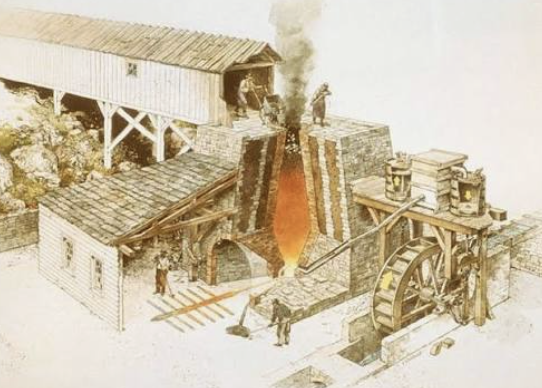
Hopewell Furnace National Historic Site is a fascinating place to understand early American industry. We traveled to the wooded hills of southeastern Pennsylvania to find this preserved iron-making community. It tells the story of how raw natural resources—iron ore, timber, and water—were transformed into the materials that helped build a young nation.

Established in 1771, the furnace was part of a network of iron plantations that supplied tools, stoves, and other iron products used throughout the colonies and the early United States. Walking through the site today feels like stepping back into an 18th- and 19th-century industrial village.

At the heart of the historic site stands the massive stone blast furnace, where iron ore was smelted using charcoal made from nearby forests. During its operation, Hopewell Furnace produced pig iron that could later be refined into finished products such as cookware, farm tools, and hardware.

The furnace also played a role in the American Revolution, producing iron that supported the colonial war effort. The surrounding landscape—woodlands once used for charcoal production and fields that supplied food—reveals how closely industry and agriculture were intertwined in early America.

Hopewell was not just a factory but an entire community. The furnace complex included the ironmaster’s elegant home, workers’ houses, barns, a company store, and other buildings that supported daily life.
We started our visit with a background film about the site and viewed the exhibits in the Visitor Center, but we missed the guided tour for the day. But walking around the site on our own did remind us that long before the giant steel mills of the nineteenth and twentieth centuries, small rural furnaces like Hopewell were quietly laying the industrial foundations of the United States.
One thing I have come to appreciate during our travels is that not every National Park site is breathtaking because of dramatic scenery or famous landmarks. Sometimes memorable places are the ones that quietly tell the story of ordinary people doing extraordinary work. Hopewell Furnace seems like one of those places. It may never attract the crowds that gather at Yellowstone or the Grand Canyon, but it tells an important chapter of American history that we know very little about.
The nation’s story wasn’t written only by the presidents and generals that we have seen so much of on this trip….. It was also forged—quite literally—by hardworking men and women who spent long days beside blazing furnaces, producing the iron that helped build a country.
Another thought.…..On this trip, we have visited Pullman National Historical Park, where we saw the height of the Industrial Revolution; Steamtown National Historic Site, where the power of steam and the railroads brought that industrial age to life; and today, Hopewell Furnace, where we saw some of its earliest building blocks. Together, they span nearly 150 years of American industry—from making iron with charcoal in a rural village, to the rise of steam locomotives that connected a growing nation, to manufacturing luxurious railroad cars in a planned industrial city. What a fascinating way to see the story of American industry unfold, one National Park site at a time. Thank you, National Park Service!!!
