
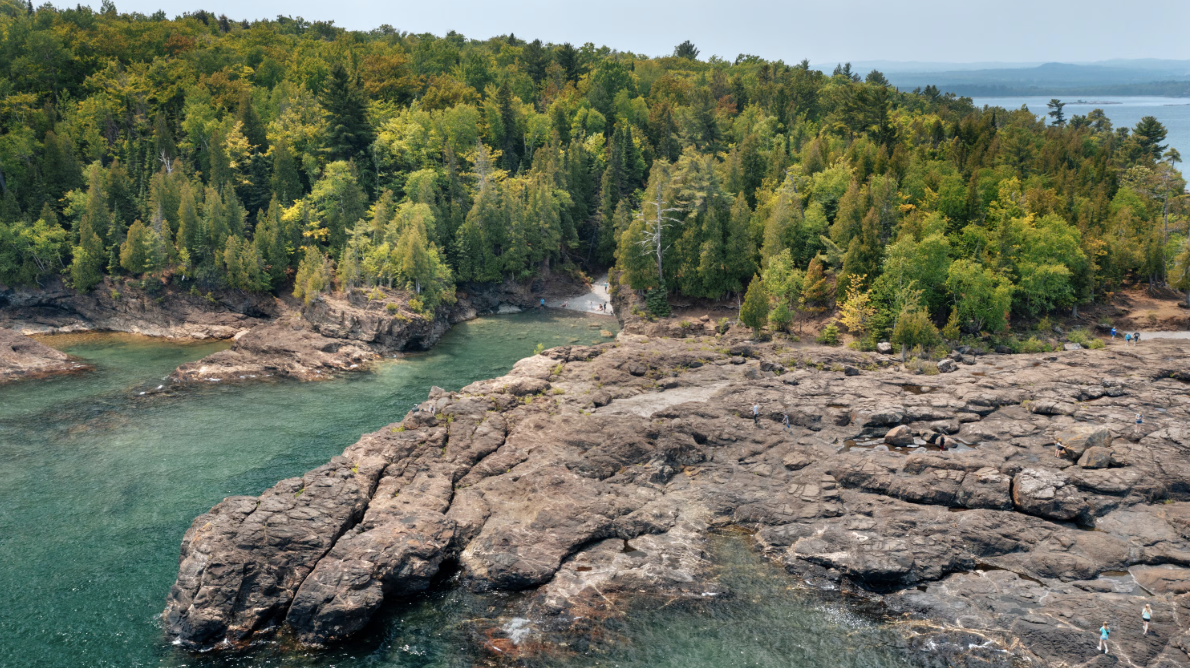

The Keweenaw Peninsula is composed of some of the oldest exposed rock in the world, dating back about 1.1 billion years, and is mineral-rich. The first great mining boom in the United States began in 1843 with the discovery of the red metal, copper, first in Copper Harbor.
Keweenaw is actually the Ojibwa word for “to portage”, and the area is named for the shortcut the natives used in the early days when paddling birch bark canoes.

The Keweenaw Peninsula is separated from the rest of Michigan’s Upper Peninsula by the Keweenaw Waterway — a partly natural, partly man-made channel that cuts across the base of the peninsula between Houghton and Hancock.
Together, they form a navigable route across the peninsula, connecting Lake Superior on the west side with Lake Superior on the east side. That is why the Keweenaw often feels almost like an island.

Snowfall is no small matter in these parts!! They get so much snow on the Keweenaw Peninsula, about 20 feet each year, that they have to shovel their roofs.


Staying at the Laurium Manor
Our stay at Laurium Manor Inn in Laurium, Michigan, felt less like checking into a hotel and more like stepping into the grand finale of the Keweenaw copper boom!
The mansion was built in 1908 for Thomas H. Hoatson Jr., a wealthy copper mining executive associated with the Calumet & Arizona Mining Company. It is enormous…a 45-room, 13,000-square-foot mansion.

In a region shaped by mines, shafts, company towns, immigrant labor, and industrial ambition, Laurium Manor shows the other side of the copper story: the wealth that copper created. This home was built for an astonishing $50,000 (equivalent to $1.7 million today!)
The house is opulent: grand staircases, ornate woodwork, formal rooms, heavy doors, fireplaces, stained glass, and the kind of details that make you wonder how many craftsmen it took to create them. It is beautiful… but after visiting mining sites around the Keweenaw, it was impossible not to think about the contrast between the men who worked underground and the owners who built homes like this above ground.

Laurium itself is not located in a polished resort town. It is part of Michigan’s Copper Country, where history is still visible in the streets, old homes, churches, mining ruins, and the nearby communities of Calumet and Hancock.
These are some of the pics I took while walking around the house on my self-tour! They offered daily tours of the home, as well as a self-guided tour option, which I chose.
What made the stay especially interesting was that the mansion had survived into a second life. It had once been vacant, but in 1989, Julie and Dave Sprenger purchased it and began the restoration that turned it into Laurium Manor Inn. Without people willing to take on old buildings that are too large, too expensive, and too complicated, places like this can disappear quickly…luckily for us, it did not!
For us, Laurium Manor became part of the Keweenaw experience, not just a place to sleep. It connected the landscape, the mines, the money, and the people into one story.

The cliffs and shoreline of Lake Superior reveal the peninsula’s natural beauty, but Laurium Manor reveals the human ambition that once transformed this remote region into one of the world’s great copper-producing regions. This is where the Keweenaw copper boom still seems to echo through the staircases, woodwork, and grand old rooms.
Keweenaw’s remoteness and small population have allowed this 60-mile finger of land to remain relatively unchanged for many years… since the great copper boom of the 1800s. We spent one day exploring a scenic loop of the peninsula, stopping at picturesque settings along the way.
Some of our stops:
This is the Eagle River Timber Bridge, a striking wooden arch bridge that carries the highway over the Eagle River in the village of Eagle River

Eagle Harbor Lighthouse

We got a sense of why this remote-feeling shoreline mattered so much: copper came out of the peninsula, ships carried people and supplies across Lake Superior, and small harbor communities depended on these lights and lifesaving stations.


Brockway Mountain Drive is one of the great scenic roads of the Keweenaw Peninsula. It runs between the Eagle Harbor area and Copper Harbor, climbing up along a high ridge above Lake Superior.

The Keweenaw at this point felt remote but still welcoming—a narrow finger of land reaching into Lake Superior, full of history, wind, trees, and water.
Copper Harbor
Arriving at Copper Harbor felt like the end of the road in the best possible way. It sits near the very tip of the Keweenaw Peninsula, surrounded by Lake Superior, thick forests, rocky shorelines, and the memory of copper mining. It is small, remote, and scenic — the kind of place where you can feel that you have driven as far north as the map will reasonably allow. We stopped for lunch here and…gave into another serving of fudge! (It is too bad we both like this stuff, or else it would be easier to talk ourselves out of these splurges!!)
Historically, Copper Harbor was one of the early gateways to the Keweenaw copper boom. In the mid-1800s, prospectors, miners, investors, and supplies moved through this area as people rushed into Michigan’s Copper Country. The harbor provided a protected place for boats on Lake Superior, and nearby Fort Wilkins was built in 1844 to help maintain order during the mining rush and protect federal interests in the region. Today, Copper Harbor is less about mining and more about scenery, recreation, and atmosphere.

The End of the Road!!
Copper Harbor is often referred to as “Land’s End” because it marks the literal northernmost settlement and the end of the Keweenaw Peninsula on the map. Beyond Copper Harbor, there is no major highway to continue on—just water, wilderness, and Canada somewhere beyond the horizon.
Although it feels like the end of the road…it is also the northern terminus of Highway 41. This was a first for us… standing at the very beginning of a highway that we have traveled for many thousands of miles during our lifetime! This highway stretches nearly 2,000 miles south from Michigan through Wisconsin, Illinois, Kentucky, Tennessee, and Georgia before finally reaching Miami.
For us, it also represented another milestone in our journey filled with national parks, historic sites, waterfalls, lighthouses, and countless unexpected discoveries.
Part of our Miles of Memory Roadtrip, May 15-August 4, 2026