
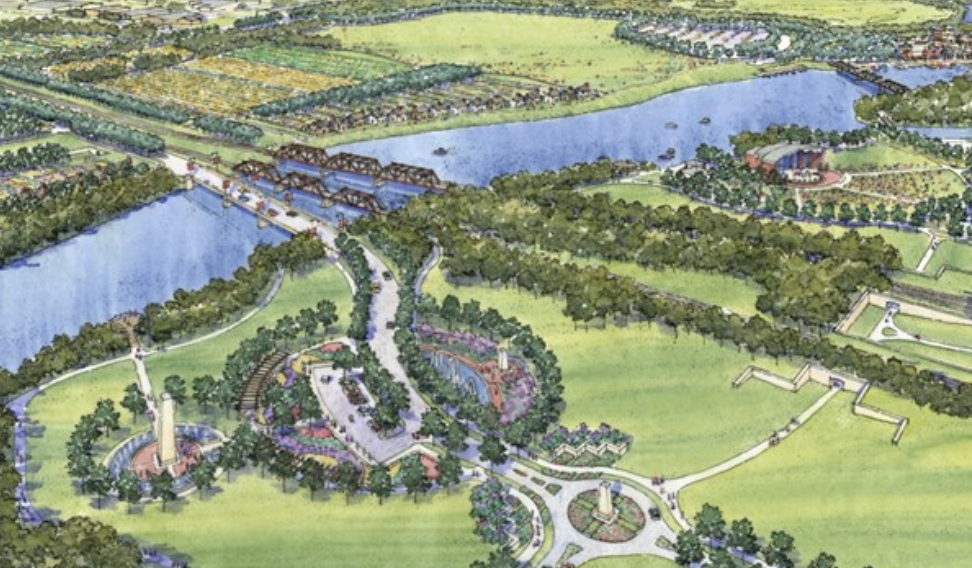
Some national park sites are known for mountains, canyons, geysers, or sweeping views. River Raisin National Battlefield Park, in Monroe, Michigan, did something very different. It asked us to stand in a quiet place and listen to a story most of us probably did not learn very well in school.—or, more likely, learned many decades ago and promptly forgot! This park definitely fell into that category.
The park is very modest. There are no dramatic cliffs, no grand monuments towering over the landscape, no battlefield stretching endlessly in every direction. Instead, there is a visitor center, interpretive signs, walking paths, memorial spaces, and the nearby River Raisin.

The visitor center helped make sense of the conflict. Without that context, it would be easy to look around and think, “This is just a quiet patch of land.” But once the story is explained, the landscape changes. We had to walk and read and try to imagine January 1813 — the cold, the confusion, the fear, the aftermath. It is hard to picture such suffering in a place that now feels so calm.

A large diorama recreates the little French settlement of Frenchtown as it appeared along the River Raisin, with its homes, fences, and surrounding countryside. Seeing the settlement laid out visually made it much easier to imagine this as an actual community rather than simply a battlefield marked on a map.
The exhibits and theater presentation introduced us to the complicated story of the battles fought here in January 1813, during the War of 1812. American troops—including a large number of Kentucky volunteers—were fighting British forces and their Native American allies for control of this part of the Northwest Territory.


The American defeat was devastating. What followed became even more infamous: wounded American prisoners were killed in the aftermath, an event remembered as the River Raisin Massacre. The rallying cry “Remember the Raisin!” later helped stir American troops as the war continued. Of the roughly 934 American soldiers involved, almost all were killed, wounded, or captured.

“Remember the Raisin” was not about a river or a town or a line in a textbook. It was about grief, anger, revenge, and memory. It was about how one terrible event can become a slogan, and how slogans can carry both history and pain.
The War of 1812 was not just something that happened around Washington, D.C., or New Orleans. It played out along the Great Lakes, in borderlands, settlements, forts, and riverside communities. Michigan was not a backdrop; it was a contested place.

This battlefield sits at the intersection of competing worlds: American expansion, British power, Native resistance, frontier settlement, and the violent uncertainty of the War of 1812. The story here is complicated; different people experienced these events in very different ways.
River Raisin National Battlefield Park was not a long visit for us…We spent time in the Visitor Center, but the rain kept us from viewing much of the battlefield. But it was a meaningful visit. We left knowing a little more about the War of 1812, a little more about Michigan, and a little more about the cost of building a nation in contested territory.
Not every national park site is meant to dazzle. Some are meant to make us pause. This one did.