
6/10-11/2026
Finding Our Bearings in the North Woods!
There was a distinct moment when we realized we had left the everyday world behind and entered the realm of “the lakes.” For us, that moment came as we began exploring Voyageurs National Park, Minnesota’s remarkable water-based wilderness.

With its maze of interconnected waterways, countless islands, and dense forests, Voyageurs took a little time to understand. Fortunately, we had friends who knew the region and were eager to help us find our way. Maryann and Brenda are Minnesota friends we met years ago on an OAT trip through the Balkan Peninsula. They generously offered to plan the northern Minnesota portion of our journey, including visits to both Voyageurs and Isle Royale National Parks, and invited their friend Maureen to join the adventure.

We dedicated our first afternoon to exploring two distinct visitor centers, and it was the perfect way to prime ourselves for the massive scale of this place.

Each stop offered a different window into the park’s rich tapestry—from the geology of the Canadian Shield to the grueling, larger-than-life history of the French-Canadian voyageurs who paddled these waters centuries ago.


Standing on the edge of the glassy water, looking out at the endless pine-topped islands…..

You can almost hear the ghostly echoes of the Voyageurs ‘ rowing songs (which we heard in the dated but interesting movie at the visitor center!). The name Voyageurs comes from the French word for traveler.

It’s hard to comprehend just how massive these border lakes are until you see them laid out on a map. Voyageurs National Park has 655 miles of total shoreline, and nearly 200,000 acres of land and water.

So, as wonderful as the view is from the shore, Voyageurs is a park best experienced from the water (the park features 30 named lakes, plus 500+ smaller, unnamed ones).
The Voyageurs Philosophy… you haven’t truly seen the park until your feet are off dry land and you’re moving with the current!

So we began a 6-hr guided boat tour into the heart of the park.…. total immersion! This ride took us deep into the heart of the park’s watery wilderness. Six hours on the water meant we were leaving the modern world completely behind and navigating the historic routes of the fur traders.

We were blessed with beautiful weather as we cruised through the park, surrounded by the incredible scenery of the northern Minnesota wilderness. Our guide, Bill, made the journey even more enjoyable. His knowledge of the area was impressive, and he kept us entertained with funny stories and fascinating bits of history about the places we passed.
Ellsworth Rock Gardens
One stop on our visit was the Ellsworth Rock Gardens, an outdoor sculpture garden hidden along the shores of Kabetogama Lake. While the gardens are known for their colorful displays of flowers and carefully designed plantings, we arrived at a time when there was very little color. The stonework, terraces, and landscape design only hinted at what the gardens must have looked like at their peak.

We read about the thousands of lilies and colorful flower beds that once covered the terraces.

Sadly, the gardens we found seemed largely untended and bore little resemblance to their former glory.

Who Created this in Lake Superior?
The gardens were created by Jack Ellsworth, a Chicago-area businessman who spent summers on the island. Beginning in the 1940s, he started arranging the local granite rocks into artistic formations. Over nearly 20 years, he carefully stacked and balanced thousands of stones to create terraces, walls, sculptures, and geometric designs.
What makes it so remarkable is that he didn’t use cement or mortar — the structures were built by hand, using the natural shapes and weight of the rocks. The garden stretches along the shoreline and includes hundreds of stone arrangements, with some reaching several feet high.
Walking through it feels a little like discovering a stone “city” in the forest. This is a great example of how people have interacted with the landscape in the Northwoods…..one person’s creativity blending into the wilderness.


The unusual stone sculptures and sweeping views of Lake Kabetogama were interesting, but the flowers that once brought the place to life were mostly gone. It felt less like a garden and more like the fading remains of one.

I.W. Stevens Island
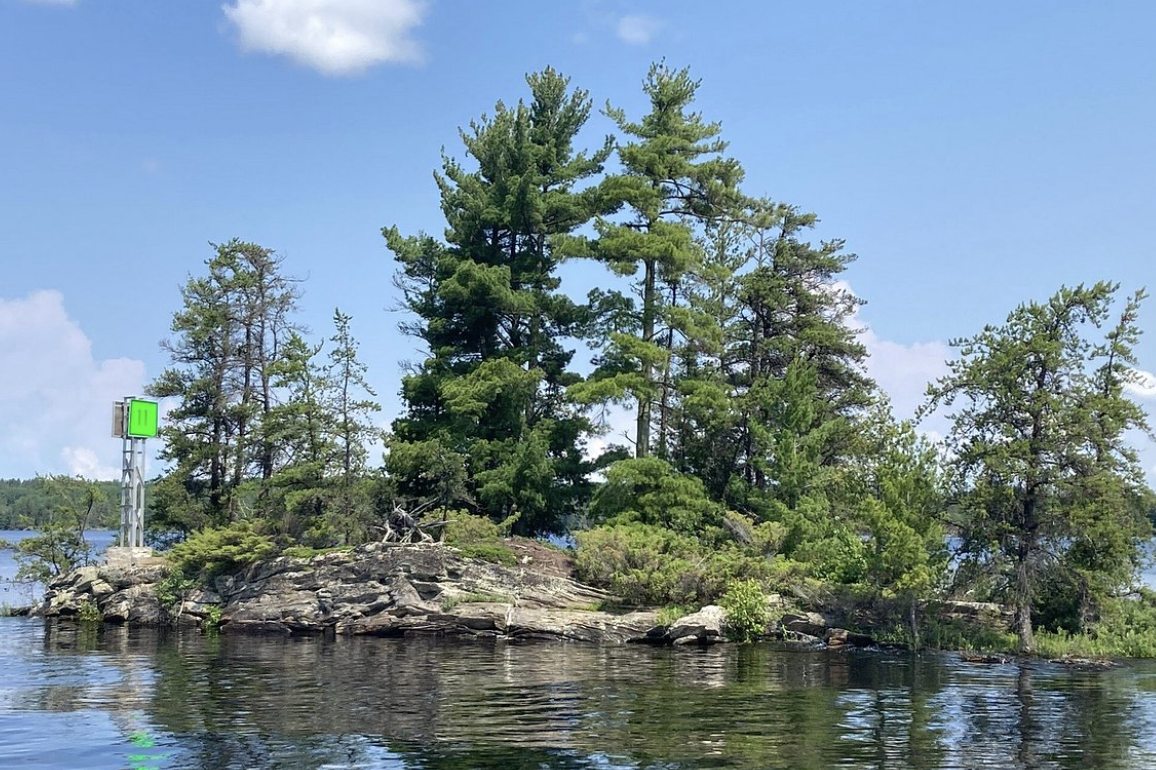
Every island seemed to have its own personality, with rocky shores, tall trees, and views that stretched across the sparkling water.

Our next stop was I.W. Stevens Island. This island was a reminder of the many stories and landscapes preserved within the park
I.W. Stevens

This island was once home to an extraordinary Norwegian immigrant who chose to live almost entirely alone on Namakan Lake. For nearly 50 years, Stevens operated a small resort, grew and preserved his own food, cut firewood, harvested ice, and endured the long northern Minnesota winters.

The surviving cabins and outbuildings are simple and weathered, but that somehow makes the story even more compelling. Standing among the towering pines, it was easy to appreciate both the beauty of his surroundings and the enormous determination required to make a life there.


Kettle Falls
One of the most memorable stops was Kettle Falls, a historic and scenic area where we could appreciate both the region’s natural beauty and history. Standing there, it was easy to imagine the voyageurs and early travelers who navigated these same waters long ago.

Kettle Falls Hotel is one of the most unusual places in Voyageurs—and quite unlike a modern national park lodge. It is a remote, slightly quirky old North Woods hotel reached only by boat, about 15 miles from the nearest road. It is also the only lodging located inside Voyageurs National Park.


The hotel was built around 1910–1913, when dams were being constructed at Kettle Falls. Its earliest customers included dam workers, lumberjacks, commercial fishermen, trappers, and traders. As logging and commercial fishing declined, fishermen and vacationing families became the main guests.

The building is now part of the Kettle Falls Historic District and is listed on the National Register of Historic Places. The National Park Service acquired it in the 1970s and completed a major renovation in the 1980s, while preserving its old-fashioned character.

Kettle Falls sits between Rainy Lake and Namakan Lake, very close to the international boundary. From the nearby dam and overlook, you can stand in the United States and look south into Canada—one of those geographical oddities that feels completely backward!


This hotel felt like arriving at an isolated outpost that had welcomed travelers for more than a century. Stopping for lunch, seeing the crooked saloon, walking to the dam, and looking across the border made it one of the most memorable stops!

Back in the boat, we kept our eyes open for wildlife. We spotted several eagle nests and were lucky enough to see one of the majestic birds soaring nearby — always a special moment!

As enjoyable as our ride was, we saw little wildlife. Bald eagles, wolves, moose, and black bears could be considered the big four of Voyageurs NP wildlife. Around 150 black bears inhabit the park; Minnesota has the most bald eagles in the lower 48 states, with more than 1300 pairs. At last count, the park itself had 42 breeding pairs of eagles. Only about 40 to 50 moose reside in Voyageurs.

This boat tour gave us a wonderful perspective on Voyageurs National Park. The combination of peaceful waters, fascinating history, wildlife, and a great guide made it a day we will surely remember. Sometimes the best adventures are the ones where you simply sit back, enjoy the view, and let the landscape tell its story… This was one of those days!
After the boat ride, we stopped at a local bar to have a drink. This was the description of one of the drinks… as Wisconsinites, we just had to laugh!!

