
5-15-26
Six and a half hours after driving from home, we arrived in Charleston, South Carolina, one of America’s oldest and most beautifully preserved cities. It has a great southern atmosphere… many church steeples rising above pastel-colored houses, palm trees swaying beside cobblestone streets, and the scent of the harbor drifting through the air. We found the beautiful Hampton Park to set up our picnic lunch next to a large pond, with lots of birds and local runners. Given more time, it would have been a great park to explore.


But we were on a mission, since we had purchased 2:45 ferry tickets to Fort Sumter National Historical Park. Our first stop was the Visitor Center downtown. The Visitor Center is housed in the former Charleston railroad depot and warehouse complex, built before the Civil War, and one of the earliest major railroad facilities in the United States.


We walked through the displays before taking the 20-minute walk to the ferry to Fort Sumter.

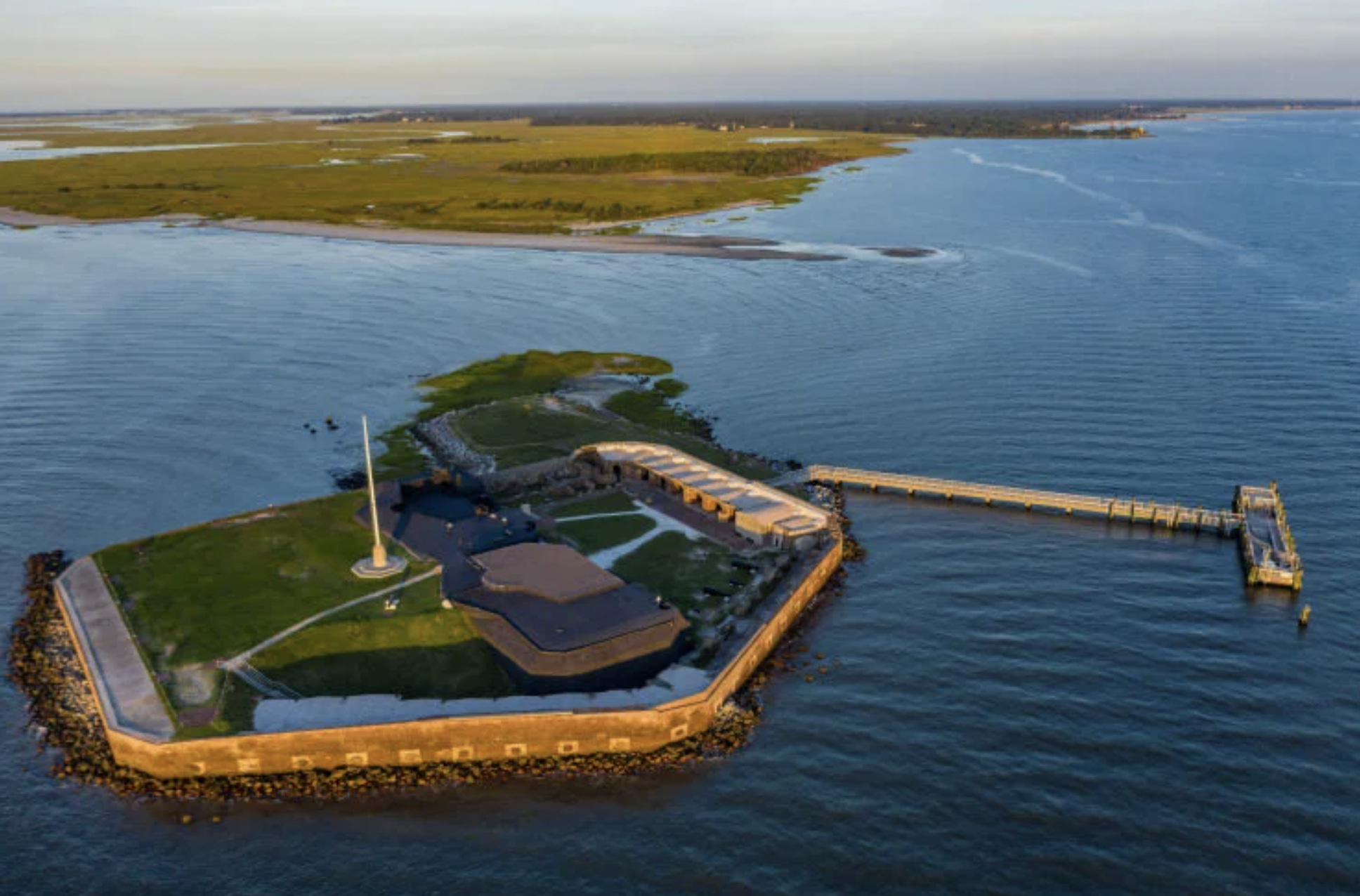
Fort Sumter sits quietly in Charleston Harbor today, but its history echoes loudly through American memory. Built in the early 1800s as part of a coastal defense system, the fort was designed to protect the important port city of Charleston from foreign invasion. Constructed on an artificial island of granite blocks, it was considered a formidable structure for its time, with thick masonry walls and tiers of cannon emplacements facing the harbor. Construction actually began after the War of 1812 to help defend Charleston Harbor

The fort became immortalized on April 12, 1861, when the first shots of the American Civil War were fired there. Confederate forces surrounding the harbor demanded the surrender of the small Union garrison stationed inside the fort. When the Union commander refused, Confederate batteries opened fire in a bombardment that lasted 34 hours. Though no soldiers were killed during the initial shelling, the attack ignited a war that would last four devastating years and reshape the United States.
Our tour was self-guided through the fort and museum. It was complemented (since we were the last tour of the day) by a presentation and flag-lowering ceremony by the Park Ranger.

In photographs and paintings I had seen before our visit, the fort looked massive and imposing, but it was quite surprising to see that the actual structure is fairly compact, probably because it was built on an artificial island. In addition, much of what we saw today is lower than the original construction because the fort was heavily damaged during the Civil War and has been rebuilt several times.
We had time to explore…. So, as I so often do, I took many pictures of things to look at later when I had more time…
The video highlights……