
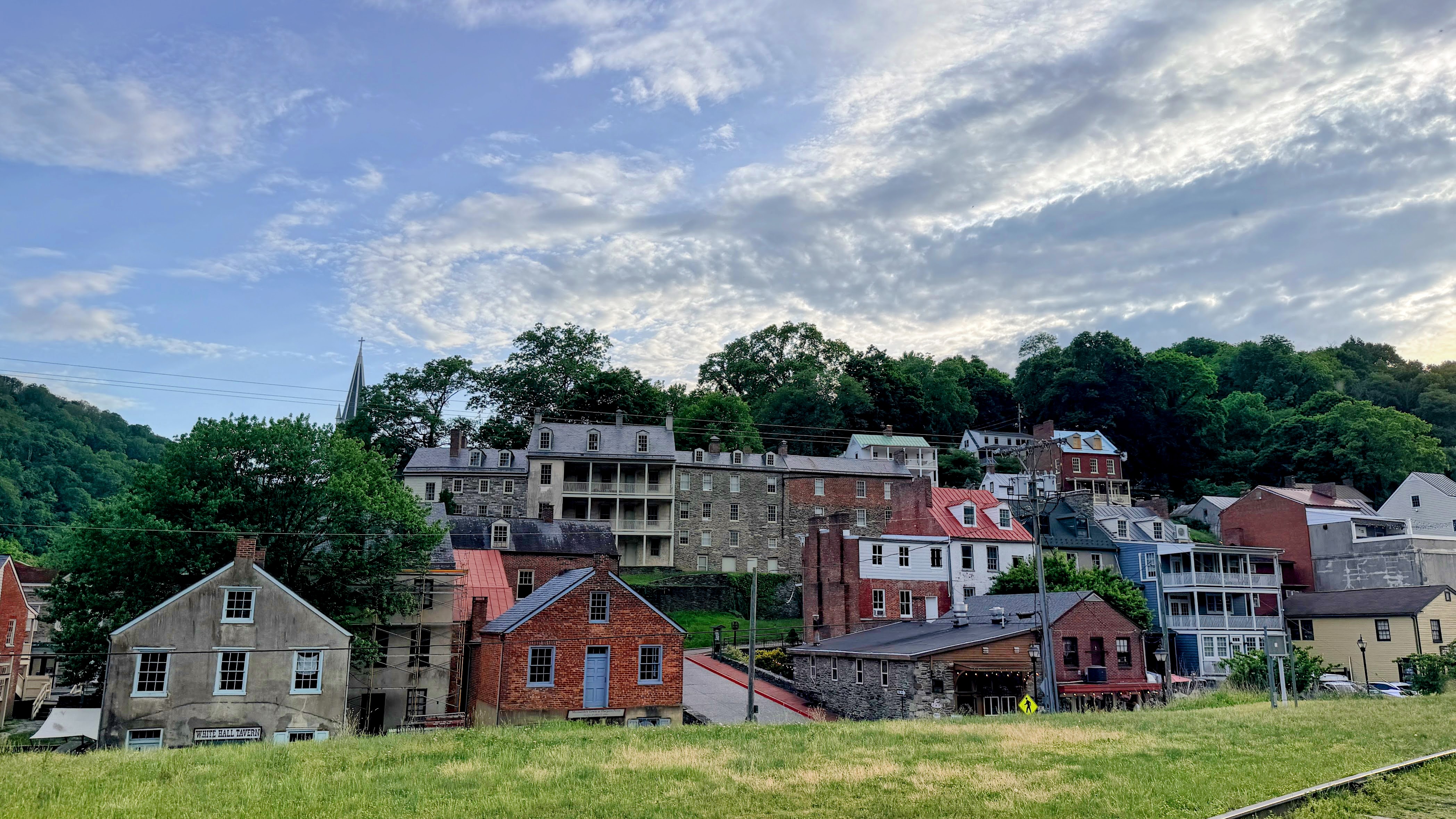
Our wonderful drive along the backroads landed us next in Harper’s Ferry, West Virginia… one of those places where canals, railroads, Civil War history, rivers, bridges, and tunnels all overlap in a very compact landscape. What a fascinating location to explore!

Set where the Potomac and Shenandoah Rivers meet, the town is interesting even before you learn its history. Walking the narrow streets and climbing the hills, it is easy to imagine the tension and activity that once filled this small town. Harper’s Ferry was the site of John Brown’s 1859 Raid, an event that helped push the nation toward the Civil War.
What was John Brown’s Raid?
John Brown’s Raid was one of the most dramatic events leading up to the Civil War. In October 1859, Brown, a fierce abolitionist who believed slavery was morally evil, led a small group of followers to Harpers Ferry. His goal was bold and radical: seize the federal armory and weapons there, arm enslaved people, and spark a widespread slave uprising throughout the South.
Brown and about 20 men captured the armory and cut telegraph lines, hoping enslaved people in the surrounding countryside would join them.
But the uprising never materialized the way he expected because the local militia surrounded the raiders, and townspeople and soldiers exchanged gunfire with Brown’s group. Several people were killed, including two of Brown’s sons.

Brown and the remaining men took refuge inside the small brick engine house, later nicknamed “John Brown’s Fort.” The standoff ended when U.S. troops stormed the building under the command of then-Colonel Robert E. Lee.
Brown was captured, tried for treason against Virginia, murder, and inciting slave rebellion, and was executed on December 2, 1859. What made the raid so important was its effect on the country because many in the North admired Brown’s willingness to die fighting slavery, even if they disagreed with violence.
Many in the South were terrified, believing more slave uprisings could happen, and the event deepened the already severe mistrust between the North and the South.

Brown became a symbol: to some, he was a martyr for freedom; to others, he was a dangerous extremist. Historians often describe the raid as one of the final sparks that led to the American Civil War just 18 months later.
This is a link to the song “John Brown’s Body,” which I remember from when I was a kid!
Harper’s Ferry National Historical Park felt really unusual compared with other national parks or battlefields we have visited. Instead of being centered around one monument, visitor center, or scenic loop, Harper’s Ferry is really a collection of interconnected places spread across the town, the rivers, the heights above, and even into neighboring states!
The experience unfolded in pieces that we did over two half-days. There was a lot of walking, climbing, and discovering involved as we wandered through layers of American history!


Meriweather Lewis

This was a surprise!!! We connected John Brown’s Raid and the Civil War with Harper’s Ferry, but now we have discovered the important connection to Meriwether Lewis!
Before the famous expedition west, Lewis came to Harpers Ferry in 1803 because the town was home to the federal armory — one of the young nation’s key centers of manufacturing and engineering. At the Harpers Ferry Armory, Lewis obtained and supervised the production of specialized equipment for the expedition, including rifles, pistols, knives and tomahawks, scientific instruments, ironwork, and repair tools.

Lewis also arranged for the construction of a collapsible iron-frame boat designed for river travel in the West. Much of the expedition’s practical preparation happened here before Lewis headed down the Ohio River to meet William Clark.
This gave Harpers Ferry an unexpected place in the story of American exploration: industrial innovation, westward expansion, military history, and abolition and Civil War history! All layered into one small town at the meeting of the rivers.
It is fun to imagine Lewis walking these same narrow streets, gathering supplies for a journey into territory Americans barely understood!
The old brick buildings, church steeples, railroad tracks, and mountain views create a setting that makes it easy to imagine the lives of the people who lived through such divided and difficult times.

The town was filled with museums. Within the historic Lower Town of Harpers Ferry, the National Park Service owns most of what visitors think of as “Harpers Ferry” — the historic streets, museums, John Brown’s Fort area, and many surrounding slopes. The Town of Harpers Ferry itself is tiny — only about 0.6 square miles. Harpers Ferry National Historical Park is much larger — about 3,600+ acres spread across West Virginia, Maryland, and Virginia.
So we walked around town to check out as many museums as we could. Fascinating… but it was a hot day for this area (90 degrees), and at times we ran into school groups. We discovered that flooding is not an uncommon problem here! Look at the vertical bar showing water depth during various floods!


An excellent film gave us a nice background, and after finishing the town sites, we headed out for a hike through the Virginius and Hall’s Islands to see the ruins of mills, homes, and canals. It was a cool and delightful walk (except for that very long snake in the middle of the path!)

And we discovered we were not alone in the woods!! These three kept an eye on us!


Our B and B!!

We were very fortunate to get a room at the Stonehouse B&B…it is the only bed-and-breakfast in Harpers Ferry’s historic Lower Town… which made it really handy for walking around and parking our car!

The stone house was built in 1839, a couple of decades before the Civil War, when Harpers Ferry was a bustling industrial and transportation town centered on the federal armory, canals, railroads, and river commerce. The house would have been standing during some of Harper’s Ferry’s most dramatic years — including John Brown’s raid in 1859 and the Civil War occupation and destruction that followed.
As a lodging business, however, the B&B is much newer. The current inn opened in 2011, and its history notes it as an ‘adaptive reuse of the old 1839 structure’ rather than a continuously operating inn.
Many historic sites tell one story. Harper’s Ferry feels like it tells the whole complicated American story in miniature. After driving through the back roads of Virginia and the Carolinas, arriving here, where the rivers cut through the mountains and the old brick town sits on the cliff, it was our pleasure to explore, discover, and become educated in situ!
As usual, I took too many pics of things I would like to review or remember! Many are in this video: