
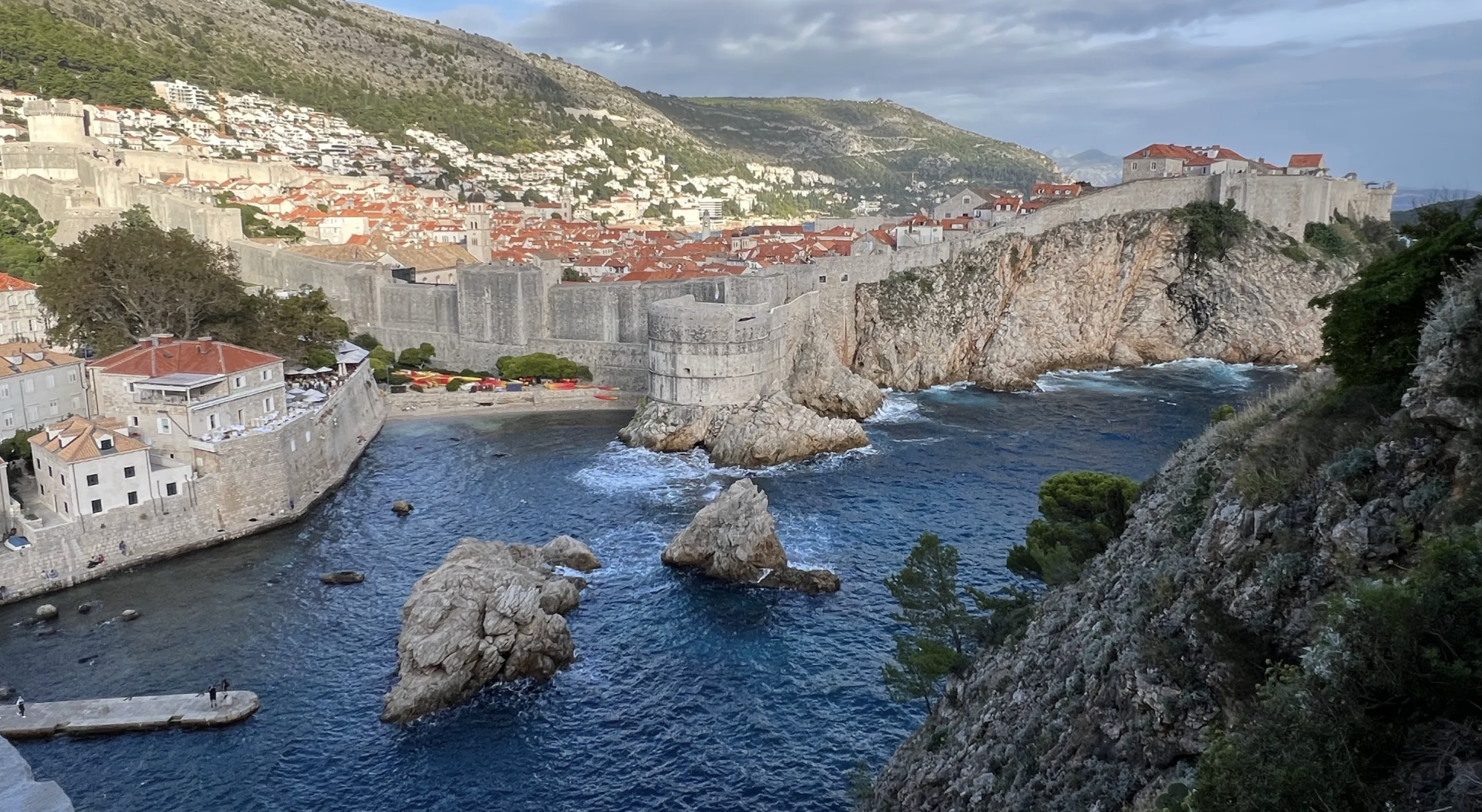
Because of the pandemic, we weren’t sure this trip would happen—even up until just a couple of weeks before departure. But with our booster shots in place and full confidence in our tour company, Overseas Adventure Travel (OAT), we were excited to resume international travel.
This time, we’re heading to a part of the world we’ve never explored before: the Balkan Peninsula. While we do have some personal connections—a friend who served in military leadership there during the Balkan Wars of the 1990s, and our doctor who is originally from Kosovo—most of what we know comes from books and articles.
And so… our new adventure begins!

Often referred to simply as “the Balkans,” the Balkan Peninsula is a geographical and cultural region in southeastern Europe. It takes its name from the Balkan Mountains, which stretch approximately 557 kilometers from the border between Serbia and Bulgaria to Cape Emine on the Black Sea coast. The word “Balkan” comes from a Turkish term meaning a “chain of wooded mountains.”
After the Allied victory in World War II, Yugoslavia was reconstituted as a federal socialist republic known as the Socialist Federal Republic of Yugoslavia (SFRY). Its internal borders divided populations along ethnic and cultural lines—a source of tension from the start. Under the leadership of Josip Broz Tito, Yugoslavia maintained a delicate balance both within its diverse population and between the global powers of the U.S. and the Soviet Union.
Following Tito’s death in 1980, that fragile balance began to unravel. By the 1990s, the region was engulfed in what became known as the Balkan Wars or Homeland Wars, as constituent nations sought independence from the federation.
Today, we’re visiting many of those newly independent countries—each with its own complex and compelling history.

We explored 6 present-day countries of the Balkans: Croatia, Slovenia, Montenegro, Bosnia and Herzegovina, Serbia, and Albania.
September, 2021, Traveling with Overseas Adventure Travel