
Istria: The Head of the Dragon!
We traveled 8 hours north to the “head of the dragon!” Istria is a wedge-shaped peninsula in northern Croatia. Many medieval towns are located in this area, along a scenic road that winds through vineyards and fields.

Plitvice Lakes
Along the way, we stopped at the famous 𝙋𝙡𝙞𝙩𝙫𝙞𝙘𝙚 𝙇𝙖𝙠𝙚𝙨, a 114-square-mile national park with 16 turquoise lakes linked by waterfalls and cascades. The upper and lower lakes have 440 ft. of elevation between them.


This natural wonder has been a UNESCO Heritage site since 1979. We took a 2.5 hr. walking tour along the water’s edge with a local guide who grew up here. It would be hard to find a more peaceful and beautiful place!
Opatija
First of all, the pronunciation!!! It is uh·PAH·tuh·yuh The Croatian letter “J” is pronounced like the English “Y.”
This lovely city is located in the Kvarner Gulf which separates the Dalmatian coast of Croatia from the area called Istria. This area is located just south of Trieste, Italy, and definitely feels Italian, as do the people who also speak Italian (and who have tried to leave Croatia and become part of Italy!)

This is a beautiful town surrounded by landscaped parks and gardens dotted with Hapsburg-era grand villas and elegant facades. This has been a destination for wealthy European aristocrats, dignitaries, and artists since the mid-1850s. Modern-day Opatija began then, when a wealthy merchant built the Villa Angiolina. Other wealthy families, including aristocrats, soon built vacation villas there. We could see these stately summer homes all around town.
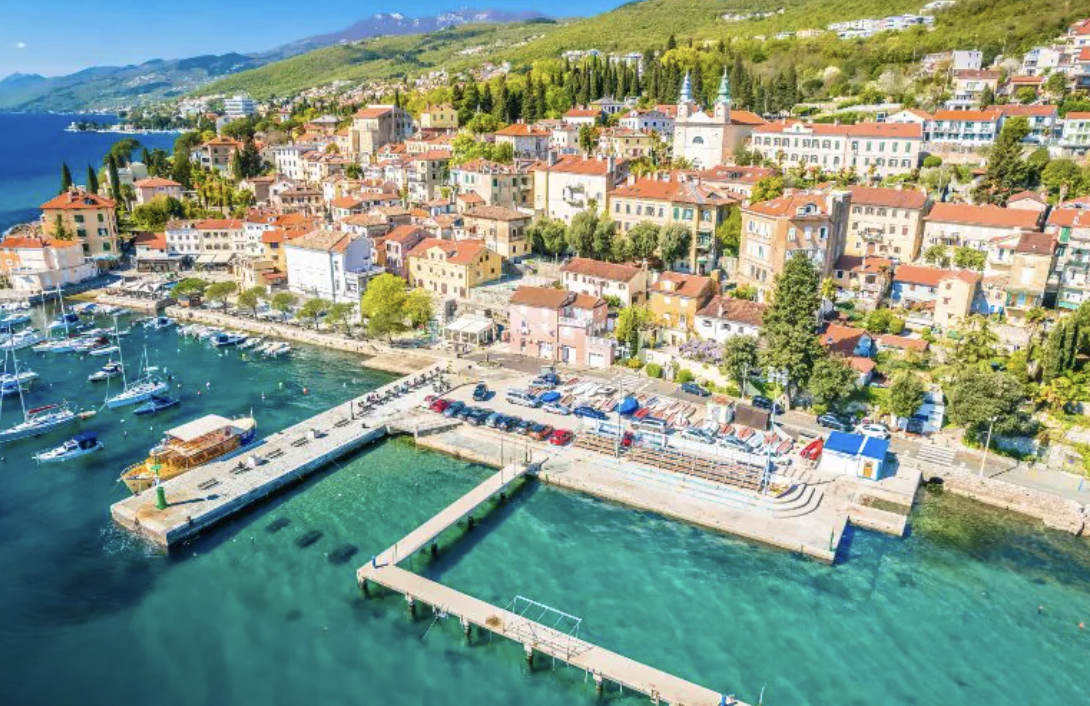
Although we had a drizzly, cloudy day, we walked along the Lungomare (not all 7+ miles!), a promenade that snakes along the coastline. It was impossible to get a good picture….so this is what it would look like on a clear day!

Motovun
We visited the medieval town of 𝗠𝗼𝘁𝗼𝘃𝘂𝗻, a captivating walled town perched on a 277 meter hill in the Mirna River valley. It was fortified in the 14th century by the Venetians and within the double walls we found a cluster of Romanesque and Gothic buildings housing a smattering of artist studios, restaurants, and tourist-oriented shops.

We hiked around the town with a local guide, using our “whisperers” to hear. The hills are steep, and group members don’t walk at the same pace, so these devices have been great for hearing “aides” for the group to still hear our guide.


Of course, we can’t seem to go anywhere without tasting the delights of the area. In this shop, we were treated to regional wines, cheeses, and truffle treats!


The damp, dark 𝙈𝙤𝙩𝙤𝙫𝙪𝙣 𝙁𝙤𝙧𝙚𝙨𝙩 at the base of the town contains a hidden treasure…..Istria’s famous 𝙩𝙧𝙪𝙛𝙛𝙡𝙚𝙨. During the fall and winter, there are said to be some 12,000 dogs wandering the Istrian forests sniffing around for this expensive delicacy…..one of which has been entered into the World’s Book of Records as the largest truffle ever found. We had a demonstration by a “truffle hunter” and his dog to show how they work together to search for the truffles during the season.

Buzet
Our last stop in the Istrea region was in 𝗕𝘂𝘇𝗲𝘁, a family-run rakija distillery called Aura. Rakija (which we have found ALL over!) is a traditional fruit brandy popular in the Balkans and southeastern Europe. It is made by distilling fermented fruit and typically has a high alcohol content, ranging from 40% to 60% alcohol by volume. Powerful stuff!!!

Here we learned about the process of making traditional brandies and jams from local plants and fruits. More tasting, of course!!
September, 2021, Traveling with Overseas Adventure Travel