
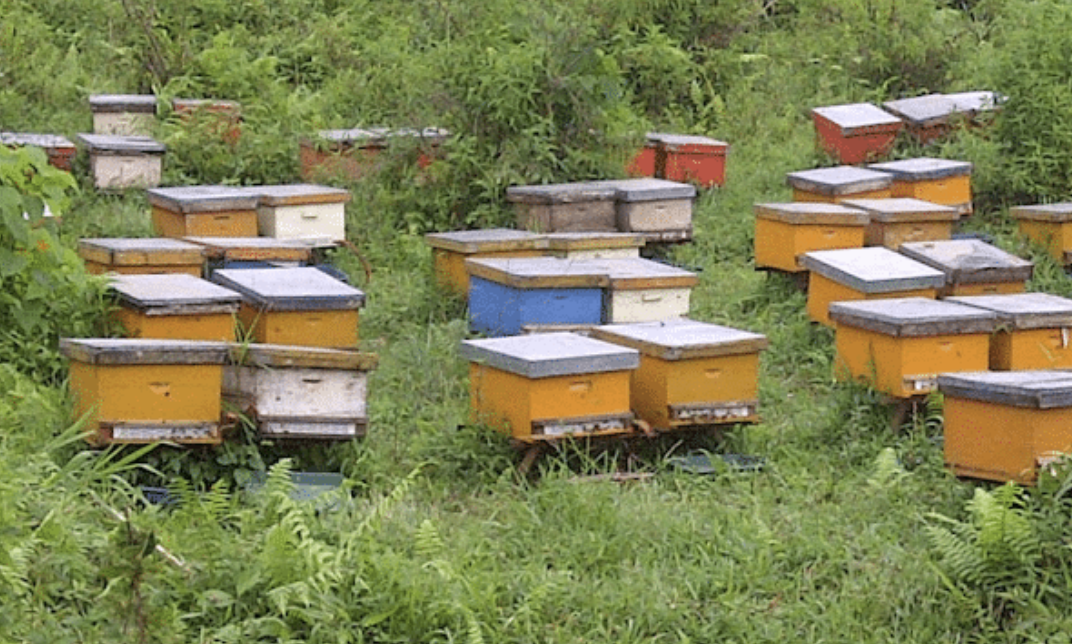

This was a delightful adventure—a day spent at a honey bee farm! The wild thyme and fir flowers native to this remote region of Greece produce exquisitely sweet organic honey, treasured since ancient Greek times. That rich tradition lives on today, and we had the opportunity to learn not only about the bees but also about the family dedicated to keeping them thriving.
The “Bee Presentation”

Before donning our protective gear, it was really enlightening for many of us to learn more about these fascinating creatures called honey bees. Here are a few of the facts we learned, or were reminded of:
Their complex Social Structure: Each colony consists of a single queen, thousands of worker bees (all female), and a few hundred drones (male bees).
The Role of the Queen: The queen bee is the only reproductive female in the hive. Her main job is to lay eggs, up to 2,000 per day. She also produces pheromones that regulate the behavior of the hive.
Worker Bee Tasks: Worker bees have various tasks depending on their age, such as cleaning the hive, feeding larvae, producing wax, and foraging for nectar and pollen.
Honey Production: Bees make honey by collecting nectar from flowers, which they store in their honeycomb pouches (like little backpacks on their hind legs!). They evaporate the water content by fanning their wings, turning the nectar into honey, which serves as food for the colony.
Communication: Honey bees communicate through a “waggle dance.” This dance tells other bees the direction and distance of food sources.
Lifespan: Worker bees live for about 6 weeks during the busy summer months, while drones live only until they mate with a queen. The queen can live for several years, up to 5 years in some cases.
Stinging: Only female worker bees can sting, and they die after stinging because their stinger gets lodged in the skin. The queen can sting multiple times without dying, but she typically only uses her sting to fight rival queens.
Colony Collapse Disorder: This is where most worker bees in a colony disappear, leading to the collapse of the hive. The exact causes are still being studied, but factors like pesticides, diseases, and habitat loss are believed to play a role.
Face Recognition: And the most astonishing to us: honeybees can recognize human faces! Despite their tiny brains, honeybees have a process to recognize patterns, which is similar to how humans recognize faces. They learn to associate specific arrangements of facial features (eyes, nose, mouth) with a particular individual!
Wow…it was time to get to see the bees close up…so the group climbed into our protective gear!

The boxes that bees live in, beehives, are specially designed structures used to house honeybee colonies.

Modern beehives mimic the bees’ natural habitat but are built to make honey extraction, hive management, and colony monitoring more efficient. It consists of stacked rectangular boxes with removable frames. Each box holds frames where bees build their honeycomb and store honey.

The removable frames within each box are spaced so bees can move freely between them, allowing bees to build comb naturally while making it easy for beekeepers to inspect the hive, harvest honey, or conduct maintenance. This design helps reduce damage to the bees’ work when honey is harvested and keeps the colony structure intact.
We wore the suits because he brought the frames right to us for close observation!

The idea of bees stinging was brought up…and we learned a few more things!
- Bees sting primarily as a defense mechanism to protect themselves or their hive from perceived threats. When a bee feels threatened, it may use its stinger to inject venom into the attacker.
- When a bee stings, it releases alarm pheromones that alert other bees in the colony to the danger. This can lead to a swarm response where multiple bees sting the perceived intruder to defend the hive.
- Honeybees die after stinging because their barbed stinger gets stuck in the skin, tearing part of their abdomen when they fly away. In contrast, other bees, like bumblebees, can sting multiple times without dying because their stingers are not barbed.
The demonstration was followed by some honey tasting, a cooking demonstration on the making of pita bread, and a delicious lunch!


Then….we could not leave without purchasing some of the delicious honey!!! We loved this place…not only are they into the bees, but maintaining the region’s cultural heritage and making sure the industry thrives in the modern age.
2024, with Overseas Adventure Travel