
….one of the most intriguing and influential cities of the ancient world
Athens, the capital of Greece, has a metro population of about three million, making it the country’s largest city.

Fortunately, our hotel was located within walking distance of “Ancient Athens”, which is only a few square miles in diameter. Ancient Athens was our focus….the countless historic ruins that trace thousands of years of Athenian culture.
The Acropolis
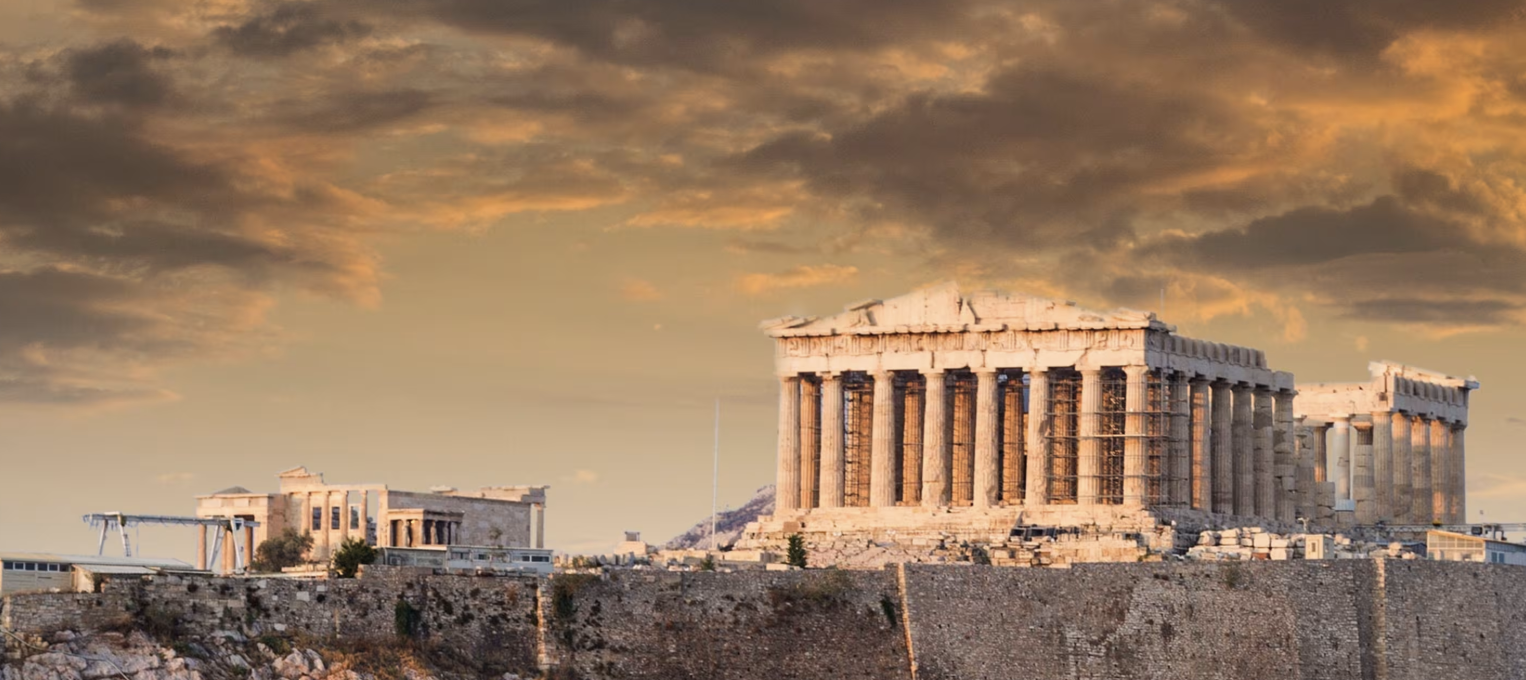
One’s heart kind of skips a beat upon seeing the Parthenon perched atop the Acropolis! The Acropolis of Athens is one of the most iconic and significant ancient sites in the world! Its name, derived from the Greek words “akron” (high) and “polis” (city), refers to its elevated position and central role in Athenian society. The famous mount is visible from almost anywhere in central Athens.

The Acropolis served not only as a fortress in times of war but also as a religious center and a symbol of the power, wealth, and culture of Athens during its Golden Age. It remains a powerful symbol of ancient Greek civilization and a UNESCO World Heritage site.
The temples and altars scattered across the Acropolis reflect its significance as a place of worship and civic pride, where the divine and human realms intersected. It includes several buildings from the 5th century BCE: The Parthenon, Erechtheion, Propylaea, and Temple of Nike. Despite the crowds and scaffolding, we tried to get a feeling of the layout and architecture of each of these sites.
Parthenon on the Acropolis
The Parthenon is the most iconic structure on the Acropolis and one of the greatest masterpieces of ancient Greek architecture. Constructed between 447 and 432 BCE, the Parthenon was dedicated to Athena, the patron goddess of the city, and symbolized the power, culture, and wealth of Athens at the time.

The Parthenon we see today was not the first. An early version was destroyed by the Persians in 480 BCE. The current Parthenon, along with many of the other structures on the Acropolis, was initiated in the mid-5th century BCE during the Golden Age of Athens.

Over the centuries, the Parthenon has undergone numerous transformations, serving as a Christian church, a mosque, and even a gunpowder storage during the Ottoman period. In 1687 CE, the building was severely damaged by an explosion during a conflict between the Venetians and the Ottomans.

Built in the Doric order, the Parthenon’s design is marked by its harmonious proportions and architectural precision. Its massive colonnade, consisted of 46 outer columns and 19 inner columns, creating a sense of symmetry and balance. The entire structure slightly curved to correct optical illusions and enhance its aesthetic appeal.
Our views were somewhat limited because of the ongoing restoration and preservation efforts. The Parthenon has endured various forms of damage over time: the explosion of 1687, centuries of weathering which have eroded the marble, and corrosion from modern pollution.


In addition, previous restoration efforts used inappropriate materials and methods, which ended up causing more harm than good. Despite this, the Parthenon remains a powerful symbol of ancient Greek culture and Athenian democracy.

We suspect this restoration will be going on for many, many decades! The restoration work is extensive, highly technical, and requires substantial financial resources. With Greece just coming out of their 2008 financial crisis…it is hard to finance large scale projects like this.
Erechteion on the Acropolis
The Erechtheion is a temple dedicated to both Athena and Poseidon. It is famous for its Porch of the Caryatids, the six sculpted female figures that serve as architectural supports. Five of the originals are now housed in the Acropolis Museum to protect them from environmental damage. One also resides in the British Museum.
Constructed between 421 and 406 BCE, it is known for its asymmetrical layout, which was necessary due to the uneven terrain of the Acropolis and the need to incorporate existing sacred sites.

The Erechtheion was believed to mark the spot where Poseidon struck the ground with his trident, creating a saltwater spring, and where Athena’s sacred olive tree stood—a symbol of her victory over Poseidon in their contest for the city’s patronage.

Temple of Athena Nike on the Acropolis
The Temple of Athena Nike is a small structure dedicated to the goddess of victory, symbolizing Athens’ military prowess. Nike is the Greek goddess of wisdom and war and epitomizes victory. The warrior maiden was also the patron, protector, and namesake of Athens.

Propylaea on the Acropolis
The Propylaea is a monumental gateway that serves as the entrance to the complex. Designed to awe visitors as they ascended the sacred hill, the Propylaea is a stunning example of classical Greek architecture, blending grandeur with symmetry and balance.


Odeon of Herodes Atticus on the Acropolis
Odeon means a theater or concert hall. The odeon was designed as a venue for musical performances, festivals, and other cultural events. Its architectural grandeur, with a semicircular seating arrangement and a majestic stage building showcases the blend of Roman engineering with the cultural legacy of ancient Greece.

The theater could originally seat around 5,000 spectators, with its seating area (cavea) built into the natural rock of the Acropolis hill. The odeon was covered with a wooden roof made of cedar, one of the most impressive features of the structure at the time. The arched façade is part of the original structure built in 174 CE. The concave rows of marble seats were added in the 1950s.
The arched walkway dates from 160 BCE. The two-level arcade stretches 535 feet.

Restored in modern times, the theater hosts concerts, operas, and theatrical performances, especially during the Athens and Epidaurus Festival each summer. Renowned artists and performers from around the world have graced its stage, from Maria Callas to Luciano Pavarotti.

This 7.5 acre Acropolis thrived for about 1,000 years until pagan worship was banned during the Byzantine period. It was subsequently seized by the Ottomans (mid-15th century), significantly damaged by the Venetians during the Morean War (1687) and attacked three times in the 19th century. Extensive restoration began in the mid-1970s.
Other Sites around Athens…..
Temple of Zeus
Dedicated to Zeus, the king of the gods, the temple was completed during the reign of Roman Emperor Hadrian in the 2nd century CE. When it was finished, the temple boasted 104 massive Corinthian columns, each standing 56 feet high, making it one of the largest temples of the ancient world. However, it was destroyed during the Sack of Athens in 267 CE and most of the materials were carried off for other construction.


Today, all that remains of the Temple of Olympian Zeus is a cluster of Corinthian columns. Despite its incomplete and ruinous state, the Temple of Olympian Zeus remains a symbol of the enduring legacy of their religious devotion to this most important King of the Gods and father of a dozen Olympian gods.
Hadrian’s Arch
Hadrian was responsible for the completion of the Temple of Olympian Zeus. To immortalize him, a giant sculpture of the Roman emperor was crafted from ivory and gold. The emperor was further honored in 132 CE with this 59-foot triumphal arch.


Acropolis Museum
The Acropolis Museum opened in 2007. The facility is amazing! Walking through the 150,000 square feet of exhibition space is fascinating with every step. The museum is dedicated explicitly to the artifacts and history of the Acropolis of Athens.
The Acropolis Museum houses many artifacts and sculptures that were once part of the temples. More than 3,000 artifacts are displayed on three floors. The relics reflect over 2,500 years of Athenian life, culture and religion.

The glass paneling and elevation of the third floor allowed us to easily see the actual ancient city of the Acropolis….the Parthenon was always in plain sight, only .2 miles away. The floor has the same dimensions and cardinal orientation of the Parthenon to display the entire frieze of the temple…..just as in ancient times. It was as if we were walking around the actual core of the Parthenon.

The metope pictured below, one of the panels removed from the Parthenon, depicts a battle of a centaur versus man. It underwent careful cleaning and restoration and is one of the few displayed at eye level in the gallery.


Among the highlights in the permanent collection are five of the original caryatids (woman columns) from the Erechtheion.


Owl of Athena. The three foot marble statue at the museum entrance dates from the 5th century BC. The sacred owl was a constant companion of the virgin goddess and came to symbolize her infinite wisdom, judgement and insight. The Athenian Owl was the first double-sided coin minted over 2,400 years ago. It gave rise to the expression heads (Athena) or tails (her owl). The owl is also the symbol of Athens.
Before Pericles erected the Parthenon as we know it today, two other temples pre-dated it. The permanent exhibition on level one includes remnants from that archaic period, particularly the enormous ‘poros’ pediment from the Parthenon (an ancient type of architectural and sculptural element made from poros stone, like limestone.)

The Acropolis Museum is consistently rated as one of the best museums in the world. What a fantastic walk through history!
Ancient Agora of Athens
During some of our free time, we walked to The Agora…..one of those places where you can almost hear the echoes of ancient footsteps. Among those ancient footsteps: Socrates who spent much time in the Agora, engaging Athenians in debates and discussions about morality, justice, and wisdom; and the Apostle Paul who preached during his visit to the city, engaging in discussions with local philosophers, including Epicureans and Stoics.

The Agora was the heartbeat of public life — not just a marketplace, but a gathering spot for civic activities, religious festivals, and casual socializing— for over 800 years (600BCE until its destruction by barbarians in 267 CE.) It was rebuilt and again demolished between 580 and 590 CE due to the Slavic invasion. Moving into relatively modern times, the agora was once again rebuilt during the Greek city-state. It is then when excavation began.

The Agora sits just below the Acropolis, but little survives from the classical Agora. The main things that survive are the rebuilt stoa and a well-preserved temple.

These were among the placards at the entrance.

This is a sprawling 30 acres of this amazing archeological landscape.


The Stoa of Attalos, a grand colonnaded building reconstructed in modern times, offers a glimpse into what these spaces looked like back then. A stoa is simply a “temple, or covered walkway for public use.” This Stoa –named for King Attalos II– is now a reconstructed museum and visitor center.


The museum is inside: the collection includes interesting artifacts from the Neolithic period to late antiquity, showcasing the Agora’s development over centuries.


Spolia: In the Ancient Agora, and throughout ancient Greece and other historical periods, it was common practice to use spolia—reused building materials from older structures—to construct new buildings or to restore existing ones. Below, reused materials were used to build a wall as protection against the barbarians.

The Temple of Hephaestus above the Agora: This is one of the best-preserved ancient temples in Greece. It was finished in 415 BCE after 34 years of construction. The project was initiated by Pericles (495 – 429 BCE), a leader of Athenian democracy. This Doric-style temple was dedicated to Hephaestus, the god of metalworking, craftsmanship, and fire, as well as Athena Ergane, the goddess of pottery and crafts.


The structure is made of Pentelic and Parian marble, showcasing intricate friezes that depict scenes from Greek mythology, such as the labors of Heracles and Theseus. It is remarkably intact due to its conversion into a Christian church in the 7th century CE, which preserved it from the extensive damage and repurposing that many other temples experienced. Today, it stands as a testament to ancient Greek religious practices, architectural skill, and their reverence for the gods who symbolized aspects of everyday life and work.
Within the Ancient Agora, the Holy Apostles Church, is the only fully intact structure. Built in the late 10th century and rebuilt in the mid-1950s, the Byzantine church is relatively modern compared to the surrounding ruins.

The church is an excellent example of Byzantine architecture. The exterior is decorated with brickwork and incorporates both classical and Byzantine elements, including re-used stones from earlier structures in the Agora. This is a significant site because of the transition of Athens from its classical pagan past to its Christian Byzantine era.
Wow.!……Our visit to the Ancient Agora provided a brief window into ancient Athens’s day-to-day life and governance, helping to understand the essence of one of the most influential cities of antiquity. It is good that I have written some of this down; even with this it is just too much to understand or remember! I am enjoying history more than ever…but this all seems a bit over the top!!😂😂
Presidential Guards at Unknown Soldier Tomb
We watched the guards change at the Tomb of the Unknown Soldier in front of the Hellenic Parliament Building located in Constitution Square (AKA Syntagma Square).

These two soldiers are part of an elite infantry unit of the Hellenic Army assigned to the Presidential Guard. They are wearing the traditional summer ceremonial uniform; red hat (fez) with the long tassel, pleated kilt, two pairs of white stockings and leather clogs with black pompons attached. Most amazing is their ability to stand perfectly still for an hour without any facial or eye movements. Also amazing….those long slow steps!!
National Archeological Museum
The National Archaeological Museum in Athens is one of the most important museums in Greece and houses an extensive collection of artifacts from various periods of Greek history. We visited this just before our tour ended…which was perfect because it helped bring together so many sites we had seen over the last month. But, not so perfect, in that we were about at the end of our stamina after ingesting so many historic sites over a month-long period through two different countries!

I still can not pretend I remember or understand all we have experienced….I just know I am wiser than when we started the trip! Here are a few of the highlights in this museum:

However, our favorite are the frescoes from the Akrotiri site in Santorini. Akrotiri was the advanced Minoan settlement (1600 BCE) we visited several weeks back, which featured multi-story buildings, sophisticated drainage systems, beautiful artworks, etc.

These are are some of the most remarkable examples of prehistoric Aegean art. They date back to the Bronze Age and showcase the artistic and cultural sophistication of the Minoan civilization. The settlement was buried under volcanic ash after the catastrophic eruption of Thera around 1600–1500 BCE, which helped preserve the frescoes and other artifacts in remarkable condition. The volcanic ash acted as a protective layer, ensuring the vibrant colors and intricate details of the frescoes were maintained over millennia.


The frescoes were created using the buon fresco technique, where pigments are applied to wet plaster, allowing the colors to become a permanent part of the wall surface as it dries. The Minoan artists employed naturalistic styles, vivid colors, and dynamic compositions, emphasizing movement and life. They used mineral-based pigments, resulting in a color palette that included deep blues (from copper compounds), reds, and yellows, giving the frescoes their striking vibrancy.

This museum was really a comprehensive journey through ancient Greek history, art, and civilization, showcasing the country’s contributions to world culture and heritage. I wish I had a comprehensive brain to remember it all!
Plaka Neighborhood
We did a lot of walking through the “Plaka”, a vibrant and historic neighborhood located at the foot of the Acropolis. Plaka is one of the oldest neighborhoods in Athens, known for its charming labyrinthine streets, neoclassical architecture, and well-preserved remnants of ancient Greek, Roman, Byzantine, and Ottoman civilizations. It has been continuously inhabited since antiquity and was once the heart of the city’s commercial and social life.

Today it exudes a relaxed and charming atmosphere, with its narrow cobblestone streets, bougainvillea-draped buildings, and traditional tavernas (restaurants). There are lots of opportunities for souvenir shopping (another NO for us!!) while enjoying views of the Acropolis.


My appreciation for history has undoubtedly deepened with this visit to Athens (I might be catching up to Petie!!!!). One can not help but have admiration for the ancient Greeks’ architectural genius and their enduring legacy. Walking the ancient streets where philosophers like Socrates and Plato once strolled certainly evokes a connection and fascination to the past like I have never felt before. We’re so grateful for the unforgettable memories.
2024, with Overseas Adventure Travel