
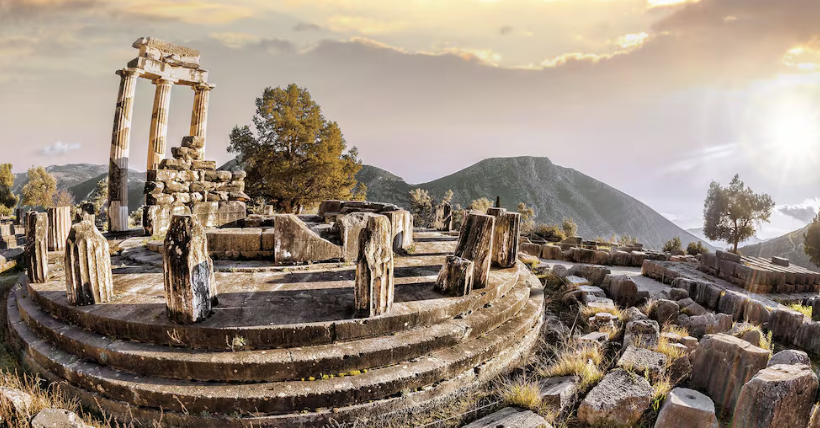
The Oracle of Delphi
I have to admit that the Oracle of Delphi is something I have heard about for many years, but knew nothing about! This was a meaningful and relevant visit…but I still had to do additional research to summarize what I just saw! So first…..the story and the mythology, using some Greek art…..to help:
What is the Oracle of Delphi?
From the 7th century BC until the 4th century AD, the Oracle of Delphi was one of the most significant religious and cultural institutions in ancient Greece, and was renowned for its prophetic powers. The oracle was dedicated to the god Apollo; it was believed that Apollo spoke through the Pythia, a priestess who would deliver his divine messages.

Pilgrims from all over the Greek world and beyond would travel to Delphi to seek guidance on a wide range of matters, from personal issues to important state affairs. She was the “go to” for high ranking officials, as well as the revered “seer” to the common people.
The process of consultation involved the Pythia entering a trance-like state, often described as induced by vapors rising from a chasm in the earth. In this altered state, she would utter cryptic and often ambiguous pronouncements, which were then interpreted by priests.

These responses were highly influential and could shape decisions in politics, warfare, colonization, and religion. The reputation of the oracle was such that even powerful leaders like Alexander the Great sought its counsel.
The Oracle of Delphi remained influential for over a thousand years. Its decline began with the rise of Christianity and the eventual closure of pagan temples by Roman Emperor Theodosius I. He declared Christianity as the only recognized religion while outlawing all Hellenistic temples, worship and customs. The Christians dismantled most of Delphi and finally left in the 7th century. The site lay in ruins until 1892 when a French archeology team began excavation.
Despite its eventual fall, the legacy of the Oracle of Delphi endures as a symbol of ancient Greek religion and the search for wisdom. Even Michelangelo in the 16th century painted her on the ceiling of the Sistine Chapel.

Delphi Archaeological Museum
Our first stop before exploring the archeological site was this amazing museum. This is a treasure trove of artifacts from Delphi’s heyday, and it helped bring the site’s historical and cultural significance into sharper focus before our actual visit.
The museum houses a remarkable collection of ancient sculptures, friezes, and treasures, including the famous Charioteer of Delphi. This bronze statue is one of the best-preserved examples of ancient Greek sculpture; it has a serene expression and fine detailing.

The museum displays an array of offerings left by pilgrims from across the ancient world. These gifts, including gold, ivory, and intricate statues, illustrate how far-reaching Delphi’s influence was. Everything in this museum is what was actually found; no replicas!

The craftsmanship on display is extraordinary. The precision shows the advanced techniques of ancient artisans.


This statue of Antinoos, Roman Emperor Hadrian’s beloved friend, was discovered in 1894, fully intact (well, except for those arms!)


The Sphinx of Naxos (560 BCE), a monumental statue, evokes the mystery and mythological importance of the sanctuary. This was a votive offering at the Temple of Apollo by the people of Naxos, an island in the Cyclades group. It has the head of a woman, the body of a lion and wings of an eagle. In ancient times, sphinxes were considered guardians of tombs and sanctuaries.

The Dancers of Delphi…experts believe this sculpture was located in the inner sanctum of the Temple of Apollo.

The Twins of Argos…Cleobis and Biton…were votive offerings by the city of Argos. (580 BCE)

The museum is filled with other masterpieces from the Archaic, Classical, and Roman periods, including scenes of the gods watching the Trojan War and a nine-statue family monument from the fourth century BC. The craftsmanship on display is extraordinary. The sheer artistry and precision in these works provide a window into the advanced techniques of ancient artisans.
The Archeological Site
The Archeological Site of Delphi on Mount Parnassus is a UNESCO World Heritage Site that draws over 600,000 visitors annually. The site was a religious center and a cultural and intellectual hub.
The Roman Agora is the first set of remains upon entering. Typical ancient Greek city-states had an agora… equivalent to our city squares…a meeting place where merchants set up shop to sell goods and services. This expansive area was the civic and commercial center. When the Romans took control of Delphi in the 4th century, they did some remodeling….which is why it is called the Roman Agora.

Delphi itself was considered the “navel, of the world”, a symbolic center marked by a stone known as the Omphalos. Legend has it that, in his attempt to locate the center of the Earth, Zeus released two eagles from opposite ends of the world. They met in Delphi, the “naval of the earth.”

There are several “treasuries”; Greek city-states built these to commemorate victories and thank the oracle, whose prophecies and advice contributed to those victories. The buildings safeguarded valuables for temple offerings plus housed materials used by visiting embassies. Treasuries here were built by the Athenians, Thebans, Corinthians, and the Syracusans—the great powers of their day.


Approaching the Temple of Apollo, we walked the Sacred Way used by ancient Greeks such as the historian Plutarch, who was a priest of Apollo at Delphi.


The Temple of Apollo was where the oracle was prophesied. This ancient sanctuary was set at the foot of the mountain with a vista over olive groves stretching to the Bay of Itea. Those entering the sanctuary of Apollo in ancient times first purified themselves with the water at a fountain.


According to Greek traditions and writings, five temples were built at Delphi throughout history, all severely damaged or destroyed by fires, earthquakes, and wars.

This 5000 seat theater is the highest point of the Site of Delphi, and overlooks the Temple of Apollo. It held 6500 spectators for events like the Pythian Games (second in importance to the Olympic games, they were held in honor of Apollo every four years). I had to get this pic from the web since we did not have the energy to walk up here….the rugged landscape makes Delphi a bit of a workout on a hot day!
This was an amazing walk through history and I am grateful to have learned more about Delphi. Delphi feels like a mystical place, where where we could try to sense the weight of ancient beliefs and practices. It was not hard to imagine ancient figures, from humble citizens to powerful kings, consulting the Pythia and hanging on her cryptic words. All of this leaves me with a sense of wonder and respect for the ancient Greeks!
2024, with Overseas Adventure Travel