
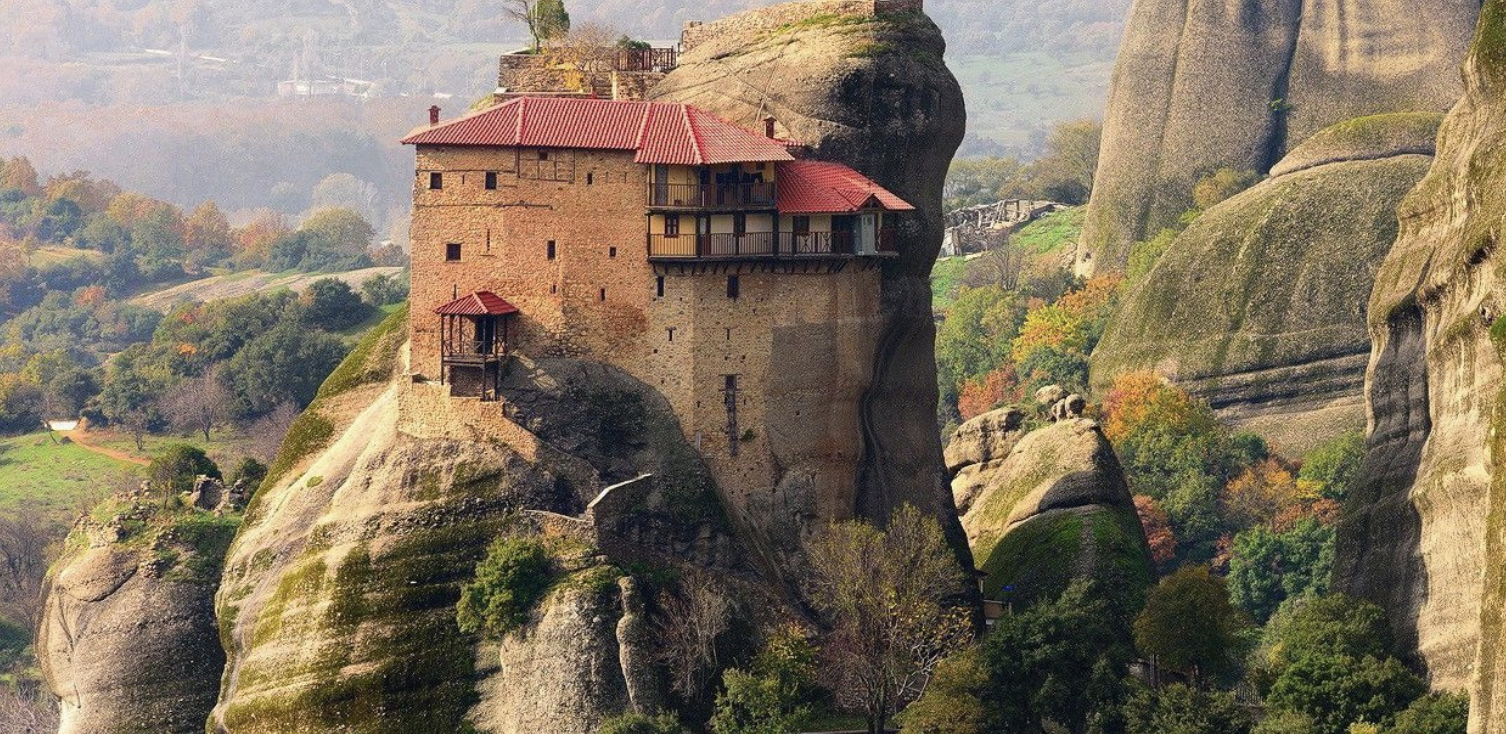
After a week on our small ship, we returned to a land tour, starting with a long bus ride (5 hours) to Kalambaka, a quiet town (@12,000) set amidst a landscape of rocky sandstone pinnacles and plains.

Kalambaka provides unique views of one of our next stops, the colossal rock formations of Meteora.
Battle of Thermopylae
On our way to Kalambaka, we drove by the location of one of the most famous battles in ancient history, the Battle of Thermopylae. It took place here during the Second Persian Invasion of Greece (@480 BCE).

Fought at a narrow coastal pass of immense strategic value, it was a crucial point for defending central Greece. Though vastly outnumbered, the Greek forces mounted a heroic stand.

A small Greek force, made up of roughly 7,000 soldiers, came together from various Greek city-states; the Spartans, famous for their military discipline and prowess, took the lead. The Persian army, determined to conquer Greece, was immense, with estimates ranging from 100,000 to 300,000 soldiers (although modern historians suggest a smaller but still overwhelming force compared to the Greeks.)

Although the Greeks were defeated at Thermopylae, the battle became a symbol of heroic resistance against overwhelming odds. The Spartans’ willingness to sacrifice themselves for the greater good inspired future generations and became central to the Greek identity.
The battle has been immortalized in literature, art, and popular culture, celebrated for its themes of honor, sacrifice, and the defense of freedom. It remains a powerful symbol of resistance and the strength of the human spirit in the face of overwhelming adversity.
Meteora…..Where earth meets heaven
Meteora is a breathtaking UNESCO World Heritage site known for its otherworldly rock formations, and monasteries perched atop towering cliffs.

The name “Meteora” translates to “suspended in the air” or “in the heavens,” aptly describing this dramatic landscape of immense sandstone pillars that rise steeply from the ground.

These geological wonders were formed millions of years ago through seismic activity and erosion, creating a unique and awe-inspiring setting. Below are a few pics from our hotel room.


The history of Meteora dates back to the 11th century when monks seeking solitude and spiritual elevation began to inhabit caves and small shelters within the rock formations. Over time, these early hermitages evolved into monasteries, with construction of the first monastic communities starting in the 14th century.

Access to the monasteries was initially challenging, requiring precarious rope ladders or nets to transport goods and people up the cliffs. The complex was built using ropes, pulleys, and ladders, as there were no easy access routes to the top of the rock. For centuries, monks and supplies were hoisted up by hand, adding to the sense of isolation and spiritual focus that defined monastic life here.


The baskets, sometimes large enough to hold a person, were hoisted by ropes and pulleys, an ingenious method that allowed the monks to haul up heavy stones and other building materials from the valley below.
Later, steps were carved directly into the rock, providing safer access and allowing for the construction of more elaborate monastic complexes.

The monasteries of Meteora became centers of religious devotion and cultural preservation, housing priceless manuscripts, religious artifacts, and vibrant frescoes that depict scenes from Orthodox Christian theology.

Today, several of the monasteries (7) are still active, though fewer monks and nuns reside there compared to the past. With fewer people choosing the monastic life these days…. It is questionable what the future of these amazing structures will be.
We explored two of the six monasteries that are open to the public. Each offered a glimpse into Byzantine-era architecture, religious practices, and stunning panoramic views of the surrounding valleys and peaks.
Varlaam Monastery…the second-largest Monastery


Wow….the spiritual devotion and architectural ingenuity of the monks who built this is amazing! It dates back to the 14th century, when a monk named Varlaam was the first to ascend the rock and establish a small hermitage. The monastery as it stands today, however, was primarily built in 1517 by two brothers, who expanded it into a flourishing monastic community.

It is built in the Byzantine style, and is adorned with exquisite 16th-century frescoes painted by Frangos Katelanos, a renowned iconographer of the period. These frescoes depict scenes from the Bible, the lives of the saints, and martyrdom. We were not allowed to take pictures in the chapel areas…but we snapped these before entering.

The monastery also has a small museum that houses a collection of religious artifacts, manuscripts, and vestments used throughout its long history.


The monastery is still active today, with a small community of monks who continue to live a life of prayer and reflection.
St. Stephens Monastery

Founded in the 14th century, St. Stephen’s Holy Monastery flourished over the centuries, evolving into a significant spiritual center. Despite enduring periods of hardship—including damage during World War II and the Greek Civil War—it continued to thrive.

The monastery has two main churches: one dedicated to St. Stephen, which dates back to the 16th century, and another, more modern Church of St. Charalambos, built in the 18th century.


Unlike many of the other Meteora monasteries, which are inhabited by monks, St. Stephen’s is home to a community of nuns. The nuns maintain the monastery, engage in religious services, and practice traditional crafts, such as iconography and embroidery. We also saw them manning the gift shop!!!
This monastery is known for its beautiful Byzantine-style frescoes and icons. But most importantly, despite the crowds of visitors, it is a place of spiritual reflection and pilgrimage… a peaceful retreat for those seeking a deeper connection with the Orthodox faith.


Oh my, we find these Packer fans everywhere in the world!! In this case, it is one of our fellow travelers, Jim, from Wausau, Wisconsin.
Meteora’s significance extends beyond its religious and historical importance….what a testament to human ingenuity and endurance!


Home Hosted Dinner Prep Work!
In preparation for our home-hosted dinner, we had a few Greek lessons from our guide Effe!! Since I have zero facilitation with language, I am going to have to depend on Peter for communication with our host family! This is one time I can say, with a straight face, it’s all Greek to me!!!


Our Home Hosted Dinner
Such fun we had tonight! Our large group (19) split into three groups, with each small group visiting a local home for dinner and conversation. A local taxi service took us through very narrow and winding streets to a home in Kastraki, a village of about 3,000 people.
Our hosts were Gabrielle and Hari. Gabrielle, originally from Argentina, is a housewife, and Hari is a Jack-of-all trades, from builder to tour guide. They both speak at least three languages.

Their lovely home was built into the base of one of Meteora’s immense rocks. Hari built the home himself, starting with an abandoned winery.

We started with a homemade pre-dinner drink in the living room, where one wall was the rock you see above! The drink contained Raki, a spirit made from twice-distilled grapes and aniseed (like we had many times in a previous trip to the Balkan Peninsula!!)


Dinner was delicious and our conversation allowed all of us to come away feeling more informed about Greece and their everyday life.
They have a solid connection to their traditions and a fantastic flair for hospitality. The OAT Home Hosted dinners are really valuable in getting to know the people, not just the location of an area.


They seem to embrace a relaxed Mediterranean lifestyle of food, socializing and leisure. Even after we left @ 8:30pm, they were going out to meet friends!
Meteora….. is undoubtedly one of the most unique and awe-inspiring places in the world we have visited!

2024, with Overseas Adventure Travel