
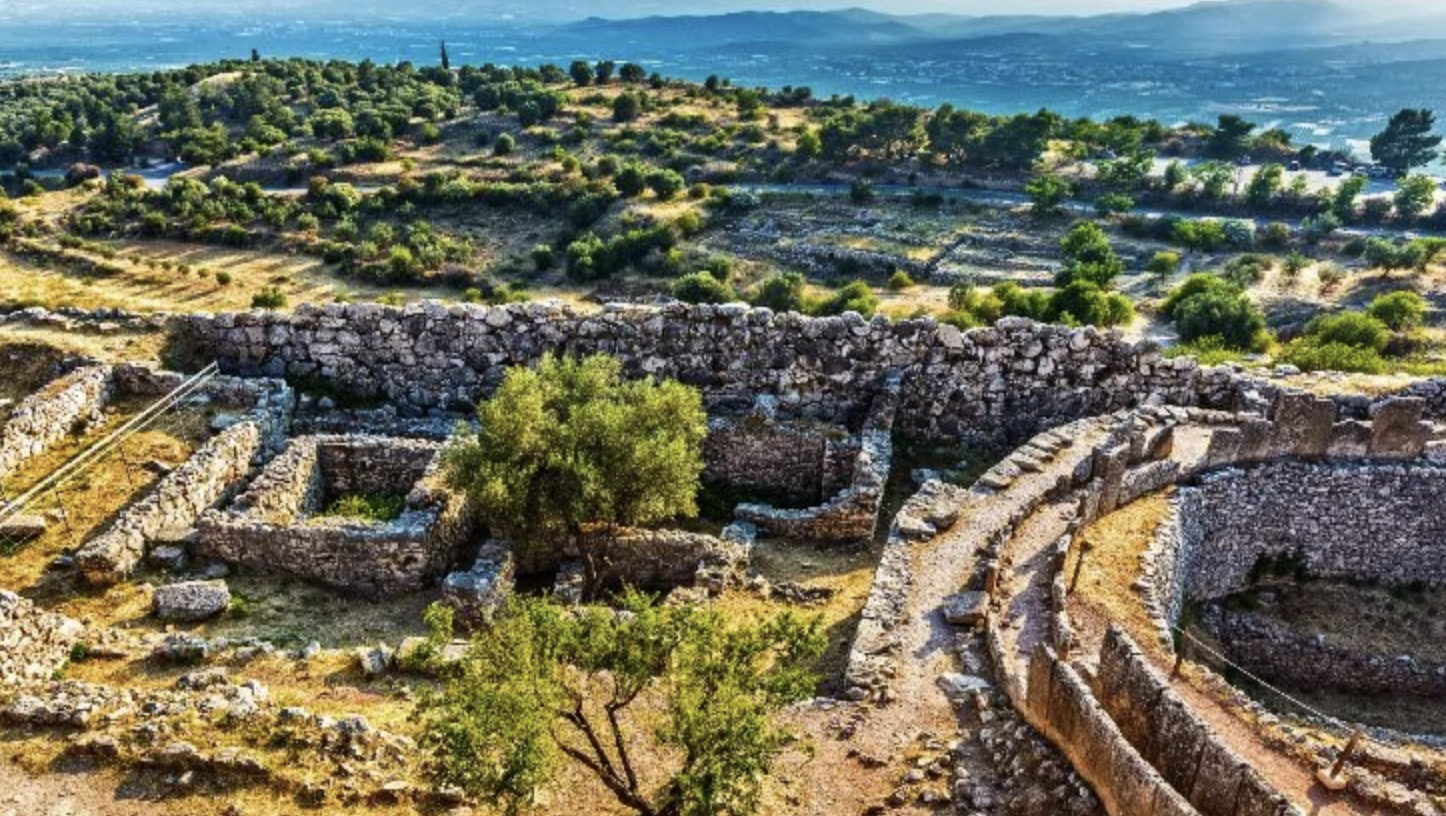
Mycenae, one of the most significant archaeological sites in Greece, is known as the center of the powerful Mycenaean civilization that flourished between 1600 and 1100 BCE…..a thousand years before Athen’s golden age! The entire complex lies in a majestic mountain setting in a valley looking to the sea.
Our first view of Mycenae was the famous Lion Gate, the grand entrance to the fortified city. Carved around 1250 BC, this gate is an iconic symbol of ancient Mycenaean architecture….it features two lions sculpted in stone.

This is Grave Circle A….
This is a series of royal tombs were discovered in the 19th century by the archaeologist Heinrich Schliemann. Mycenaean royalty were buried here. The six rectangular holes (called shaft graves) contained several bodies (19 total—9 women, 8 men, and 2 children). Royals were found embalmed and lying on their backs with their heads facing east—toward the rising sun—indicating a belief in an afterlife.


These tombs contained a wealth of treasures, including gold masks, weapons, and jewelry. The most famous find is the so-called “Mask of Agamemnon,” a gold funerary mask that was once believed to belong to the legendary king himself. Although this identification has been questioned, the discovery highlights the richness and power of Mycenaean royalty.

Beyond the gate lies the ancient palace complex, which was once a hub of administrative and political power. The remains of the royal residence, storerooms, and workshops reveal the advanced nature of the Mycenaean society.

The ruins of the city offer a glimpse into the grandeur and complexity of ancient Greek culture, with its impressive walls, tombs, and monumental architecture.


The Treasury of Atreus, also known as the “Tomb of Agamemnon,” is another remarkable structure. This beehive-shaped tomb, built around 1250 BC, showcases the engineering prowess of the Mycenaeans with its massive stone dome and precise masonry. These tombs tombs were where Mycenaean kings were buried with their weapons and enough food and drink for their journey to the underworld.

Although no treasure was found inside, the tomb’s monumental size and design make it one of the largest and most impressive burial structures of its time.

Being inside reminded me of the time in Egypt when we climbed into one of the pyramids!

From the museum….


Modern historians are still trying to figure out who the Myaceans were and what happened to them! They apparently had contacts with the Minoan people of Crete, from whom they adopted aspects of religion and the arts. Around 1200 BC, they likely attacked Troy. Troy fell, and the Mycenaeans became the rulers of the Aegean…. And soon after disappeared!


Rick Steeves book on Greece mentions that Ancient Greek tourists visited the dramatic ruins of Mycenae and concluded that the Mycenaeans must have been the heroes who’d won the Trojan War (as related in Homer’s Iliad and the Odyssey.). They thought of the Mycenaeans as their ancestors, the first “Greeks.”
The next four centuries saw Greece fall into the Dark Ages. Then, in 1876, German archaeologist Heinrich Schliemann excavated this site and it comes alive to us today! This was a nice trip into some pre-history…but I really have to work on putting together a timeline of all the history we have seen…. The BC’s and BCE’s are running together🥲🥲
2024, with Overseas Adventure Travel