
Walking Tour
Latvia’s capital, Riga, is one of Europe’s best showcases of Art Nouveau architecture. About a third of the city’s central buildings were built in this ornate style around the turn of the 20th century (1890-1910), when Riga was booming as a major port of the Russian Empire (so it flourished!). Riga now has the highest concentration of Art Nouveau buildings in the world—about 800 structures—making it a unique architectural treasure.

Architects experimented with flowing lines, floral motifs, and sculpted human faces on facades, creating entire streets that look like open-air museums. Riga’s Art Nouveau is so significant that UNESCO recognized it as a key reason for listing the city’s historic center as a World Heritage Site.

Our guide today was Vesma, and she started the tour in Riga’s Art Nouveau district. Vesma explained that there are three types of Art Nouveau we should be looking for:
1. Eclectic / Decorative (Ornamental) Art Nouveau – the most dramatic: the Facades are highly ornamented with sculptures of faces, animals, masks, and mythological figures. There are lots of curves, garlands, floral patterns, and details that almost overwhelm the surface. It is designed to impress — Riga’s wealthy merchants and industrialists commissioned these to show status.
2. Vertical / Perpendicular Art Nouveau: This is more restrained, elegant, and common in apartment buildings around the city center. The emphasis is on tall windows, vertical lines, and symmetry rather than heavy decoration. They look simpler, focusing on structure over sculpture, giving a stately, dignified appearance.
3. National Romantic Art Nouveau: This is Latvia’s unique version, developed in the early 1900s and inspired by Latvian folklore and nature. It uses natural stone, wood, and folk motifs, and the buildings look heavier and more rustic, with less external ornamentation. They often feature earthy tones rather than bright colors.
As elsewhere, the Art Nouveau movement in Riga was driven by a desire to express greater individuality, with a touch of local flair, while creating a more rational form of architecture than was prevalent in the 19th century.


What an absolute pleasure to walk the streets of this city!! This is a short video from our walk, during and after seeing the Art Nouveau:
Museum of the Occupation of Latvia
The Museum of the Occupation of Latvia… a sobering and powerful experience. The museum traces the country’s turbulent 20th century, when Latvia endured occupation by both the Soviet Union and Nazi Germany.


Personal stories, photographs, and artifacts brought the harsh realities of those years into sharp focus.


The displays were arranged chronologically through the occupations, from the mass deportations of Latvians to Siberia, to the persecution of the Jewish community under Nazi rule, and finally the decades of Soviet domination.

Especially haunting were the sections devoted to the stories of those who never returned from exile, their names and faces preserved in testimony. Documents, letters, and belongings make the suffering deeply personal.


The museum is not only about tragedy — it is also about resilience. Exhibits highlight the Latvian spirit of resistance, from underground movements to citizens’ roles in the Singing Revolution that eventually restored independence. Videos and interactive displays make evident the determination of ordinary Latvians to shape the nation’s return to freedom in 1991.

This was yet another example of a museum helping us develop a deeper understanding of how history scarred the Baltic people, but also how courage and unity brought them through. Another place that was not easy to visit… but essential for our understanding.

Organ Concert at Church
We enjoyed an organ concert in Riga’s Lutheran Cathedral, the home of one of the world’s most famous historic organs. The organ was originally built in the 19th century and restored to preserve its majestic sound.


The organ is one of the largest and most renowned instruments in Europe. Originally built between 1882 and 1884 by the famous German firm E.F. Walcker & Sons, it was the largest organ in the world at the time of its completion.

With more than 6,700 pipes, the organ is capable of producing a breathtaking range of tones — from delicate, flute-like whispers to thunderous, room-shaking chords.
As the music began, the soaring notes filled the vast Gothic interior, resonating off the high vaulted ceilings and echoing through the stone walls. The power and clarity of the instrument …… It’s as if the building itself were singing.

Sitting among visitors…..it is easy to feel transported — the chance to hear music as it was meant to be experienced….. grand, immersive, and spiritually uplifting. The performance was enhanced by the closed-circuit television system, which allowed us to see the organist playing (the organ is positioned high in the rear gallery, out of direct view). The live video was transmitted to screens placed in the nave.
Relaxing Around Riga!


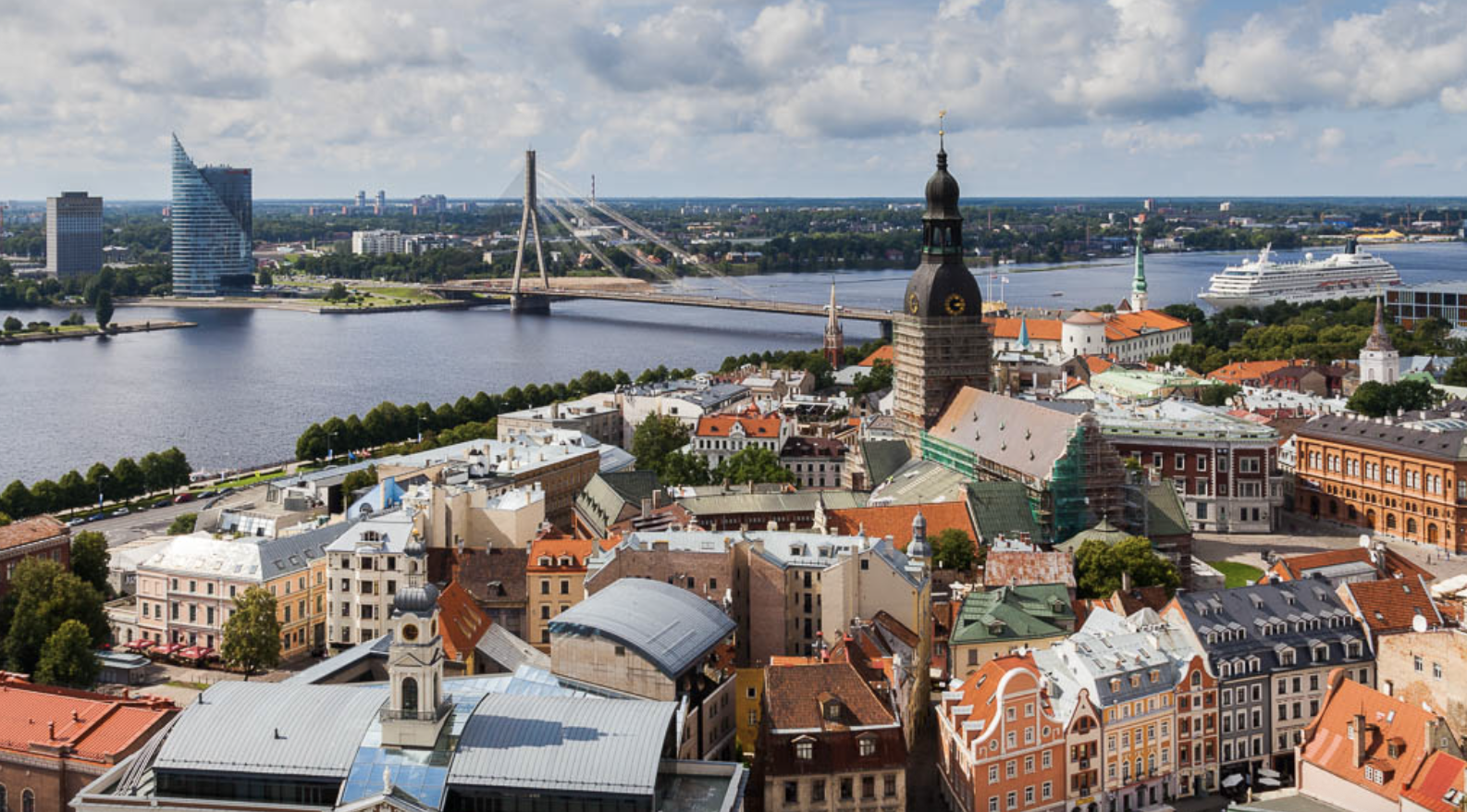
This is the river that runs through Riga… the Daugava River. It is a long river (634 miles) that originates in Russia, flows through Latvia, and empties into the Baltic Sea. The picture above was taken very near our hotel; there were boat rides along the scenic waterway, but unfortunately, we didn’t leave enough time to take one. The river has shaped the city’s trade, transport, and defensive history since Riga’s founding in 1201.