
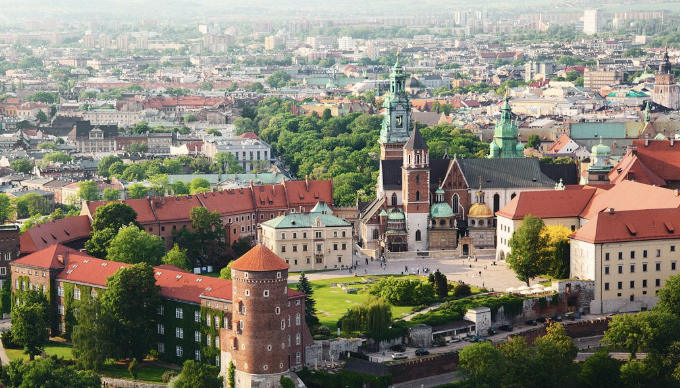
Kraków, Poland’s second‑largest city, sits on the Vistula River and was the royal capital of Poland for centuries. It has a beautifully preserved medieval old town, the grand Wawel Castle, a vibrant Jewish quarter (Kazimierz), and poignant reminders of WWII history. The city is also known for lively squares, and as we were pleased to learn, very affordable food and drink!

Our hotel, the Golden Tulip, was located in the Kazimierz district, the city’s historic Jewish quarter. This was once the heart of Jewish culture in Poland, where synagogues and courtyards held stories of merchants, scholars, and families whose lives were forever changed by WWII. As we came to learn in the days ahead, most all of Kazimierz’s Jews perished in the gas chambers of Belzec and Auschwitz-Birkenau in WWII.

After checking into our hotel room (following 20+ hours of travel), we started exploring the neighborhood in search of dinner. We shared a comforting meal of “Potato Dumplings with Broad Beans & Bacon”, a dish that was both hearty and rooted in tradition.

As we walked back to our hotel, something about the surroundings felt strangely familiar. We soon realized why: we had recently rewatched Steven Spielberg’s Schindler’s List, and much of it was filmed right here in this very neighborhood.

Walking these streets brought the film’s haunting images into sharp reality. The narrow streets, the faded buildings—all of it seemed to carry echoes of lives that once thrived here. Families laughed, children played, and shopkeepers opened their doors each morning. And then, so suddenly, that life was stolen. The days ahead will help us understand more.

The next morning, before meeting members of our travel group, we took a private tour to the…….
Wieliczka Salt Mine

This was a journey into the heart of the earth… a glittering subterranean world where centuries-old craftsmanship meets natural wonder! The Wieliczka Salt Mine, a UNESCO World Heritage Site since 1978, sits just outside Kraków and offers a blend of history, artistry, and geology.
Dating back to the 13th century—and with documentation as early as 1044—Wieliczka has stood as a pillar of medieval Poland’s prosperity. The salt itself was once called “white gold” because it was so valuable; in medieval times, it was as precious as money, since it preserved food before refrigeration. Its significance as a “royal salt mine” underscores how central this mineral was to the Polish Crown… It was an economic powerhouse that once contributed 1/3 of the income to the throne.

Today, this mine is an underground museum! Over the centuries, miners carved out nearly 190 miles of tunnels across nine levels, reaching depths of up to 1000 feet.
On this tour, we explored about 2 miles, through three levels of chambers, and down to about 250 feet below the ground.

Life-size models and dioramas of miners and horses brought the history to life. We saw scenes of miners guiding trolleys, stable areas, and traces of old cart routes.
Horses were integral to transporting salt underground. They pulled trolleys and powered wooden hoisting wheels (treadmills), often spending their entire lives in darkness.


Walking further inside the mine, we found the walls, floors, and ceilings all carved from pure rock salt, often glimmering with a crystalline sparkle. Over the centuries, the miners, who were also artisans, sculpted chapels, statues, and even chandeliers from salt.
One of the most famous is the Chapel of St. Kinga, a vast underground cathedral where every surface—from the altar to the floor tiles—is made of salt! That includes its chandeliers, altar, detailed reliefs such as The Last Supper, and a statue of Pope John Paul II. This is an “underground salt cathedral” with soaring dimensions!


The air in the mine is rich in micro-elements, which are said to be beneficial for respiratory health. In fact, some chambers were used as underground sanatoriums where people with asthma or lung issues could stay and breathe the mineral-rich air.

This mine has centuries of history—over 750 years of uninterrupted operation (until the early 2000’s). Wieliczka’s salt is still edible today, and the mine produces a specialty gourmet salt, though large-scale production ended in 1996.

This wasn’t just an ordinary attraction—this was really a journey into creative ingenuity! Whether carved churches, sparkling lakes, or the miner’s pub, each chamber evoked complete awe at what humans can imagine and create. We have never seen anything like this!!
For dinner tonight, we met our Tour Guide, Maurius, and two other members to learn more about the neighborhood (we will meet the others tomorrow). Among our stops, a local neighborhood pub, where we enjoyed our first taste of Polish Vodka, one of Poland’s cultural treasures!

Vodka has been made in Poland since at least the 8th century, with written records appearing by the 15th century. Poland and Russia both claim to be the birthplace of vodka, but Poles argue their “wódka” came first. Historically, vodka was used not only for drinking but also for medicine and rituals.

Polish vodka is made either from grain (usually rye, wheat, or barley) or potatoes.
To be labeled “Polska Wódka,” it must be produced in Poland using traditional Polish grains or potatoes and local water. No artificial additives are allowed. Traditionally, it is served in small chilled shot glasses.
Poland has a tradition of infusing vodka with fruits, herbs, or spices. Bison grass infused ours!


Our last stop for the day was at a “Milk Bar”. A milk bar in Poland is a no-frills, cafeteria-style eatery that serves hearty, traditional Polish comfort food at low prices. First opened in the late 19th century and later expanded under Communism, milk bars were heavily subsidized by the state to ensure workers and students had access to affordable, filling meals.
Despite the name, they don’t just serve dairy; they also serve simple classics like pierogi, soups, breaded pork cutlets, cabbage dishes, and crepes. Our meal was excellent…Pete had potato pancakes, and I chose the pork tenderloin with cranberry sauce, potato dumplings, and cucumber salad.

Monday, August 18, 2025…….This is the day that our tour ‘officially’ kicks off! We have met all the members of our “pre-trip” group….Sylivana from Miami, John and Joseph from New Jersey, Casey from Milwaukee, and Nancy from Appleton, WI. That makes 7 of us who will be exploring Poland together before we meet the rest of the group in Lithuania.
Listed below are some of our highlights over the next three days, not necessarily in the order we enjoyed them:
Kraków’s Old Town
Kraków’s Old Town (Stare Miasto) is one of the most beautiful and best-preserved medieval city centers in Europe. It’s a UNESCO World Heritage Site and the heart of the city’s history, culture, and daily life. We were able to wander the cobbled streets of Stare Miasto at different times over a three-day period, finding charming churches, historic monuments, bustling market squares, and rich history dating back over 700 years.
Kraków’s Old Town feels alive with history—from medieval traders and Renaissance scholars to WWII memories and modern café culture. Unlike Warsaw, Kraków wasn’t destroyed in the war, so we were walking on streets and seeing buildings much as they were centuries ago.
Kraków’s Central Square
Kraków’s Central Square is the heart of the Old Town and one of the largest medieval town squares in Europe. It has been the social, cultural, and economic center of the city for centuries.

The square was laid out in 1257 after the Mongol invasion, and designed as a massive open space (about 650 feet per side), for trade fairs, markets, and public gatherings. Over time, it became not just a marketplace but the ceremonial and cultural stage of Kraków.

The square has seen coronation parades, uprisings, executions, royal ceremonies, and papal visits (Pope John Paul II being Kraków’s most famous son). Today, it’s a UNESCO World Heritage Site, part of Kraków’s Historic Center. The square was lively, with outdoor cafés, flower stalls, and street performers.


The Adam Mickiewicz Monument….Poland’s national poet, a Romantic writer, political thinker, and symbol of the struggle for independence during the partitions of Poland. His works are central to Polish literature and identity. Although he never lived in Kraków, his importance to Polish culture earned him a monument here.
St. Mary’s Basilica
St. Mary’s Basilica (14th century), one of the city’s most iconic landmarks, is known for its Polish Gothic architecture, rich history, and magnificent interior. We have seen many churches around the world: some were bigger, more ornate, and beautiful. But this one really captured the heart and seemed surprisingly personal. The combination of intimacy, artistry, and history led us to visit the church three times!

The basilica rises dramatically with its unequal towers. The taller one served historically as a watchtower for approaching danger.


The amazing High Altar was carved by a German artist between 1477 and 1489 and is considered a masterpiece of late Gothic sculpture. It’s colossal (13 meters high!), with exquisite detail in every figure. There are over 200 figures depicting scenes from the lives of Jesus and the Virgin Mary.

We have seen the “blue vaulted starry ceiling” in other Gothic churches (Sainte-Chapelle in Paris, Scrovegni Chapel in Italy, and Notre-Dame Basilica in Montreal). The design is intended to transform the building’s interior into a representation of the heavens… Looking up gives the feeling that the church is “heaven on Earth.”
Rynek Underground Museum
Just four feet below our feet on the Old Square is a 4,000-square-meter archaeological site known as Rynek Underground. This is a high-tech museum that explores excavated medieval merchant stalls and provides an opportunity to experience the city’s entire history, from its first settlers to the death of Pope John Paul II. The subterranean excavation began in 2005, after the discovery of various artifacts around Cloth Hall led to speculation about what else might be found below street level.


What they found was a treasure trove of items and remnants that painted a vivid picture of everyday commercial life in Krakow over the past 700 years….merchant stalls and every-day objects, including weights, coins, clothing, and jewelry; preserved stretches of medieval thoroughfares, remnants of a settlement that was destroyed by raiding Tatars in 1241, centuries-old aqueducts, and a cemetery showcasing some of the peculiar burial practices of the 11th century!


This museum showcases a treasure trove of Kraków history, but mixes the artifacts with lasers, smoke machines, holograms, and 3-dimensional models of everyday objects that can be manipulated via touchscreens.


There are long passageways with small nooks and crannies, and small archaeological treasures have been found in most of them, including some skulls estimated to be from soldiers who died trying to defend Kraków from the Swedish Flood in the early 17th century.


We saw stone foundations of merchant stalls that stood in the 12th–14th centuries.


This was a fascinating look into life before Kraków received its charter and the market square was laid out.

We could have spent much more time in this museum. Entrance is limited to 300 at a time, and our tickets were for later in the day, by which point we were out of both time and energy. It is definitely on the list for a return visit if we get back to Krakow! This museum didn’t just show history—it immersed us in medieval Kraków.
Wawel Castle & Cathedral
A new day greeted us with yet another exceptional local guide, fresh sights to discover—and a surprising change in transportation!


Wawel Hill contains Poland’s most important complex of buildings: Wawel Castle and Wawel Cathedral. These two adjacent buildings have been the heart of Polish history for centuries (the Polish version of Buckingham Palace and Westminster Abbey rolled into one!) They are a mix of architectural styles, from Gothic to Renaissance, each layer reflecting Poland’s complex past.

Almost every Polish king was crowned in the Wawel Cathedral, starting in the 14th century. It also became the final resting place for monarchs, military leaders, saints, and cultural heroes, making it both a church and a national pantheon. The line was long to enter the cathedral, so we did not; but l read that entering its crypts is like walking through a condensed version of Poland’s history!

All of these rulers used the adjacent Castle as a residence and added their own architectural details to the building.
The partitioning of Poland in the late 1700’s (when Russia, Prussia, and Austria divided Poland & erased it from the map of Europe for over 120 years!) left the Royal Castle in a state of disrepair. The occupying Austrians used it as a military hospital and even went so far as to demolish several buildings. Restoration began after WWI when Poland regained independence, only for the Nazi Governor-General to make it his headquarters during WWII. Today’s Castle complex is a muddle of styles, including Medieval, Romanesque, Renaissance, Gothic, and Baroque.
Our tour was limited to the castle courtyards and did not include entry to the State Rooms, Royal Apartments, or the vast wealth of treasures within. So…. we missed that glimpse of grandeur of Poland’s kings and queens! But while strolling the courtyards, it was easy to imagine the royal processions that once passed through those stone arches!
Jagiellonian University
We took a quick stop in the courtyard of Jagiellonian University, one of Europe’s oldest and most distinguished universities. It was founded in 1364 by King Casimir the Great and remains Poland’s premier university.


The most renowned graduate is Nicolaus Copernicus, the astronomer who formulated the heliocentric theory.

Other notable alumni include Pope John Paul II and numerous Polish leaders, writers, and scientists.
We finished off our morning tour with a very different kind of lunch! It was called żurek, a traditional sour rye soup (made from a sour rye starter of rye flour and water). The fermentation gives the soup a tangy, slightly sour taste that sets it apart from most other European soups. When it arrived, it wasn’t in a bowl but in a round loaf of bread, its top cut off like a lid, the center scooped out to hold the steaming soup!


The smell was hearty and earthy, with pieces of sausage and a wedge of hard-boiled egg in the broth. We dipped our spoons into the creamy broth and tasted the sour rye base. But… very unfortunately… it was the YUK factor! Neither of us cared for it! This may be a Polish tradition, and I am Polish…but no!
I did enjoy the tea served in this unique cup/pot combination as well as the panna cotta for dessert!


Kazimierz (Jewish Quarter)
This is our last morning in Krakow, and we were fortunate to have a wonderful local docent who took us on a guided walk through two neighborhoods. We started in the Kazimierz district, where she described the period before World War II, when it was a thriving center of Jewish life in Kraków. It was filled with synagogues, schools, and bustling marketplaces. Families contributed to a rich cultural fabric of literature, theater, music, and political activity.

On the eve of the war, Kazimierz was home to about 20,000–25,000 Jews. But when the Nazis occupied Poland, this centuries-old community was uprooted—Jews were forced out of Kazimierz and confined to the ghetto across the river in Podgórze. From there, most were deported to concentration and extermination camps.


The once-bustling quarter became a silent witness to loss and destruction. After the war, only a fraction of the Jewish population returned, and many soon emigrated, leaving Kazimierz neglected and in decay for decades.
Beginning in the 1990s, the district experienced a revival…with restoration projects, Jewish cultural festivals, and renewed international interest breathing life back into its streets. Steven Spielberg played a significant role in drawing worldwide attention to Kazimierz and sparking its renewal with the movie Schindler’s List. He chose to shoot many scenes in Kazimierz, even though the wartime ghetto had been across the river in Podgórze. The atmospheric streets, synagogues, and courtyards provided a powerful backdrop.
Today, Kazimierz has only a tiny permanent Jewish population (@100). What keeps Kazimierz alive Jewishly today are its restored synagogues, the Jewish Community Center, and cultural events like the Jewish Culture Festival, which draws thousands each year. This is a short slideshow of our walk through the neighborhood:
Podgórze Neighborhood
Podgórze is less ‘polished’ than Kraków’s Old Town or Kazimierz, but that’s part of its authenticity. It was founded in the late 18th century as a separate town and became part of Kraków in 1915. Today, it blends quiet residential streets, industrial heritage, WWII history, and new creative spaces.
In March 1941, the Nazis forced Jews from Kazimierz and other parts of Kraków into a walled ghetto here. Over 15,000 people were crammed into a small area designed for only 3,000. From here, most were deported to Płaszów labor camp or to Auschwitz-Birkenau.

Ghetto Heroes Square is the main square of the ghetto, where people were gathered before deportations. Today it’s a memorial: 33 large metal chairs and 37 smaller ones are scattered across the square, symbolizing the possessions left behind and the people’s absence. Unlike statues of heroes or soldiers, this memorial is about absence and loss. It is simple and powerful.
Schindler’s Factory Museum
Today’s visit to the Schindler’s Factory Museum was, not surprisingly, very emotional. The museum is located in the original factory building where Oskar Schindler employed Jewish workers during World War II. The building itself is original — Schindler leased it in 1939 and produced enamelware and, later, munitions under the company name Deutsche Emailwarenfabrik (DEF).

The administrative offices — including Schindler’s own office — have been preserved as part of the museum. The museum is not a factory tour, however. We did not see production lines or machinery from the 1940s. The majority of the museum is a large, immersive historical exhibition about Kraków during the Nazi occupation (1939–1945). It focuses on daily life, the ghetto, the persecution of Jews, and the broader story of the war in Krakow (there are 45 meticulously assembled rooms designed to show what streets, hair salons, train stations, and more looked like in Krakow during this contentious period in history)

Schindler himself appears in the narrative, but he’s not the main focus — he is one of many figures in the wider context of wartime Kraków. The exhibits with photos, films, personal stories, and reconstructed spaces were moving. Included were stories of individual survivors connected to Schindler and others who resisted.
Schindler’s preserved office with his desk and a symbolic installation of enamelware……..


This is one of Kraków’s most powerful museums because it gives a deep, emotional understanding of how the Nazi occupation reshaped everyday life in the city, including the fate of Kraków’s Jewish community.
Throughout the tour, our guide would mention things that led up to such a horrific act as the holocaust…she called them the ‘toolbox of dictators’. This is a summary of some of those things. They seem alarmingly familiar in 2025.
Standing in the very place where Schindler made decisions that saved lives added so much authenticity compared to a traditional museum visit. Truthfully, I was in tears by the end of the tour. I didn’t take that many photos, but here is a short clip of what I did capture:
Visiting Krakow was a much more emotional experience than I was expecting… emotions that are almost impossible to put into words… grief for what was destroyed, anger at the cruelty that enabled it, and a profound respect for the resilience of those who endured. We have met Holocaust survivors before in Israel… this was another one of those occasions to pause, reflect, and feel the heavy weight of a history that we pray does not repeat itself.
The Ukrainian border lies only 95 miles away—so close that the horror of today’s war seems even more real. We noticed Ukrainian flags hanging in shop windows and in the church near our hotel. We know there are families who have found safety here, in the compassion of locals who give freely what they can. Kraków carries its history of loss and resilience, and now it carries the struggles of its neighbors too.