
We boarded an afternoon train in Kraków’s modern Główny station for the trip to Warsaw. The platforms were bustling, but everything ran smoothly and on time. The train station and cars by were clean, comfortable, and quiet…really a pleasurable ride.
As the train pulled out, the scenery quickly shifted from Kraków’s urban edges to stretches of Polish countryside. Rolling fields, small villages with red-roofed houses, and the occasional church spire broke up the flat landscape. It felt peaceful just watching the view glide by. The whole ride took just under three hours, which went by quickly.

We arrived in the heart of Warsaw. The contrast with Kraków was quickly evident… here was the energy of a modern capital, with tall buildings and a faster pace of life… compared to medieval Kraków.
In 1939, Warsaw was home to around 1.3 million people, including one of Europe’s largest Jewish communities. Cafés, theaters, and literary salons thrived; the city had a vibrant mix of Polish, Jewish, German, and Russian influences. But during WWII, especially after the Warsaw Uprising in 1944, around 85% of the city was destroyed—blown up block by block on Hitler’s orders.

Historic palaces, medieval streets, priceless archives, and artworks were lost. Almost the entire Jewish Quarter, including the beautiful Great Synagogue, vanished. The population was decimated: hundreds of thousands were killed or sent to camps.


What we are seeing today, Modern-day Warsaw, is a powerful mix of careful restoration, stark reminders of war, and contemporary design. My research informed me that prewar Warsaw felt more architecturally cohesive: elegant, European, with winding medieval streets and richly detailed facades. The modern Warsaw that we are seeing, however, is layered: a reconstructed Old Town next to socialist-era buildings, next to steel-and-glass towers. It’s dynamic but sometimes jarring.
Warsaw’s ‘New City’
Our first stop in the ‘New City’ was the Palace of Culture and Science. This is the tallest building in Poland (in 1955, it was the tallest building in Europe at 778 feet) and one of the city’s most recognizable landmarks. Built between 1952 and 1955 as a “gift” from the Soviet Union, it reflects the imposing Stalinist architectural style. It remains a controversial icon of Warsaw since many Poles still view it as a symbol of Soviet domination (and often refer to it as Stalin’s ‘Finger’!)

It dominates Warsaw’s skyline and houses theaters, museums, cinemas, offices, and even a swimming pool. Its most popular feature is the 30th-floor observation deck, which we visited to take in the city’s sweeping views.

Directly across from the Palace of Culture sat our hotel, the Polonia Palace Hotel, one of Warsaw’s most historic (1913) and elegant hotels. During the 1920-30s, it was a hub for Warsaw’s elite and visiting dignitaries.

Remarkably, unlike much of Warsaw, the hotel survived the destruction of the Second World War. During the German occupation, it was used by the Nazis, but the building itself was not demolished in the 1944 Warsaw Uprising or subsequent devastations. After the war, with much of Warsaw in ruins, the Polonia Palace became a crucial accommodation for foreign diplomats, journalists, and delegations. We don’t often get to stay within so much history!!
The Radio Cafe
Dinner this evening was at the Radio Café, a historic establishment that pays tribute to the legacy of Radio Free Europe (RFE). Founded by Stanisław Pruszyński, a former journalist and reporter who worked for RFE, the café serves as a gathering place for those connected to RFE’s Polish section.

Mr. Pruszyński happened to be at the café (pictured on the left) when we were there and was more than happy to reflect on its historical significance.

The café’s interior is filled with vintage radios, photographs, and memorabilia… a reminder of the golden era of Polish radio broadcasting. It also offers a cozy setting where patrons like us can enjoy traditional Polish dishes, such as the homemade pierogi on tonight’s menu.


Radio Café not only serves as a culinary destination but also as a testament to the influence of independent journalism and the role of free media in shaping public discourse.

WHAT IS RADIO FREE EUROPE?
Radio Free Europe/Radio Liberty (RFE/RL) is a media organization that provides news and analysis in 27 languages to 23 countries across Eastern Europe, Central Asia, the Caucasus, and the Middle East. Its mission is to promote democratic values by providing accurate and uncensored news in regions where a free press is not fully established.
Today, however, as a private nonprofit corporation supervised by the U.S. Agency for Global Media, it has faced legal challenges and temporary funding cuts from the U.S. government. Despite these challenges, RFE/RL continues to operate from its headquarters in Prague, Czech Republic, and its journalists are active in the field. The EU has stepped in to provide emergency funding.
However, journalists are at risk of persecution, harassment, and imprisonment by the authoritarian regimes they report on (particularly in countries like Russia and Belarus). The organization has renewed importance in countering disinformation from countries like Russia and China, especially in the wake of events such as the war in Ukraine. Its Russian-language channels have seen a significant increase in viewership.

Guided Tour of Warsaw
After breakfast the next morning, the eight of us hopped into a small bus for a guided tour of Warsaw.

Royal Baths Park
Our first stop, nestled in the heart of Warsaw, was the Royal Baths Park. Once the private retreat of King Stanisław August Poniatowski, Poland’s last monarch, the park covers almost 200 acres of landscaped gardens, romantic pathways, and grand architecture. It is really an enchanting place to roam… themed gardens, exotic plants, and even peacocks strutting the lawn!! A few of the highlights…..
This is the Palace on the Isle, a neoclassical gem seemingly floating on water! Unfortunately, it was covered by some renovation during our visit.


The Chopin Monument is one of the city’s most iconic landmarks and a beloved tribute to Poland’s greatest composer. It depicts Fryderyk Chopin seated beneath a gracefully arching willow tree, its branches appearing to sway in rhythm with his music. The monument was destroyed during World War II by the Nazis but later rebuilt and reinstalled in 1958. Today, people gather on the lawns to hear Chopin’s works performed in the open air.

This bronze statue honors Henryk Sienkiewicz (1846-1916), a renowned Polish journalist, Nobel Prize-winning novelist, and philanthropist.

Józef Piłsudski is one of the most important figures in modern Polish history. Piłsudski is honored as a national hero who secured independence after 123 years of partition… the man who helped restore Poland’s independence after more than a century of foreign rule. He served as Chief of State during the crucial first years of Poland’s rebirth.

Strolling the grounds with us were peacocks and red squirrels, amid meticulously landscaped gardens that make the park feel like a living work of art. It’s the perfect place to blend history, culture, and relaxation in the heart of Warsaw.


This park is an opportunity to step out of city life and into a timeless oasis of beauty… a place we’d happily return to again if we get back to Warsaw. But now…on to the Old City!

Old City
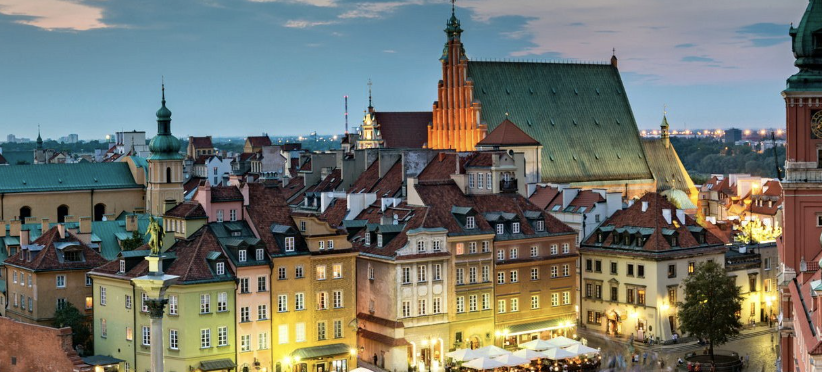
After some orientation, we were given time to wander and admire the Old Town, a fusion of Renaissance, Baroque, and Gothic architecture designed to recreate the area as it looked in the 17th and 18th centuries.
Before our wandering, however, was lunch, and we learned that lunch is the heartiest meal of the day in Poland! It was delicious, but we could not even come close to finishing these large portions!


Warsaw has quite a story to tell: a city destroyed, rebuilt by hand, and reimagined by generations who refused to let Warsaw disappear. The Old Town was faithfully rebuilt using paintings, photographs, and memories—so what looks centuries old is, in fact, a post-war reconstruction. UNESCO recognized it as a remarkable example of historic preservation.
The Main Square of Warsaw’s Old Town is a vibrant centerpiece of the city’s historic heart. Colorful, reconstructed townhouses line the cobblestone square, housing cozy cafés, lively restaurants, and quaint shops. The square is framed by St. John’s Cathedral and other historic buildings, with cobblestone streets radiating outward, creating a charming, medieval atmosphere.


At the center stands the iconic Warsaw Mermaid statue, a symbol of the city.

She stands proudly poised to strike… a reminder of the city’s resilience and fighting spirit. This is especially meaningful given Warsaw’s turbulent history of uprisings, occupation, and reconstruction!
Royal Castle
On top of colorful open-air cafés and art stalls, the Old Town houses the Royal Castle—or Zamek Królewski. Originally built in the 1740s, this castle is a precise re-creation of the 14th-century original.
The castle itself was completely destroyed by German forces during the Warsaw Uprising of 1944, but through immense national effort, it was reconstructed in the 1970s and 80s — largely funded by donations from Polish citizens at home and abroad.

The Castle was once the official residence of Polish monarchs and served as the heart of political life for centuries, housing the royal court, parliament, and ceremonial halls.

Apparently, the elegant red-brick façade gives way to lavish interiors… but unfortunately, we had to admire the royal splendor from the outside only! This building, like the rest of Warsaw, is a story of destruction and rebirth.
Basilica of the Holy Cross & Chopin’s Heart!
We had an opportunity to enjoy a walk along the Krakowskie Przedmieście, the grand boulevard that links Warsaw University with the Old Town and is one of Warsaw’s main thoroughfares. One of our stops was this church… for an unexpected reason!

Chopin’s heart is legendary! Supposedly on his deathbed in Paris in 1849, Chopin whispered a final request to his sister: that his heart be removed from his body and returned to Warsaw. This ensured that he would be reunited, body and soul, with his beloved birthplace (home is where the heart is!) He had not seen Poland for almost two decades, but it’s there where the inspiration for his mighty polonaises and delicate mazurkas flowed.
After his death, his sister went about making his dying wish a reality, pickling the heart in a syrupy substance believed to be cognac. She then smuggled it back to the motherland. Its final resting place is this Basilica of the Holy Cross, within a pillar bearing the biblical inscription from the Book of Matthew: “For where your treasure is, there your heart will also be”.

We happened upon this young man in the church playing Chopin!
Also inside this church is this monument to Pope John Paul II. It is hard to miss the legacy of Pope John Paul II, who, though not from the city (he is from the Krakow area), left an indelible mark on Warsaw. In 1979, during his first papal pilgrimage, he celebrated Mass in Piłsudski Square, where his stirring words—calling on the Holy Spirit to renew Poland—ignited hope and courage under communist rule and inspired the birth of the Solidarity movement. Statues and memorials across the city honor his visits.


This bronze statue depicts Nicolaus Copernicus holding a compass and an armillary sphere, symbolizing his groundbreaking work in astronomy. Inscriptions honor him as a hero of science and a proud son of Poland. Its plaques were altered during the German occupation, damaged in the Warsaw Uprising, and later restored after the war.
An Evening with Chopin
Warsaw is a city that loves and breathes Chopin! His music seems to be everywhere… in the concert halls, on the streets, and in the parks. Some of our group had the privilege of attending a Chopin concert in the historic Ostrogski Palace, home to the Fryderyk Chopin Museum.

The guest pianist was Koki Suetsugu, a Japanese-born pianist. He is a pianist who discovered his passion for music at the relatively late age of fourteen and moved to Warsaw to continue his training at the Fryderyk Chopin University of Music.
He performs regularly across Europe and is known for his sensitive interpretations of Romantic repertoire.
The setting itself was small and intimate. Our front-row seats enabled us not only to see the pianist’s hands gliding across the keys, but also his feet on the pedals and his body movements as he lifted himself to the music.

Every note filled the intimate hall—every note close enough to feel, as if Chopin were speaking directly to us. It was easy to just close one’s eyes and be thoroughly carried away. The melancholy of a nocturne, the fire of a polonaise, the tenderness of a waltz—they all seemed magnified by the closeness of the space and the power of his hands. But I do have to admit that I downloaded a Chopin Listening “Cheat sheet” to help me appreciate this experience!!

This was one very enjoyable performance!
Visiting Warsaw was a captivating blend of history, resilience, and vibrant modern energy. In our short time here, the city revealed stories of both triumph and tragedy—from the meticulously reconstructed Old Town, alive with colorful buildings and bustling cafés, to the solemn reminders of World War II scattered throughout. Warsaw feels simultaneously poignant and remarkably alive. Our five days in two Polish cities offered just a glimpse, and I hope to return someday to explore more. Next, we fly to the Baltic countries for another exciting chapter of discoveries!