

Ahh….Buenos Aires, Argentina—apparently, we just couldn’t stay away! This was our third visit to Argentina’s lively capital, so by now, some of the city’s famous sights felt almost familiar. But Buenos Aires had lost none of its ability to excite us. European elegance, Latin American energy, broad avenues, grand architecture, neighborhood cafes, and passionate tango traditions…all made for a lively start to our latest South American adventure.

A City Shaped by the World
Buenos Aires is really the stage on which much of Argentina’s national story has played out. It began as a colonial port, grew wealthy from trade, and became the political center of the independence movement. By the late 19th and early 20th centuries, massive immigration — especially from Italy and Spain — transformed it into a cosmopolitan city. That is why Buenos Aires feels like several cities at once: grand European-style avenues and government buildings, working-class immigrant neighborhoods, tango culture, café life, and passionate politics. The city’s identity was shaped by three big forces:
Immigration. Millions of newcomers brought languages, foods, customs, music, and labor traditions.
Politics. Plaza de Mayo, Casa Rosada, Peronism, military rule, protest movements — Buenos Aires has long been Argentina’s political heart.
Culture. Tango, literature, football, theater, cafés, and neighborhood identity are all central to how porteños — people from Buenos Aires — see themselves.
This Trip’s Explorations……
El Aeneo Grand Splendid
We had some time on our own before meeting our pre-trip group, so we walked from our hotel to an amazing bookstore…. El Ateneo Grand Splendid. This was really interesting… much more than a bookstore—it is an old theater that now happens to be filled with books!

The building opened in 1919 as the Teatro Grand Splendid, where audiences came for plays, ballet, opera, films, and tango. By the late 1980s, it had largely stopped operating as a traditional theater and continued as a cinema before finally closing in 1999. It closed not because the beautiful building fell into disrepair, but because the theater and movie business itself had changed.

Then a group of investors saw an opportunity and invested heavily in turning it into a flagship bookstore. The people behind the project wanted to preserve the building, not gut it, so they restored the frescoed dome, curtains, and architectural details, removed the seating, and installed bookshelves where the audience once sat!


What a save…this has to be one of the most beautiful and unique bookstores we have ever visited…an example of adaptive reuse done extraordinarily well. They changed the building’s purpose without erasing what it had been…not a bookstore designed to look like an old theater…but a grand theater we were still inside!

Basílica de Nuestra Señora del Pilar
Another stop on our walk was this Spanish-colonial church. It opened in 1732 and is one of Buenos Aires’ oldest churches. It originally belonged to the Recollect friars — and that is where the name Recoleta comes from.

It looks rather simple from the outside, but inside it has beautiful Baroque altars, original 18th-century religious art, and an elaborate silver-decorated main altar with Andean/Inca influences.


The Tour Begins

We met our small pre-trip group…there will be just six of us exploring Buenos Aires and Uruguay for the next five days before meeting the rest of the group in Rio de Janeiro for the main trip. Our guide’s name is Alejandro Spoltore, and we have some very interesting group members who will be fun to get to know better.
Our itinerary for the day (before taking a ferry to Uruguay tomorrow) takes us once again to Plaza de Mayo and the Casa Rosada, along the enormous Avenida 9 de Julio, and into colorful La Boca. Much of the route felt similar to what we had experienced on earlier visits—but “similar” certainly didn’t mean boring. This time around, however, there was a marathon in town, with 17,000 runners (from 50 countries!). Our bus had a hard time navigating, so at one point we had to get off the bus and take the subway!

Plaza de Mayo
This is arguably the single most important historic space in all of Argentina. It is Buenos Aires’ oldest square and has been at the city’s center since its second founding in 1580. The square later became associated with the May Revolution of 1810, the political break with Spain that ultimately led to Argentine independence. The name of the square comes from that revolution.

But Plaza de Mayo is not just old history. It has remained Argentina’s principal political stage for more than two centuries — celebrations, protests, coups, presidential speeches, demonstrations, and national crises have unfolded here.
Mothers of the Plaza de Mayo
This is one of the most powerful parts of modern Argentine history. After the military seized power in 1976, thousands of people were abducted by security forces and taken to secret detention centers. Many were tortured and killed, but their families were given no information. They simply became “the disappeared”. Argentina’s last military dictatorship lasted until 1983. The mothers of those missing sons and daughters went everywhere looking for answers — police stations, military offices, churches, government ministries — and repeatedly got nowhere. Finally, on April 30, 1977, a group of mothers gathered in Plaza de Mayo, directly in front of the Casa Rosada, the presidential palace. The organizers believed they could be ignored individually, but together they might force the government to respond.

Because the dictatorship prohibited groups from gathering in public, police told the women they had to “circulate.” So they did. They linked arms, two by two, and began walking around the Pirámide de Mayo in the plaza’s center. What began as an order intended to disperse them became their defining form of protest. They returned week after week, eventually settling on Thursdays for their regular marches. The mothers began wearing white scarves in 1977 so they could recognize one another in a crowd. They were originally associated with the cloth diapers their children had worn as babies. The white scarf became their unmistakable symbol. These white headscarves are now painted on the pavement around the plaza.
What makes their story even more extraordinary is the danger they faced. The government tried to intimidate them, and several of the founding mothers themselves were abducted and killed. Yet the mothers continued marching.
Another part of the story …. the Grandmothers of Plaza de Mayo. Some disappeared women were pregnant when they were abducted, and babies born in captivity were taken and raised under false identities. The Grandmothers formed to search for those children and ultimately helped develop sophisticated genetic techniques for identifying grandchildren even when their parents were missing. To date, the Grandmothers of Plaza de Mayo have resolved 140 cases. Their organization estimates that more than 500 children were disappeared or appropriated, and says more than 300 are still being sought.
That image — women walking around the May Pyramid wearing symbolic white headscarves — became internationally associated with resistance to the dictatorship and the demand for truth about the “disappeared.”

This pink building is the Casa Rosada — the “Pink House” — Argentina’s presidential palace and the seat of the national government. It faces directly onto Plaza de Mayo. This is the building with the famous balcony! Juan Perón and Eva “Evita” Perón (as well as Madonna! in the movie “Evita”) addressed huge crowds from the Casa Rosada’s balconies in the late 1940s and early 1950s. The balcony became one of the most recognizable political stages in Argentina.
La Boca
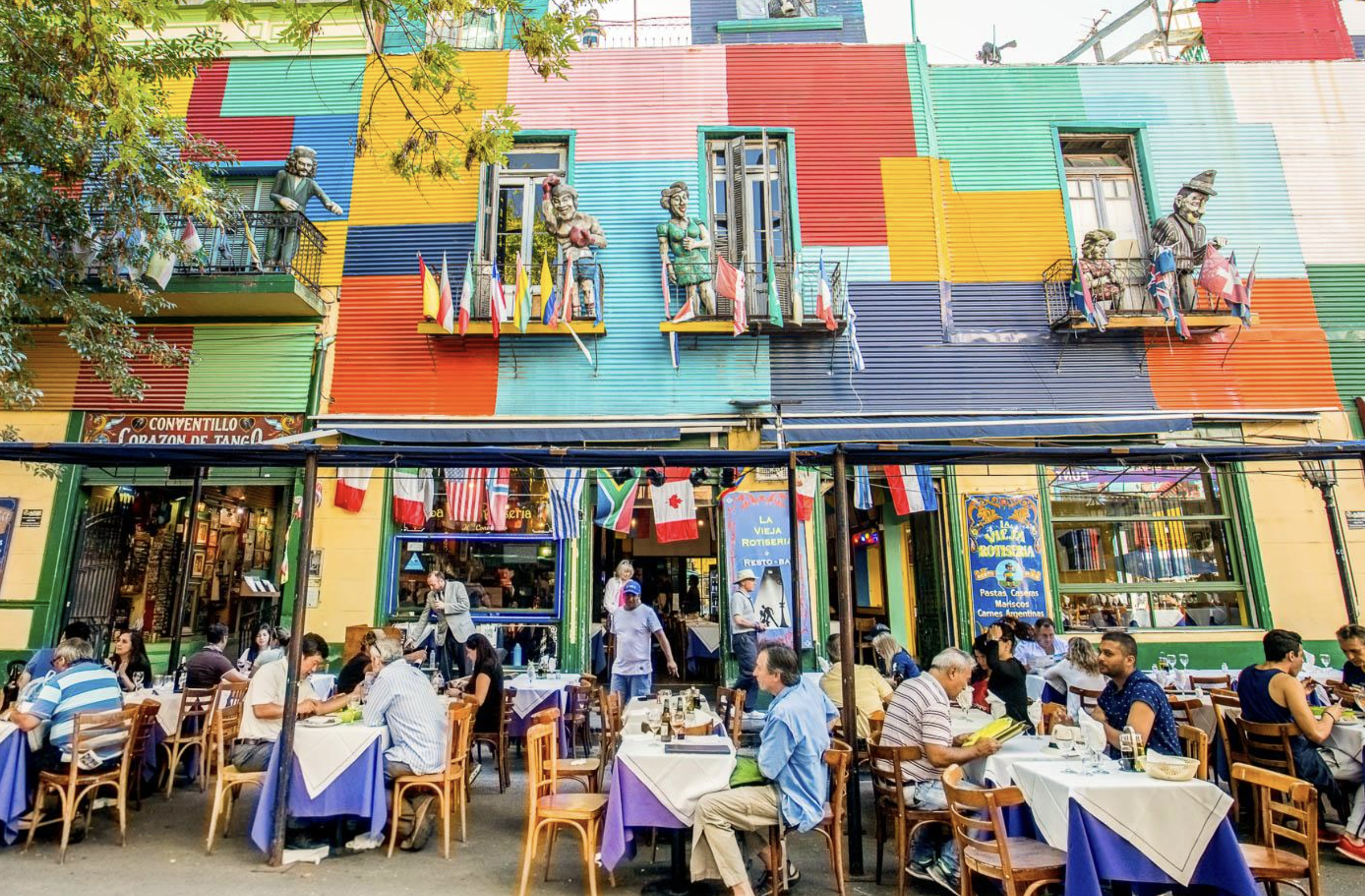
The colorful buildings in this barrio (inner-city neighborhood) called LaBoca are fun to see, but underneath all that color is a story of immigration, poverty, adaptation — and a lot of music. La Boca began as a gritty port neighborhood when in the late 1800’s, waves of immigrants — especially Italians from Genoa — crowded into communal tenements called conventillos. Sailors, dockworkers, Africans and their descendants, criollos, and newcomers from Europe all lived and worked in close quarters.

Out of that remarkable cultural jumble came new music and dance, and La Boca became one of the neighborhoods associated with the birth of tango. Their rhythms, dances, instruments, speech, and musical traditions blended into something new. UNESCO specifically describes tango as the product of that cultural mixture in the Río de la Plata region. What began in these courtyards, cafés and working-class dance halls of Buenos Aires eventually became Argentina’s most famous cultural export.

We had an opportunity to explore the area on our own before we were off for a tango lesson! Since we did this on a previous Buones Aires trip, we were hoping we might learn something that would stick this time! As it turned out, this experience was in a tenement courtyard, not in a dance studio, but still taught by two professional tango dancers.


We were taught some very rudimentary steps…(after all, the ages in our group vary between low 70’s and 87) and then were ready to show off our stuff!!


Then it was the really fun part….Watching these two amazing dancers perform, in one of the very courtyards where the tango was born! It was tempting to watch their feet, but the posture and connections between their bodies was just as impressive. I took a short video…..
Recoleta Cemetary
Walking through Recoleta Cemetery felt unlike any cemetery we had ever visited. We had been here once before, but this time, with our guide Alejandro explaining the stories and symbolism around us, the place took on an entirely new dimension.
There were no long rows of headstones stretching across green lawns. Instead, we entered what felt like an entire miniature city—only this city had been built for the dead.

Narrow passageways wound between hundreds of mausoleums, each one seemingly trying to outdo the next. Some looked like tiny Greek temples, others like Gothic chapels. There were marble angels, bronze doors, stained glass windows, elaborate sculptures, columns, domes, and family names carved into stone. Some were beautifully maintained; others showed their age, with cracked stone, dusty windows, and plants beginning to creep into the corners.

And that was part of the fascination. It makes you wonder: Who had decided to build something this grand? Who chose the statues, the carvings, the marble? And how did a family decide that this was the appropriate final resting place for generations of relatives?
Recoleta was filled with reminders of just how wealthy and influential many Buenos Aires families once were. These mausoleums were not simply graves. They were monuments to family names, social position, religion, architecture—and perhaps a little competition among the neighbors. Even after death, apparently, keeping up with the Joneses was alive and well.
And…..the extraordinary variety! One mausoleum might be elegant and restrained, while the one beside it, enormous and theatrical. Some were more than a century old; others looked much newer. There seemed to be almost every architectural style imaginable packed into a relatively small area.
And then there was the slightly unsettling realization that many of the coffins were right there inside. Behind iron gates and glass doors, you could sometimes see stairs leading underground or caskets resting within the family tomb. This was not death hidden neatly beneath the ground. It was visible, close, and very much a part of the experience.
The maze of passageways. The incredible workmanship. The beauty mixed with decay. The enormous investment made for people who were no longer alive to appreciate any of it…..one of the most unusual neighborhoods in Buenos Aires! Recoleta…..beautiful, strange, extravagant, slightly eerie, and completely fascinating!
