
Inari

When daughter Kala sent this location map of where she could find us, I realized just how far north in Finland we were!! (And, how close to the Russian border…only @ 20 miles!)

After driving several hundred miles from our arrival at the airport in Rovaniemi, Lapland, we were delighted to discover our lodging… the Inari Wilderness Resort, located on the shores of Lake Inari. It was a most enchanting place to experience the raw beauty of the Arctic.
The resort is surrounded by forests, lakes, and endless sky….a perfect way to enjoy arctic nature while still being warm and cozy. There was a mix of traditional log cabins, glass-roofed Aurora-viewing cabins, and the more traditional wilderness rooms (where we stayed).


Finland is the home of the sauna!, and we had access here, but we unfortunately did not include a bathing suit as we packed for this arctic adventure (I know in Finland the sauna is traditionally taken nude….but…that is not as ‘natural’ to us!)

Another part of our stay was the hearty Lapland cuisine—a daily buffet of freshly caught fish, wild berries, reindeer, and other yummy dishes.
Aurora Borealis
We knew we had a chance of seeing the breathtaking display of the Aurora Borealis while in Lapland! So when our guide, Marius, knocked on our door (on our first night there!) to wake us up… We sprang out of bed! This would be a first for me and a second opportunity for Pete to observe this astronomical wonder.
WOW!!! This shimmering curtain of green light was dancing across the night sky!


The Aurora’s movements felt almost alive—swirling, pulsing, and sweeping across the sky like nature’s own light ballet. They were impressive to watch, but even more impressive when captured on the iPhone camera.
Back to Astronomy 101!!
I had to do a bit of research to understand the “why” of what was before our eyes!
The phenomenon we were watching began 93 million miles away, at the Sun. The Sun constantly sends out streams of charged particles, the solar wind. When these particles reach Earth, they are guided by our planet’s magnetic field toward the polar regions. As they collide with gases in the atmosphere—mainly oxygen and nitrogen—they release bursts of energy in the form of light.
- Green auroras come from oxygen about 100 km above Earth.
- Reddish and purple hues appear at higher altitudes, where nitrogen plays a role.
- The intensity and colors often change with solar activity, which follows an 11-year cycle.
Tonight, we saw only the green auroras. But what a show!!! For the Sámi people of Lapland, the aurora has long held spiritual significance. Some saw it as the energy of ancestors or a bridge to the spirit world, while others regarded it with reverence and caution.
Sámi Museum Siida
This Sámi Museum Siida is both a cultural history museum and a nature center, dedicated to preserving and sharing Sámi traditions. The Sámi are the only recognized Indigenous people of the European Union, with their homeland (Sápmi) spanning across Norway, Sweden, Finland, and Russia’s Kola Peninsula.
This Sámi museum has received significant recognition for its excellence and cultural significance, including Finland’s Museum of the Year 2024 and the European Museum of the Year Award 2024. The museum uses a holistic approach—preserving Sámi heritage while actively involving the Sámi community to focus the story on the Indigenous people and the ongoing issues of reconciliation (historical injustices, restoring cultural rights, and ensuring the survival of Sámi languages and traditions)

We loved this museum and learned a lot about the Sámi people from both the museum and the excellent guide, Salli, who shepherded us through the exhibits. Only Sámi people were involved in the development of the museum.
I took loads of pictures, but had a hard time expressing, either through my pictures or words, how really awesome this place was. So, instead of my pictures, I am including this YouTube video featuring the Sámi themselves!
Especially fascinating is how the museum blends deep tradition with high-tech storytelling. Exhibitions aren’t just about looking at artifacts in glass cases. This museum uses immersive multimedia displays, digital projections, and interactive screens to create a multi-sensory journey through Sámi life. There would be ancient reindeer-hunting tools accompanied by touchscreens to explore how they were used, or oral histories projected onto large walls, with Sámi elders speaking in their own language.
The technology was not flashy for its own sake, but it really gave the Sámi people agency in telling their own story. We learned history by feeling the heartbeat of the culture… ancestral wisdom meeting 21st-century Finnish design!
Another highlight is the open-air museum just outside, where historical Sámi dwellings have been reconstructed. We walked among turf huts, storehouses, and traditional tent-like structures, trying to imagine how the Sámi lived through the harsh Arctic seasons!


This was a great introduction to our time in Lapland. Despite centuries of outside pressure—from forced assimilation policies to restrictions on language and traditions—they have held onto their identity with incredible strength. This was a window into a world that is both ancient and alive.
Fell Landscape
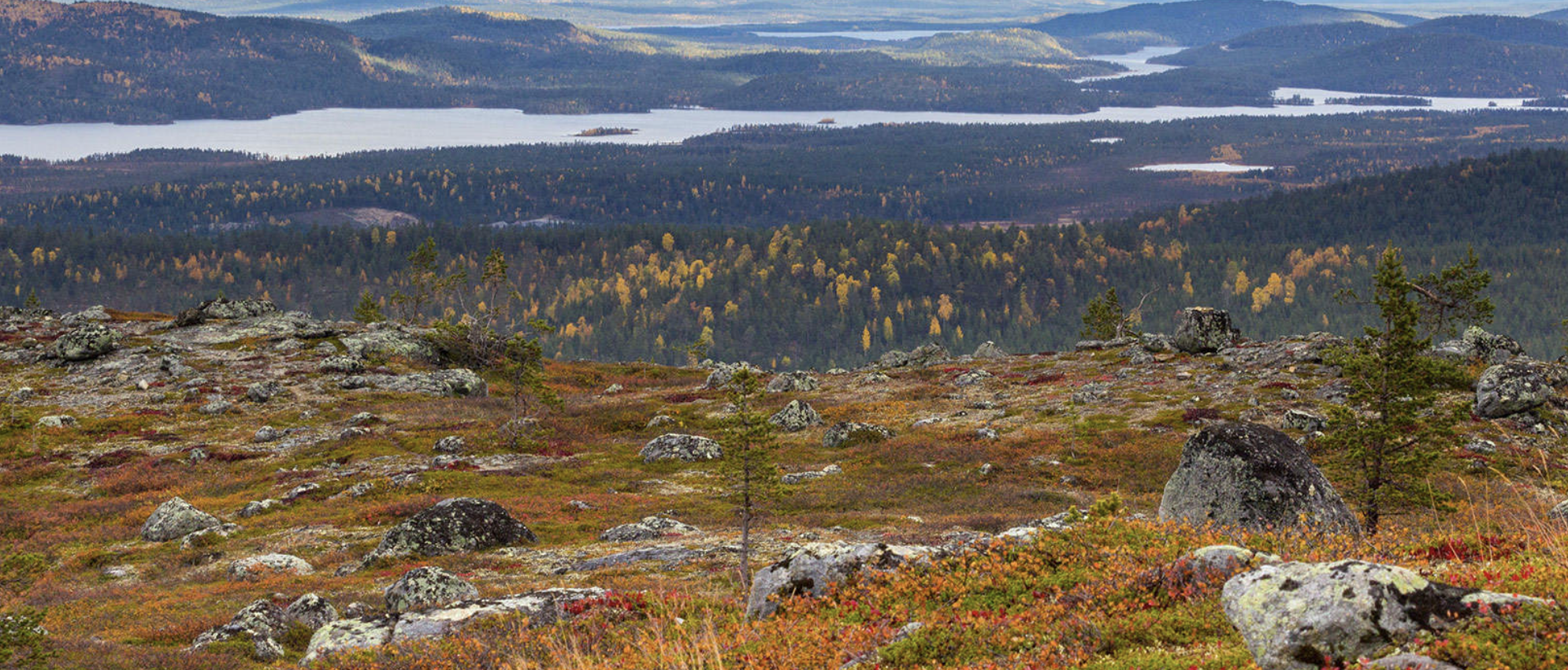
In Lapland, the fell landscape is one of the region’s most distinctive natural features. A fell is a rounded, treeless mountain or highland plateau, shaped by Ice Age glaciers. They create a landscape that is vast, open, and ancient.

We stopped for lunch at the Kaunispää fell, where a triangulation tower offered breathtaking vistas of the surrounding landscape. It was a clear day, and in addition to the vast Finnish wilderness, we could even glimpse into neighboring Russia, only @ 20 miles away! (another Sara Palin moment!)


For the Sámi people, fells are part of traditional herding lands and spiritual landscapes where reindeer graze on lichen-rich fell slopes.
Bear’s Nest Stone (Karhunpesäkivi)
On our way to the Husky Farm, we made a slight detour to the Bear’s Nest Stone (Karhunpesäkivi) near Inari, one of Lapland’s intriguing natural wonders. At first glance, it looks like an enormous boulder, but it’s actually hollow—a geological curiosity known as a tafoni, formed when rock of varying hardness weathers at different rates. This is Finland’s largest tafone, and it feels almost like nature has carved out a secret room within the stone.

Reaching the Bear’s Nest Stone took a bit of adventure of its own: a 300-step timber boardwalk climb through the pine forest.


At the end, we had to drop down and crawl on our knees to enter the cave—a slightly humbling but fun challenge at this age. Inside, we found no bears waiting for us, just the cool, quiet air of this ancient natural shelter.


The inside walls are etched with a honeycomb-like pattern, created over millennia by erosion. Standing there, it’s easy to see why legends have grown around this mysterious place. Local folklore tells of a man who once sought refuge from a snowstorm inside the stone’s hollow—only to awaken beside a slumbering bear. Terrified, he ran for his life, while the bear simply continued its peaceful nap!


On our walk back, we encountered a local blueberry picker who eagerly shared his process for picking the ripe, sweet berries that are abundant this season.
Husky Dog Farm

Raising huskies in Lapland is both a way of life and a labor of love, rooted in centuries of Arctic tradition. Huskies, especially Siberian and Alaskan breeds, are perfectly adapted to the harsh northern climate, with thick double coats that protect them from freezing temperatures and an almost endless supply of energy. In Lapland, these dogs are not just pets—they are working partners, companions, and ambassadors of the north.

Today we met Anni, the owner of 37 huskies! This lady was truly a type of “dog whisperer”…her love, passion, and dedication to these dogs seem “over the top!” This profession is truly a calling for her, and it was an absolute pleasure to meet her and some of the dogs.


These dogs are extremely well cared for. She knows each dog very well, their personalities, habits, and the roles they should play on the team. Some are born leaders who are always striving to take the lead, while others are happy to simply be part of the team.

Their pace is slower in summer/fall, but in six weeks or so, the snow will be back. In the meantime, the huskies still need exercise and stimulation, and sled runs are replaced with lighter training, playtime, and plenty of rest. Every day, however, Annie takes the teams out separately for exercise. As a former physical therapist, she also massages each one daily!!!


As we learned in both Alaska and Svalbard, Norway, these dogs actually WANT to go to work each day!! Their stamina is remarkable, fueled by a rich, high-protein diet and the sheer joy of running across snowy landscapes. In winter, Anni takes customers on sleigh rides; she also competes in sled dog races, some short and others lasting for days!
This is a very cool video of Anni and her dogs sledding across the fell landscape.
Other Interesting Parts of Anni’s Property
Anni is getting ready to have a new house “delivered!” The foundation and underground work are complete, and the house should be “dropped” in within a couple of weeks! Prefab homes are becoming more common in Lapland these days!
In the meantime, she and her son are “glamping” in this very cute little “cube” which sits on the edge of a lovely pond.


We then dined in her Kota. In Lapland, the traditional grill hut, known as a kota, is a cozy, cone-shaped structure that has been used for centuries by the Sámi people. Originally serving as a temporary shelter for hunting or reindeer herding, the kota centers on an open fire pit that provides warmth and a place for cooking at the heart of the hut.


Smoke escapes through a hole at the top, while benches or seating circle the fire, creating a communal space perfect for grilling and socializing. The design combines practicality with tradition, offering a warm and inviting glimpse into Lapland’s cultural heritage.


Today, Annie served bread, tomato/lentil soup, grilled sausages, and a cake (made by her mother!). It was all delicious, especially in this cozy environment. I so love these types of experiences that OAT provides to us!!!

What a wonderful visit!! These animals are not only working partners but companions, embodying the spirit of Lapland itself: resilient, wild, and full of life. Visiting Anni made us appreciate just how much dedication goes into raising huskies. Behind every thrilling sled ride is a lifetime of care, training, and mutual respect.

On the way back to our van, we enjoyed more of the fruits of Anni’s land….

Juican Kota Reindeer Farm

We visited a common site in Lapland…a Reindeer Farm. This farm was originally founded by this Sámi couple. Reindeer herding has long been a vital part of Sámi culture, providing not only food and clothing but also shaping spiritual beliefs and seasonal lifestyles.
Today, our guide, Visa, was an employee who knew a lot about reindeer and Sámi customs.


We got to meet and feed the animals “up close” and learn about their central role in Lapland’s heritage. Eventually, every part of these animals is used for survival… meat for food, fur for clothing, antlers for crafts, etc., not to mention their use in pulling sleighs for rides!!


At one point, we were challenged to lasso a reindeer, just as the herders do! Here is Pete getting somewhat close!

We later relaxed in the kota hut, gathered around a crackling fire.

I thought this was a telling thermometer!!


We enjoyed hot berry juice, coffee, and cookies.

Visa shared information on Sami clothing and on the birds he has handcrafted.


Then he sang a Finnish song for us!

This was really like being at a live cultural center… an exposure to an aspect of Sámi heritage and a chance to connect with the Arctic landscape and its animals.
Our Final Hike!!
For our very last walk in Lapland, Marius took 6 of us on a gentle yet rewarding 3-mile loop along the Juutua Trail, which winds along the banks of the Juutuanjoki River.

We followed a wide gravel path through pine forests and alongside rushing waters… the perfect final activity on a sunny, crisp fall day in Lapland.


There were so many berries and mushrooms available….


We crossed the suspension bridge at the roaring Jäniskoski Rapids, where the sound of rushing water filled the air.


Lean-to shelters and fire pits invite hikers to pause, rest, or enjoy a simple picnic. Firewood was available….it can be paid for online….a complete honor system.
At the end of our walk was the Sami Parliament Building. This picture does not show it, but from the air, it is evident that the building has the shape of reindeer antlers!

The Last Supper!!!
We are going to miss this group of travelers, and certainly our guide Marius, but tomorrow we begin our 200 mile drive back to the airport….and begin our individual travels home.


It has been three and a half weeks since we left home, and we are ready to return — but what a wonderful journey it has been, filled with places, people, and moments we’ll never forget.
