
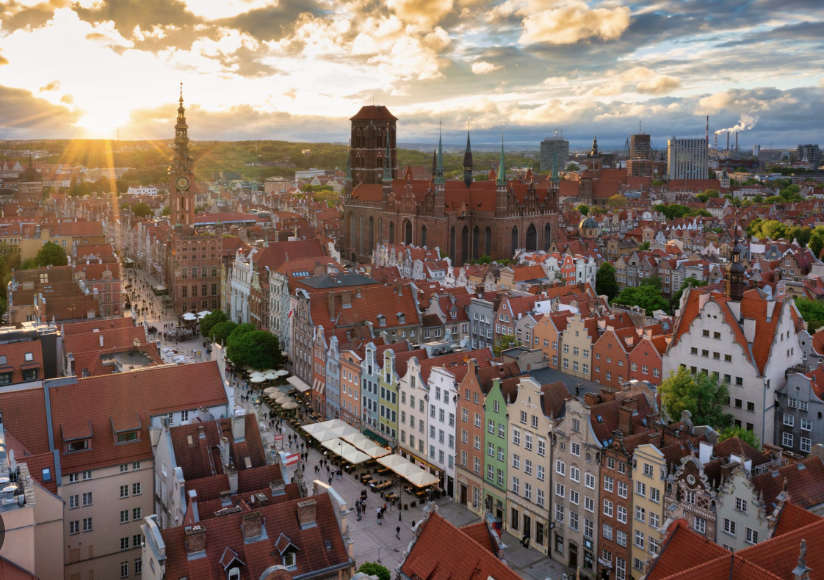
Poland was an “add-on” to our Baltic Capitals trip, so we visited only two Polish cities, Krakow and Warsaw. Warsaw, the capital, is a story of resilience—largely rebuilt (after 80% of it was destroyed in World War II), it now pulses with energy and modern structures. Meanwhile, Kraków educated us with its well-preserved medieval architecture, historic Jewish quarter, and the nearby UNESCO World Heritage site, the Wieliczka Salt Mine. A day trip took us to Auschwitz-Birkenau, one of the most haunting and significant historical sites in the world. It was a deeply emotional experience.

Poland is rich in history, from its royal past to the upheavals of the 20th century. But it’s also a modern European nation full of art, innovation, and youthful optimism. For me, visiting Poland was both a discovery and a reunion. Perhaps heritage is not just something we inherit, but something we can discover!
Poland sits in the heart of Europe, where the old and the new coexist. Today, we found medieval castles integrating into modern skylines, and cobbled streets bustling with coffee shops and tech startups! It was only a five-day glimpse, but we feel very fortunate to have added this country to our travels.
A Very Brief Summary of the History of Poland!
Poland’s history is a rich tapestry of resilience, culture, and transformation spanning over a thousand years. Founded as a kingdom in 966 AD, when Duke Mieszko I converted to Christianity, Poland quickly became a significant player in medieval Europe. The Polish-Lithuanian Commonwealth, formed in 1569, was one of the largest and most powerful states in Europe, known for its unique system of noble democracy and religious tolerance.
However, the Commonwealth gradually weakened, and in the late 18th century, Poland was partitioned three times by Russia, Prussia, and Austria…and it completely disappeared from maps for over a century! Poland regained independence in 1918 after World War I but faced enormous challenges, including invasion during World War II and decades under Soviet influence.
The Solidarity movement of the 1980s, led by Lech Wałęsa, played a crucial role in ending communist rule and restoring democracy. Today, Poland is a vibrant European nation, proud of its heritage and looking confidently to the future, blending centuries-old traditions with modern growth.
Poland Facts, Figures
• Capital: Warsaw
- Area: 120,728 square miles
• Government: Republic
• Language: Polish is the official language. It is a Slavic language. It uses the familiar Roman alphabet, but with many additional accents. German, English, and French are spoken by most members of the travel industry and in hotels.
• Location: Situated in the heart of Europe, Poland’s low-lying plains extend from the Baltic shore in the north to the Tatra Mountains on its southern border with the Czech Republic and Slovakia. To the east of the Polish border are Lithuania, Belarus, Russia, and Ukraine; to the west is Germany.
• Population: 38,562,189 (estimate)
• Religion: Catholic 87.2%, Eastern Orthodox 1.3%, Protestant 0.4%, other 0.4%, and unspecified 10.8%
September, 2025