Hill of Crosses

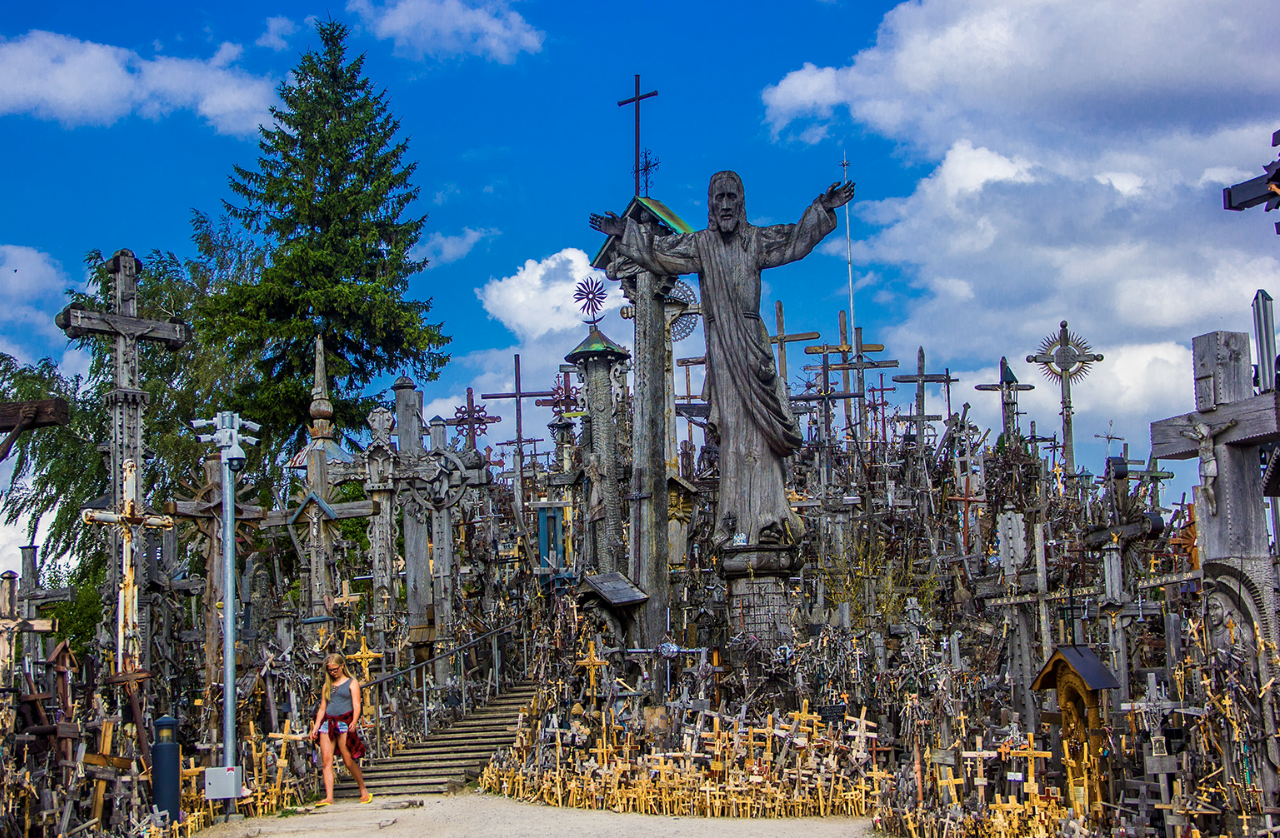
In a quiet field along a country road, rises a low hill covered with an extraordinary sight: tens of thousands of crosses, crucifixes, rosaries, and small carvings. This is a unique and moving place, considered a historically significant site for Lithuanian Catholics. 

A panoramic view of the Hill of Crosses in Lithuania, featuring thousands of crosses, a large statue of Jesus with outstretched arms, and a tall tree. The sky is partly cloudy, creating a serene atmosphere.

Some are large and ornately carved; others are simple wooden crosses tied with string or left by pilgrims. Together, they create an overwhelming sense of devotion, memory, and hope.

A close-up view of various crosses, rosaries, and small religious carvings at the Hill of Crosses, surrounded by a stone base, symbolizing devotion and remembrance.

The exact origins are unclear, but the first crosses likely appeared after the 1831 uprising against the Russian Empire.  Families who couldn’t find the bodies of fallen rebels began placing symbolic crosses here, turning the hill into both a religious site and a quiet act of resistance.

A panoramic view of the Hill of Crosses, showcasing tens of thousands of crosses, crucifixes, and carvings set in a serene landscape under cloudy skies.

This hill continued as a quiet act of defiance. When Lithuania was under Soviet occupation, placing a cross here was forbidden. But people came anyway, often at night, planting symbols of hope for loved ones lost, freedom longed for, and faith. The Soviets bulldozed the site repeatedly—but each time, the crosses returned in greater number.

A panoramic view of the Hill of Crosses, featuring thousands of wooden crosses and religious symbols scattered across a lush green landscape under a blue sky with fluffy clouds.
A man stands in the foreground of the Hill of Crosses, surrounded by hundreds of crosses, statues, and memorials under a dramatic sky. The hill is a significant pilgrimage site in Lithuania, symbolizing faith and resilience.

In 1993, Pope John Paul II visited the Hill of Crosses and held an open-air Mass, addressing the pilgrims gathered there. He spoke about the Hill as a symbol of faith, suffering, and hope, and paid tribute to Lithuania’s history of martyrdom and perseverance.

A wooden cross with a plaque stands in the foreground, surrounded by various smaller wooden crosses at the Hill of Crosses in Lithuania. In the background, a large, modern structure with a cross on top can be seen under a cloudy sky, with visitors nearby.
This is the platform from which Pope John Paul II said Mass.
A historical pilgrimage site, the Hill of Crosses, is filled with thousands of crosses, with a prominent figure leading a group through this sacred area.

Today, the Hill holds over 100,000 crosses (and still growing).  People still visit daily to leave their own cross, rosary, or small wooden carving. Pope John Paul II called it “a place of hope, peace, love, and sacrifice.”

A detailed stone monument with carvings and a figure, prominently placed on a hill surrounded by numerous wooden and metal crosses. The scene captures the serene and reflective atmosphere of the Hill of Crosses, a significant memorial site in Lithuania.

I don’t think you have to be religious to feel the power of this place. Standing there, you see that every cross is a silent prayer, a memory, or a stubborn act of hope.

A close-up image of a granite plaque featuring the inscription thanking Lithuanians for the Hill of Crosses, commemorating their faith and history. The date '7-9-1993' is also engraved on the plaque.