
Trakai
We journeyed outside Vilnius to Trakai, the de facto medieval capital of Lithuania. The Duke, Vytautas the Great, preferred the natural landscape by azure lakes and lush islands over Vilnius!
We were introduced here to a new ethnic/religious group: the Karaite (or Karaims) community. This is a small but unique group with roots going back more than 600 years. They are a Turkic-speaking people who practice Karaite Judaism, a form of Judaism that follows only the Hebrew Bible and rejects rabbinic traditions.

Their history in Lithuania began in the late 14th century, when Grand Duke Vytautas the Great brought about 380 Karaite families from Crimea to Trakai after a military campaign. They were valued for their military skills and were settled near Trakai Castle to serve as guards, translators, merchants, and mediators.
Their distinctive houses are easily recognized by their three windows facing the street—one for God, one for Vytautas, and one for the family.


The Karaim language, a branch of the Turkic family, is critically endangered, with only a handful of speakers left, but revival efforts are underway through camps, publications, and educational programs.


Karaites are known for their cuisine, especially kibinai—flaky pastries filled with meat and onions—which have become a beloved national dish in Lithuania. Under the direction of this gentleman, we each had an opportunity to make our own kibinai today!


Today, the Karaite population in Lithuania is very small, numbering only around 200 people. Despite their size, the community has remained resilient, preserving its faith, language, and traditions. In 2022, Lithuania even declared a Year of the Karaites, honoring their contributions to the country’s history and identity.

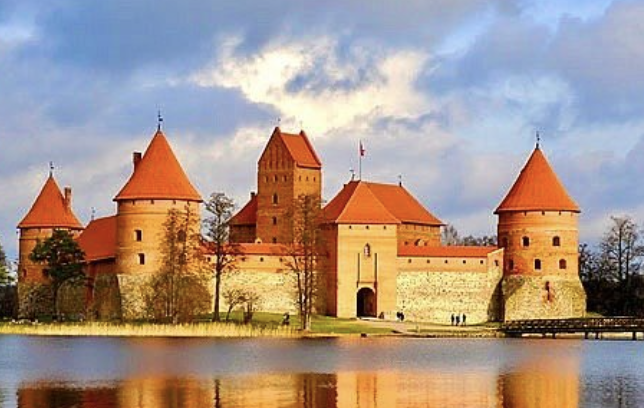
Trakai Island Castle

The Trakai Island Castle is one of the most beautiful and iconic sights in Lithuania. Built in the 14th century, the castle is strategically positioned on an island in Lake Galvė and was one of the main residences of the Lithuanian Grand Dukes, who lived there until the Grand Duke’s death in 1430. This was a political and diplomatic hub where emissaries and foreign guests were received.

After wars with the Teutonic Knights and Muscovite forces, Trakai Castle fell into decline. By the 17th century, it was in ruins, but a major restoration project in the 20th century rebuilt the castle based on historical records and archaeological evidence. Today, it is the only island castle in Eastern Europe that has been fully restored to its original form.
We did not have time for the castle tour (medieval weapons, armor, coins, documents, and artifacts), but the castle houses exhibits on medieval Lithuania, Grand Duchy heritage, and the unique story of the Karaites, who were brought here by Vytautas. This is a place where Lithuanian history, legend, and stunning scenery come together.
Instead, we took a short boat ride on Lake Galve to get a better view of Trakai Castle, a fairy-tale fortress. Unfortunately, the weather was not cooperating so our pictures are pretty gray…. this pic from the web shows our route!

Seeing the castle from the water gives a sense of why it was built there… medieval soldiers guarding the bridge and lake, the water itself serving as a natural moat, and towers/walls that would be harder to capture from land.


This was an interesting visit offering more than just a castle—it was history, culture, and natural beauty… all in one experience. We leave with a stronger appreciation of Lithuania’s diverse heritage.