
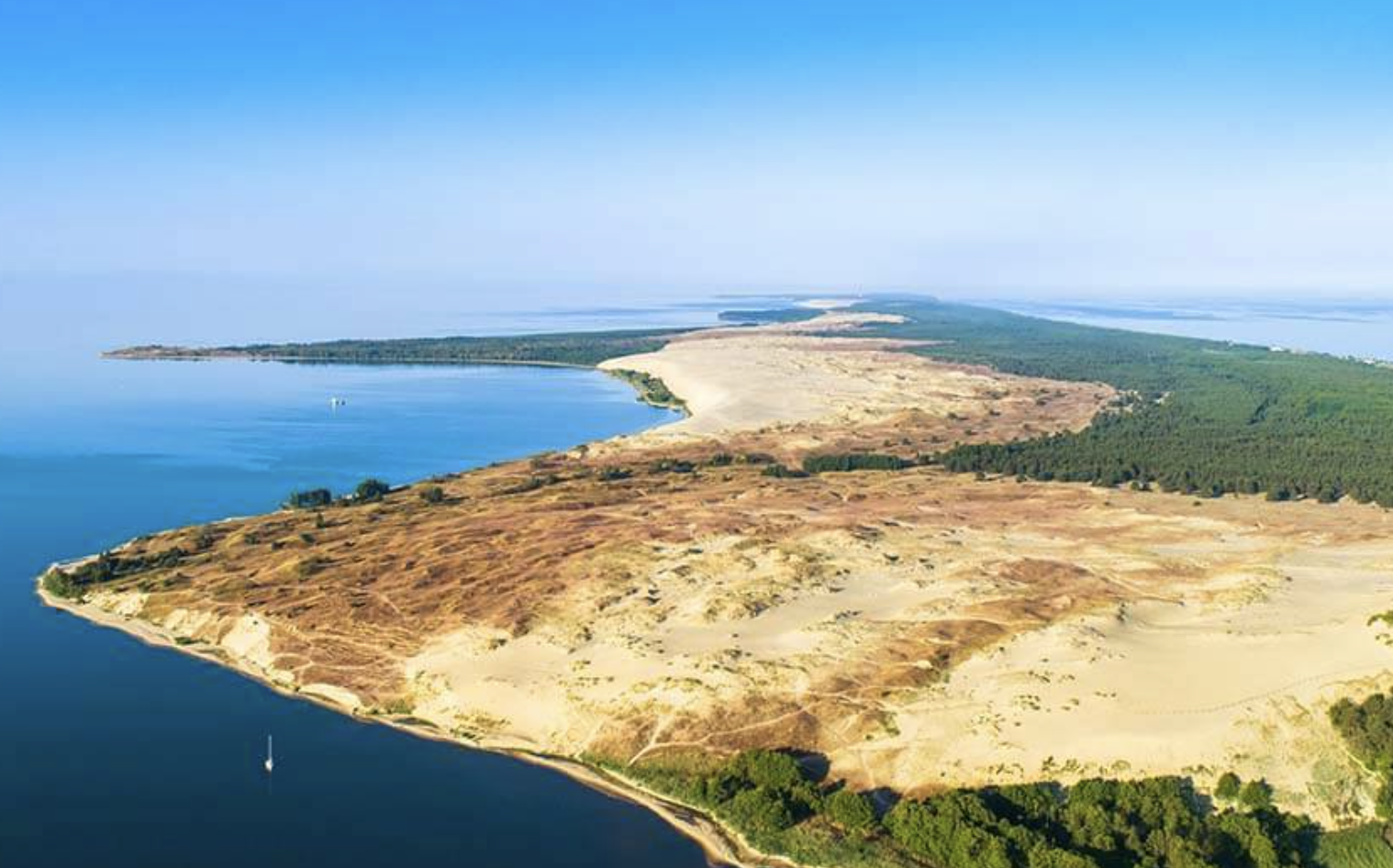
The Curonian Spit

The Curonian Spit is one of Europe’s most unique landscapes — a ribbon of shifting sand dunes, pine forests, fishing villages, and breathtaking coastline that stretches 61 miles between Lithuania and the Russian enclave of Kaliningrad.
After a short ferry ride from our hotel in Klaipeda, we found ourselves with the Baltic Sea on one side and the Curonian Lagoon on the other. This area is a UNESCO World Heritage Site shared by Lithuania and Russia.
Hill of Witches
Our first stop was the whimsical Hill of Witches. This magical place is tucked into a pine forest near the village of Juodkrantė. We followed an outdoor sculpture trail that winds up and over a sand dune, where we found over 80 wooden carvings that brought Lithuanian folklore to life.

Some are whimsical—cheeky devils, mischievous forest spirits, and cackling witches—while others are solemn or eerie, echoing ancient pagan traditions (Lithuania was considered the last pagan country in Europe). All were hand-carved by Lithuanian artists during annual woodcarving symposia that began in 1979.
This is kind of a living celebration of Baltic mythology, storytelling, and artistry. Although it was a rainy day for our walk, it was an enchanted world where the line between myth and reality was momentarily blurred! This is a short slideshow of some of the characters we encountered!
Amber Hunting!
Our next stop was hunting for amber, or “Baltic Gold”, which has been collected, worn, and traded for thousands of years. Amber is not a stone, but fossilized tree resin, formed from ancient coniferous forests about 44 million years ago. Over time, the resin hardened and was carried by rivers into the Baltic Sea, where waves continue to wash it ashore.

After storms, pieces of amber often appear on beaches, mixed with seaweed and driftwood, and locals collect them by hand. So, we all got out and started digging into the sand!


Baltic amber is usually golden yellow to deep honey, but it can also be white, red, greenish, or even bluish (rare). Unlike gemstones, amber is lightweight and warm to the touch, which makes it comfortable for jewelry.
We did not find any large pieces…but it was fun walking away with our new ‘little’ treasures!


The rain stopped, allowing us to hike along the spit (as we moved closer to the Russian border!). We came upon this sculpture of Jean-Paul Sartre, a French philosopher, novelist, playwright, and political activist, widely regarded as one of the most important thinkers of the 20th century.

Our Sarah Palin Moment…….
Next……Our own Sarah Palin moment!!! “I can see Russia from here! Well, we really could see Russia!! Truthfully, until this trip, we were completely unaware of Russia’s geographical separation…

Kaliningrad Oblast is a Russian enclave on the Baltic Sea, bordered by Lithuania and Poland, and cut off from the rest of Russia. Once a German city, Königsberg was annexed by the Soviet Union after World War II. Its German population was expelled, and it was renamed after Soviet leader Mikhail Kalinin.

Today it is one of Russia’s most heavily militarized regions, hosting the Baltic Fleet, nuclear-capable Iskander missiles, and powerful electronic warfare systems that often disrupt navigation in nearby countries. Its location makes it strategically vital but also vulnerable, as it sits inside the European Union and NATO territory.

Economically, it depends on fishing, shipping, amber mining, and Moscow’s subsidies… while residents live with a sense of isolation from the Russian mainland. The enclave is also central to military planning because of the nearby Suwałki Gap, a narrow corridor between Kaliningrad and Belarus that NATO fears could be targeted to cut off the Baltic states from the rest of Europe.
The Sundial Calendar
This is a huge and unique 36-ton horizontal calendar-sundial located on the spit. The shadow cast by the obelisk moves across a semicircular platform, indicating the time on granite slabs. These slabs are carved with hour and half-hour notches. In addition to telling the time, the sundial also functions as a calendar. The granite slabs are engraved with celestial symbols and have specific marks for each month, as well as the four key astronomical events of the year.


The sundial was significantly damaged by a hurricane, and some components have not yet been completely repaired. The sundial was built primarily as a scientific and cultural landmark rather than just a decorative feature… but since I, as yet, do not have a basic understanding of astronomical principles, I just didn’t understand how to read it!

Nida
What a lovely village… towering dunes, fragrant pine forests, and picturesque wooden cottages. Nida feels like a typical beach resort, yet also a peaceful oasis with unspoiled dune landscapes, rustic architecture, and a sheltered lagoon-side position.
We had lunch here, then took a walking tour to see some of the fishermen’s homes before visiting the Amber Workshop.


Fishermen’s boats historically carried distinctive carved weathervanes that identified each village. These weathervanes now adorn many houses and serve as cultural symbols featured on the coat of arms. The craft of making them is listed as part of Lithuania’s intangible cultural heritage.

These are examples of one of the charming traditional fishermen’s houses in Nida—wooden cottages richly adorned with folk-inspired trim, bright colors, steep roofs, and often crowned with ornate carvings or weathervanes. The wood trims evoke waves, painted in white and “Curonian blue,” and adorned with carved folk symbols like crossed horse heads.


We had a fun experience at the Amber Gallery-Museum, where we learned about the history and artistry of Baltic amber. This privately owned museum is housed in a charming, traditional fisherman’s hut and showcases amber’s significance in the region.
We viewed an impressive collection of amber pieces, from raw stones to finely crafted jewelry. On display was the largest known amber specimen in Lithuania, weighing over 3.8 kg.


This is the standout exhibit: the largest Baltic amber stone in Lithuania, weighing approximately 3,820 grams, a resin hardened over some 50 million years!


Our guide, Judita, was funny and informative. Here she is demonstrating the amber in an ethanol alcohol solution. This allows the light to pass through, so the amber looks much clearer, deeper, and more luminous — almost as if it’s glowing from within. The liquid also prevents the amber from drying out, cracking, or oxidizing (especially in raw or unpolished pieces). It doesn’t damage the amber and can be changed if needed.
Then we participated in a short hands-on workshop where we sanded and polished raw amber pieces, eventually turning them into our own amber necklace!


It turns out that the leftover amber dust from our polishing is great for creating exciting flames!